6.27 Near Misses and Revenge Trading
A near miss feels like a stolen win, not a loss, which breeds revenge trading: re-entry sized by anger, timed by impatience. Break the loop with cooling-off rules and automation, not willpower.
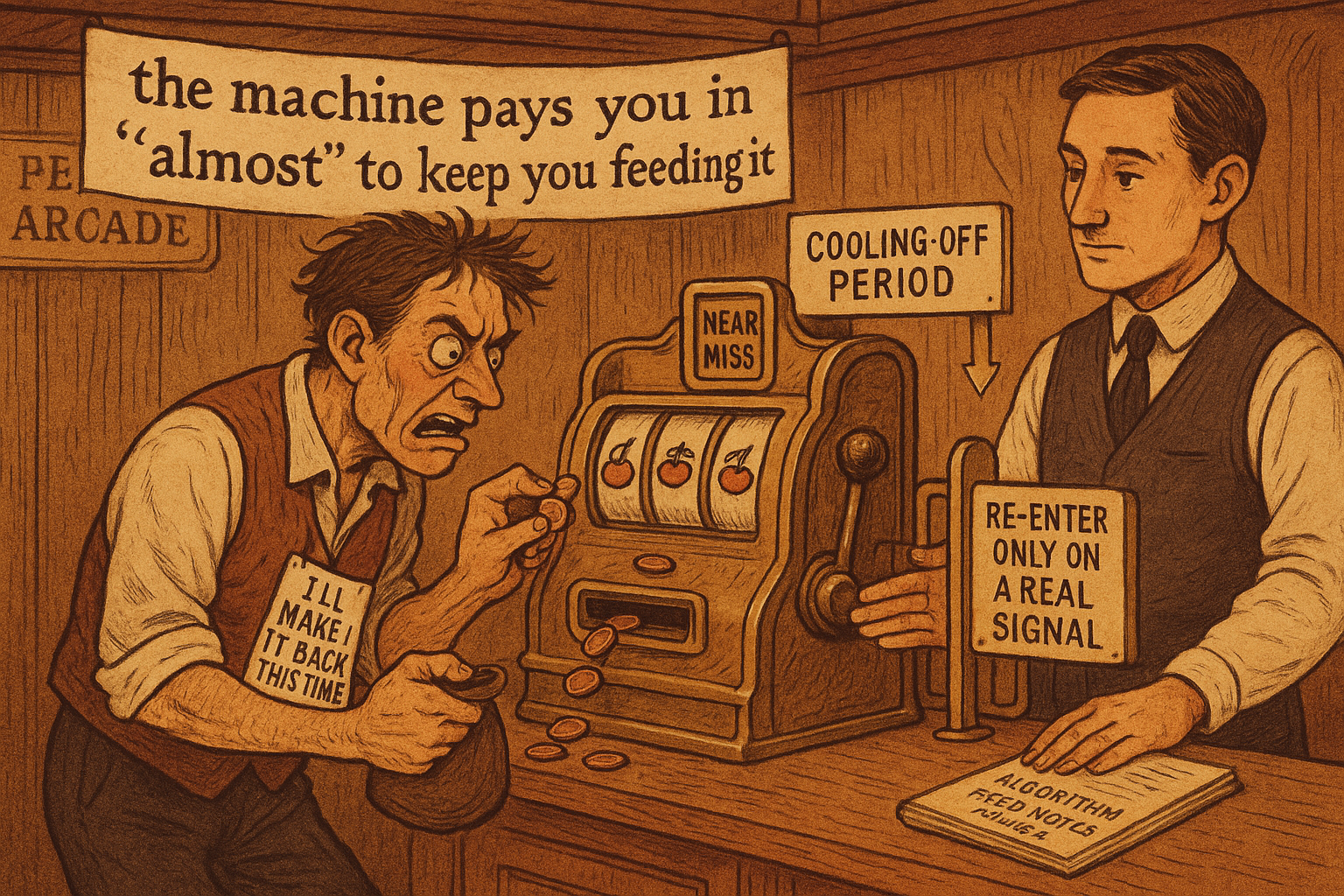
A slot machine that showed only losses would empty the casino in an hour. The machines pay in near misses, two cherries and a blank, the jackpot symbols landing just above or just below the line, because an almost-win is more compelling than a clear loss and keeps the player feeding coins. Trading has the same mechanism, and it produces the same compulsive behavior: the trade that almost worked, the stop tagged a tick before the move, breeds the urge to immediately get back in and make it right. That urge is revenge trading, and it is the near-miss factor weaponized against your account. "The Illusion of Control in Active Trading" named near misses as fuel; this is what they ignite.
A near miss is not a loss to the brain
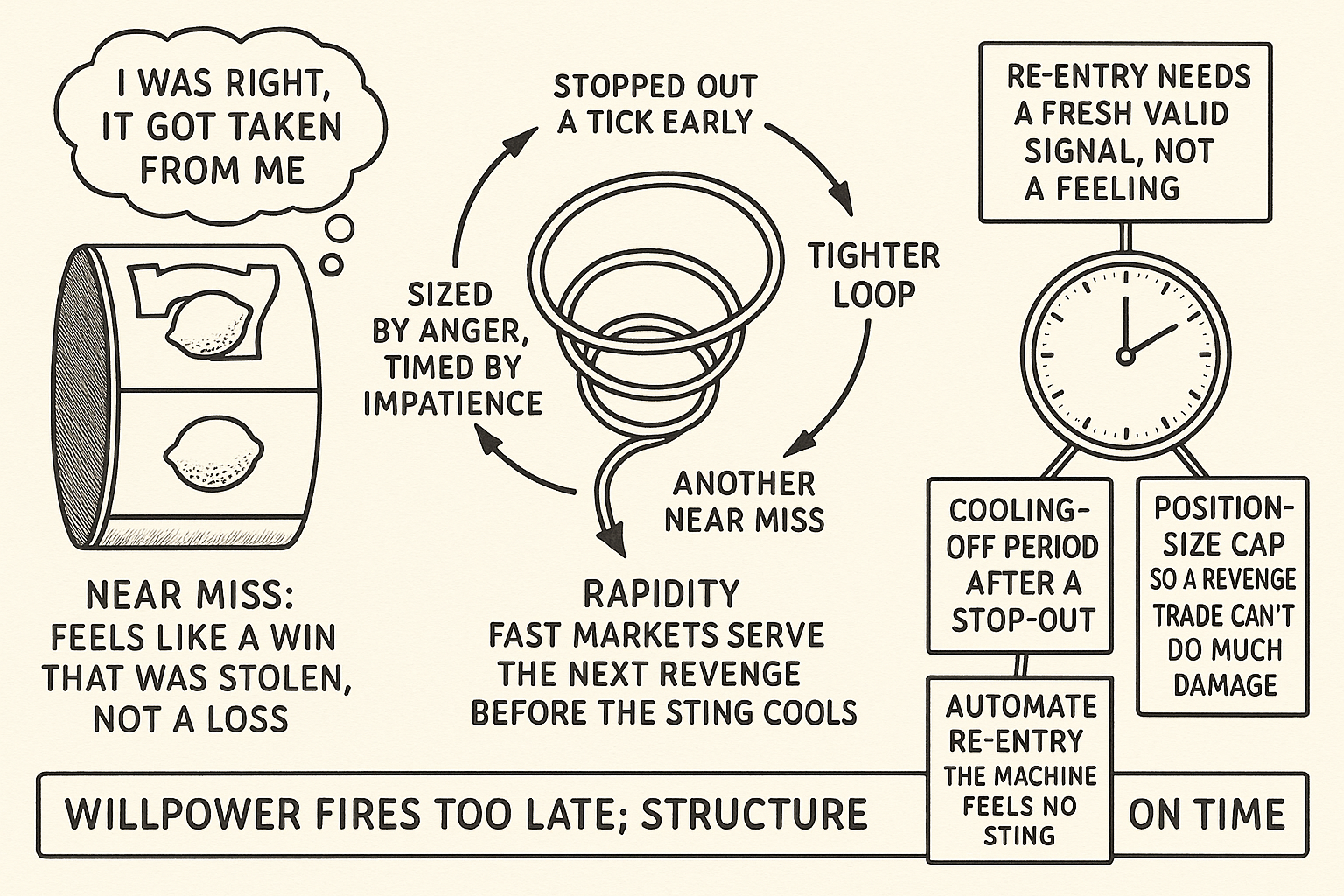
A clear loss and a near miss are the same outcome on your P&L and completely different events in your head. A trade that was wrong from the start and lost feels like a loss, and the brain files it as such. A trade that was right, that would have worked, that got stopped out a tick before the move you correctly predicted, does not feel like a loss; it feels like a theft, like a win that was taken from you by bad luck or a tick of slippage. The near miss carries the message you were right, which is far more motivating than the message you were wrong, because being-almost-right invites you to try again immediately and claim the win you were owed.
This is why near misses drive activity that clear losses do not. A string of clean losses eventually discourages a trader into stopping. A string of near misses energizes him, each one whispering that the edge is real and the next attempt will land it, so he keeps trading, keeps re-entering, keeps feeding coins into the machine. The motivational asymmetry is the engine of compulsion, and markets, especially fast ones, manufacture near misses constantly, because the difference between a winning and losing scalp is often a single tick.
Revenge trading is the near miss acting out
Revenge trading is what the near-miss urge produces when you obey it. Stopped out just before the move, you re-enter immediately to capture the gain you feel was stolen, except now you are trading from emotion rather than signal: the size is bigger because you want to make the loss back faster, the timing is worse because you are reacting to the sting rather than to a setup, and the original edge, if there ever was one, is gone, replaced by the need to be made whole. The revenge trade is sized by anger and timed by impatience, the two worst inputs to a position, and it tends to lose, which produces another near miss or another loss, which produces another revenge trade. The loop tightens with each turn.
The rapidity factor makes it worse, because fast markets serve the next opportunity for revenge before the emotion of the last one has cooled. A day trader stopped out at 10:03 can be back in by 10:04, while the sting is fresh and the judgment is hot, which is exactly the condition under which the revenge loop runs fastest. Slower trading has a built-in cooling period; the trade is over and the next setup is days away, so the emotion dissipates before it can drive the next decision. Speed removes the cooling and lets the near-miss compulsion compound, which is one more reason the fast styles that feel most engaging are the most dangerous.
Break the loop with structure, not willpower
You do not beat revenge trading by resolving to stay calm, because the near-miss urge fires before your resolve gets a vote, and "just this once, to make it back" is the rationalization that always sounds reasonable in the heat of it. The defense is structural. Re-entry rules decided in advance, so that getting back in requires a fresh valid signal, not a feeling, removes the discretion the revenge trade needs. A cooling-off rule, no new position for a set period after a stop-out, manufactures the pause that fast markets deny you. Position-size limits cap how much damage a revenge trade can do even if you take one, since the revenge instinct's signature move is oversizing. And the deepest fix, from "How to Remove Yourself from Your Trading System", is to automate the re-entry decision entirely, so the system, which feels no sting and seeks no revenge, decides when you get back in. The near miss is a feeling the machine does not have, which is exactly why the machine should be making the decision the feeling wants to corrupt.
Visualizing the revenge loop
KEY POINTS
- Slot machines pay in near misses because an almost-win is more compelling than a clear loss. Trading has the same mechanism, and it breeds the urge to immediately get back in.
- A near miss and a clear loss are identical on the P&L and opposite in the brain. The near miss carries the message you were right, which is far more motivating than you were wrong and invites you to try again at once.
- Near misses energize trading where clear losses discourage it. Fast markets manufacture them constantly, because the difference between a winning and losing scalp is often one tick.
- Revenge trading is the near-miss urge acting out: you re-enter from emotion, sized by anger and timed by impatience, the edge gone, replaced by the need to be made whole, and it tends to lose, feeding the loop.
- The rapidity factor tightens the loop, serving the next revenge before the last one's emotion cools. Slower trading has a built-in cooling period that speed removes.
- Beat it with structure, not willpower: re-entry rules requiring a fresh signal, a cooling-off period after a stop, position-size caps, and automating the re-entry so the machine, which feels no sting, decides.
References
- Systematic Trading - Robert Carver (Amazon)
- Trading Systems - Urban Jaekle Emilio Tomasini (Amazon)
- Volatility spillover among the sectors of emerging and developed
- A review on drawdown risk measures and their implications for risk
- Swayambu Temporal Symmetry (STS)
- A PRIMER FOR INVESTMENT PROFESSIONALS
- Title: Downside Tolerance and Drawdown Absorption in a Depth
- The Passion of World Politics: Propositions on Emotion and ... - jstor
- AlphaCrafter: A Full-Stack Multi-Agent Framework for Cross ... - arXiv
- Maximum drawdown, recovery, and momentum - arXiv