6.30 How to Remove Yourself from Your Trading System
Removing yourself is engineering, not willpower: inventory where you intervene, close each point with pre-committed rules, automate what you can, and hand authority from the live you to the calm you.
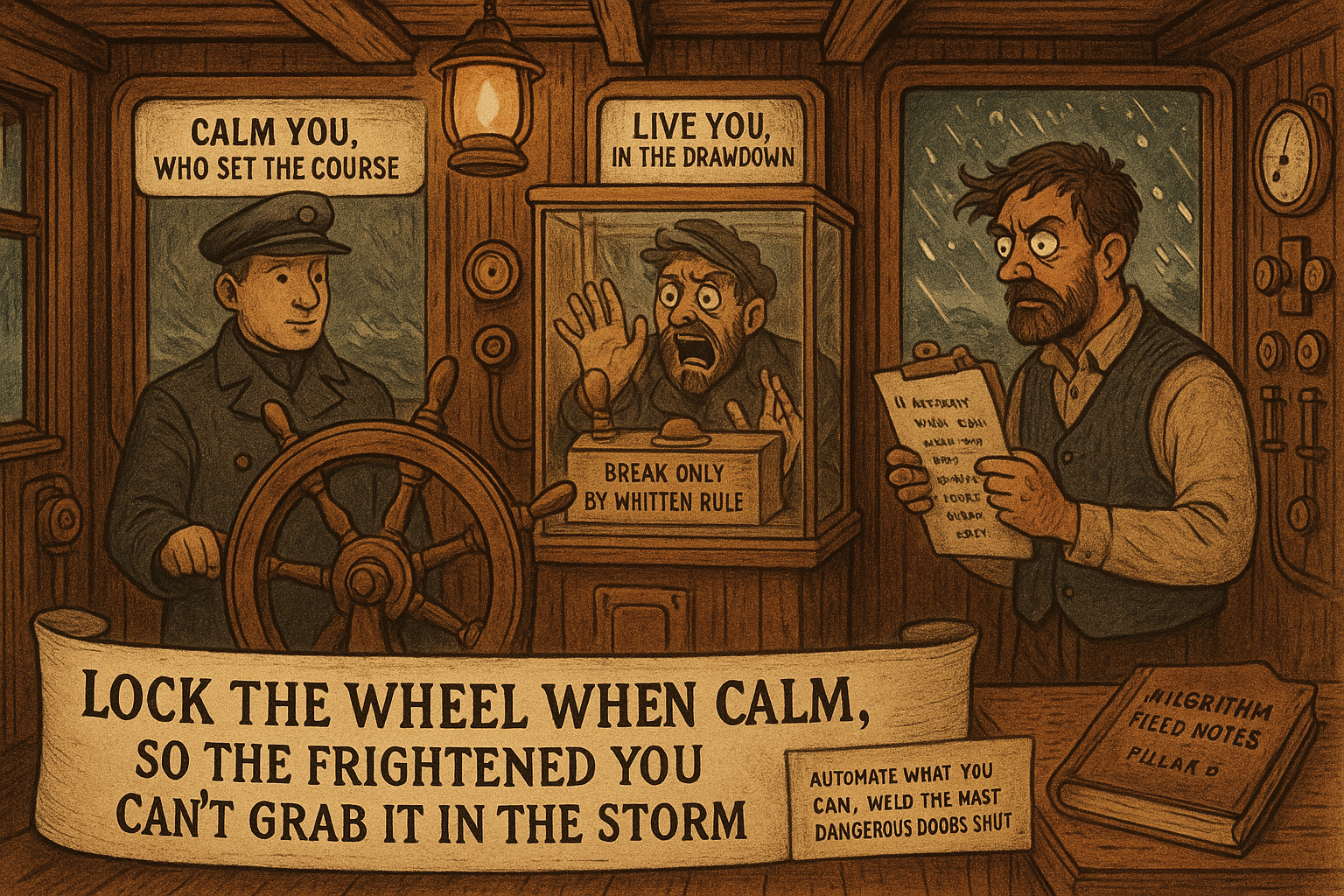
Every article in this behavioral run reaches the same conclusion: your in-the-moment judgment is the problem, and the fix is to take it out of the loop. This is the how. Removing yourself from your trading system is a concrete engineering task, not a matter of resolve, and it is done by closing off the specific points where your corrupted judgment can re-enter the process. The goal is a system that runs its decisions without consulting the version of you that feels loss aversion, near-miss revenge, and the illusion of control, because that version of you, as the whole pillar has shown, decides worse than the rule does. "The Discipline Premium in Trading" said discipline is the edge; this is how you build the machine that enforces it.
Find every point where you can intervene
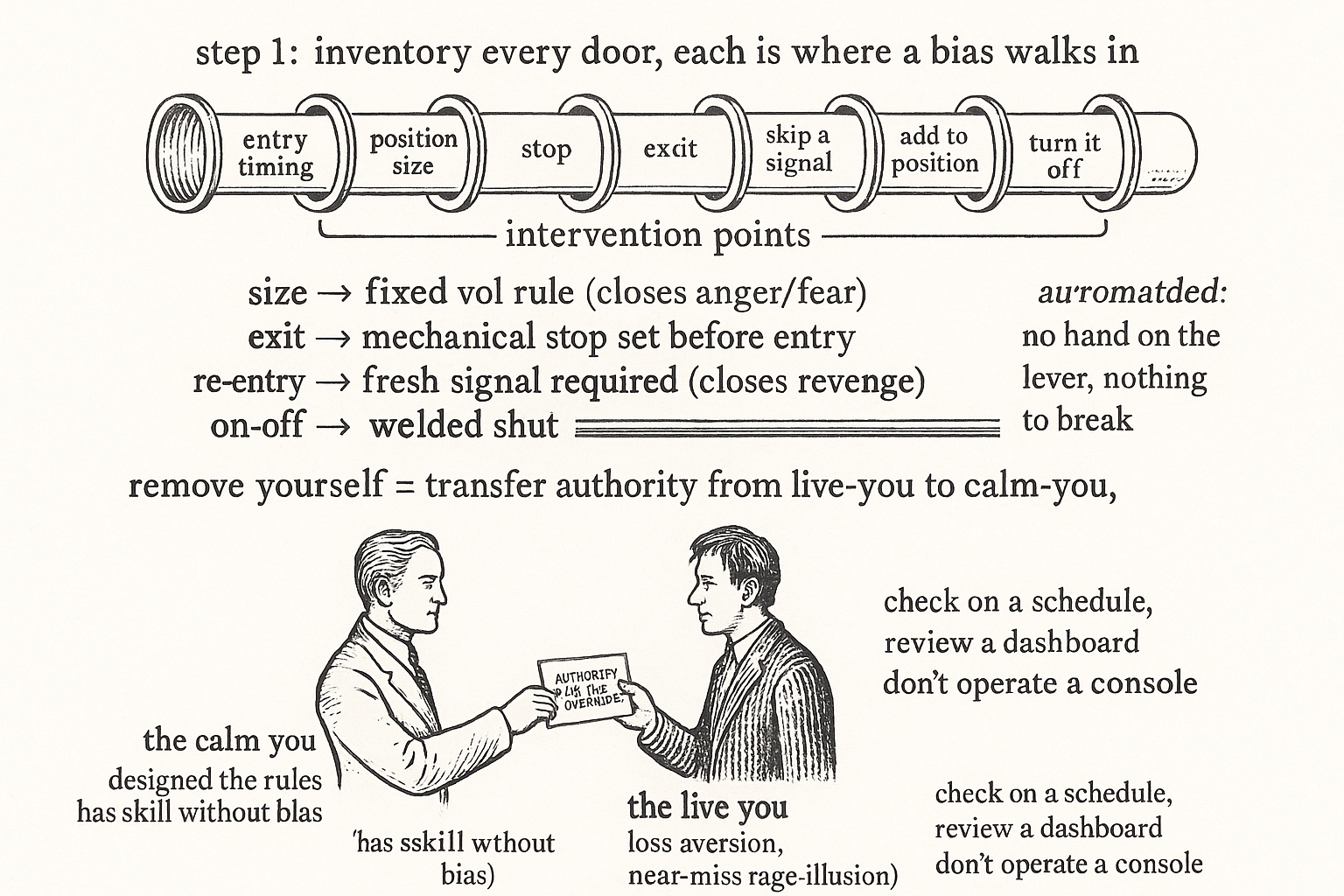
Start by mapping the decisions in your trading and marking which ones you currently make by hand in the moment, because each of those is a door the biases walk through. The entry timing, the position size, the stop placement, the exit, the re-entry after a stop, the decision to skip a signal, the decision to add to a position, the decision to turn the system off in a drawdown, every manual intervention point is a place where get-even-itis, the disposition effect, or revenge can corrupt the decision. You cannot remove yourself from a system whose intervention points you have not named, so the first step is the inventory: list every moment where the outcome depends on a choice you make while the trade is live.
Most traders discover they have far more intervention points than they thought, and that the points cluster exactly where the biases are worst, the exits and the sizing, because those are the decisions that feel like they need judgment and are actually where judgment fails. The map itself is diagnostic: a system with many live-decision points is a system mostly run by your biases, no matter how systematic the entry signal looks.
Close the doors in order of damage
Remove yourself by converting intervention points into pre-committed rules, starting with the ones the behavioral articles flagged as most damaging. Sizing first, because the urge to oversize after a loss is revenge and to undersize after a win is fear, so a fixed volatility-based sizing rule from "Why Volatility-Adjusted Position Sizing Matters" closes the door anger and fear came through. Exits next, because that is the home of get-even-itis and the disposition effect, so a mechanical stop and exit decided before entry removes the decision your brain is guaranteed to get wrong. Re-entry next, because that is where the near-miss revenge loop runs, so a rule requiring a fresh valid signal before re-entering closes it. The on-off decision last and most carefully, because quitting a system in a drawdown is the most expensive override of all, so the kill rule from "When to Switch Off a Trading System", written in advance and tied to the drawdown envelope, replaces the panic decision with a statistical one.
The strongest version of closing a door is automation: code the rule so the decision executes without you, because a rule you have to manually obey is a rule you can manually break, and you will break it at the worst moment. Automation is not about speed or sophistication; it is about removing your hand from the lever entirely, so that following the rule requires no willpower because there is no opportunity to deviate. Where full automation is not possible, the next best thing is making deviation costly and slow, a written rule you must consult, a cooling-off delay, a second person who has to approve an override, anything that puts friction between your in-the-moment impulse and the action.
Engineer your contact with the system
Removing yourself is also about reducing exposure to the temptation, not just blocking the action. The more you watch a live system, the more chances the urge to intervene gets, so check it on a schedule rather than continuously, the way "Why Systematic Trading Feels Emotionally Unsatisfying" prescribed, denying the discomfort the constant contact it needs to drive an override. Separate your research time from your monitoring time, so the engagement you crave goes into building and testing in a calm state, where your judgment is actually useful, rather than into meddling with the running strategy, where it is not. And design the moments you do interact with the system to be decision-free by default, a dashboard you review, not a console you operate, so that the normal state of contact is observation, and intervention requires a deliberate, friction-laden departure from it.
The deepest version of removing yourself is accepting that the disciplined version of you, the one who designed the rules in a calm moment, should overrule the live version of you every time they disagree, because the calm version had access to your skill without your biases. Removing yourself from your trading system is really transferring authority from the live you to the calm you, and building the structure that makes the transfer stick when the live you, deep in a drawdown or a near-miss rage, tries to take the authority back. That structure is the final product of this pillar: not a better signal, but a process that protects a sound signal from the one person most likely to wreck it.
Visualizing removing yourself
KEY POINTS
- Removing yourself from your trading system is an engineering task, not a matter of resolve. You close off the specific points where your corrupted in-the-moment judgment can re-enter the process.
- First, inventory every intervention point, every decision you currently make by hand while the trade is live, because each is a door the biases walk through. Most traders find far more than they expected, clustered at the exits and sizing.
- A system with many live-decision points is mostly run by your biases no matter how systematic the entry looks. The map itself is diagnostic.
- Close the doors in order of damage: sizing first (anger oversizes, fear undersizes), exits next (get-even-itis and the disposition effect), re-entry next (near-miss revenge), and the on-off decision last and most carefully, with a pre-written kill rule.
- Automation is the strongest close, because a rule you must manually obey is one you can manually break at the worst moment. Where automation is impossible, make deviation slow and costly with friction.
- Reduce contact with the live system: check on a schedule, separate research from monitoring, and make interaction observation by default. The deepest version is transferring authority from the live you to the calm you who designed the rules, and making the transfer stick.
References
- Systematic Trading - Robert Carver (Amazon)
- Trading Systems - Urban Jaekle Emilio Tomasini (Amazon)
- Trade Sizing Techniques for Drawdown and Tail Risk Control
- The Impact of Volatility Targeting
- Optimal Portfolio Strategy to Control Maximum Drawdown
- Are Investors Reluctant to Realize Their Losses?
- A Test of the Disposition Effect and Momentum
- How the Disposition Effect Depresses Purchase Behavior
- Conditional Volatility Targeting
- Sculpting Investment Portfolios: Maximum Drawdown and Optimal