6.29 The Discipline Premium in Trading
The discipline premium is the return for not making the mistakes everyone else makes. It can't be arbitraged away because instinct doesn't learn, but it multiplies a sound edge, not replaces one.
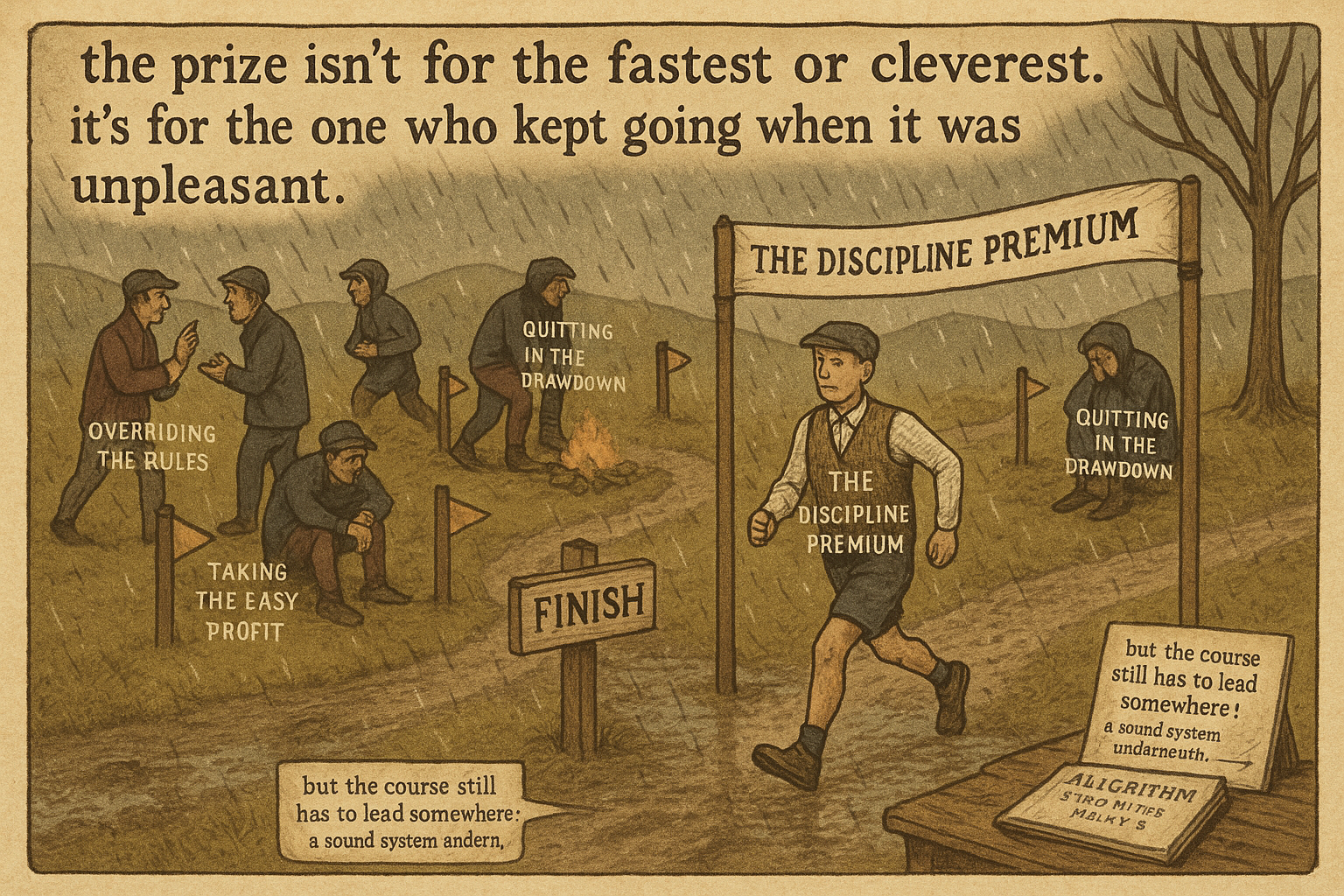
Most trading edges decay as more people discover them. The edge from discipline does the opposite: it persists, because it comes from doing the boring, uncomfortable thing that most people are constitutionally unable to do, and human nature does not get arbitraged away. While everyone hunts for the next clever signal, the most durable edge available is the willingness to follow a mediocre rule consistently when everyone around you is breaking theirs. Call it the discipline premium, the return you collect simply for not making the behavioral mistakes the rest of the market makes. "Why Simple Algorithms Beat Smart Humans" mentioned this second effect; this is the full case for discipline as a tradable edge.
Discipline is an edge because indiscipline is everywhere
A trading edge needs an inefficiency to feed on, and the behavioral biases from this pillar are a vast, permanent inefficiency. Every discretionary trader holding losers too long, selling winners too early, revenge trading after a near miss, and panic-selling the bottom is leaving money on the table in a patterned, predictable way. Those patterns show up in prices, the over-extension from herding, the mean reversion from forced liquidations, the momentum from slow reaction, and a disciplined system can be built to harvest them. The other side of every behavioral mistake is a profit for whoever is positioned to take it, and the disciplined trader is that whoever.
This edge is unusually durable because its source cannot be competed away. A clever signal stops working when enough people trade it, but the discipline premium feeds on human instinct, and human instinct does not learn. The biases are firmware, as "The Flawed Human Brain in Trading" argued, so each new generation of traders arrives with the same loss aversion and the same disposition effect, makes the same mistakes, and leaves the same patterns. The supply of indiscipline is permanent, which makes the premium for harvesting it permanent too, in a way almost no other edge is.
The premium is paid for discomfort, not cleverness
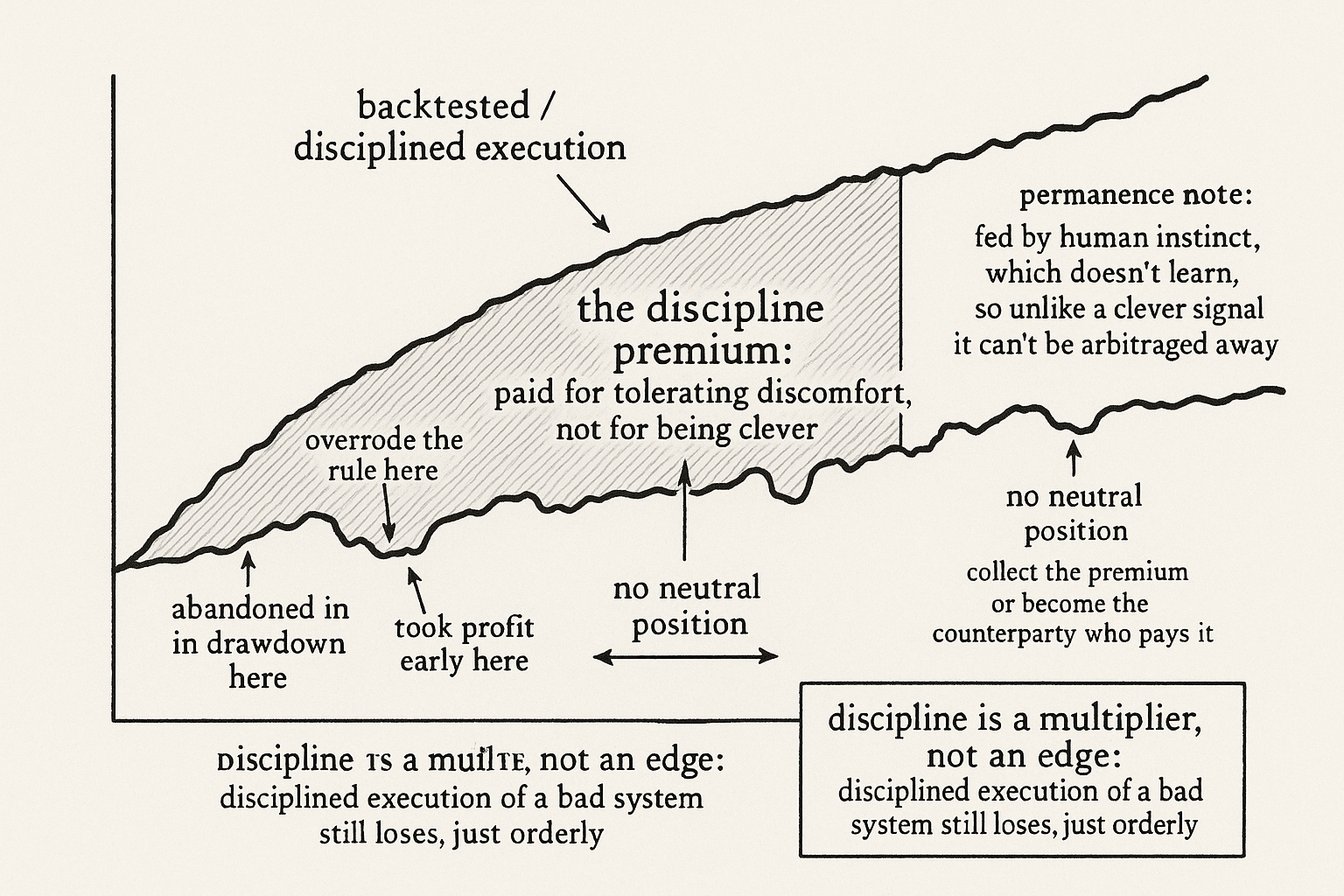
The discipline premium is not collected by being smarter; it is collected by tolerating discomfort that others will not. Following a rule through a drawdown, when every instinct screams to override it, is uncomfortable, and the discomfort is exactly why the premium exists, because most people pay to make the discomfort stop. They override the rule to feel in control, they take the early profit to relieve the anxiety, they cut the system in a drawdown to escape the pain, and every one of those comfort-seeking actions forfeits a piece of the premium to whoever endured the discomfort instead.
This reframes the emotional emptiness of systematic trading from "Why Systematic Trading Feels Emotionally Unsatisfying" as the literal source of the return. You are not enduring the boredom and the helplessness for nothing; you are being paid for them, because they are the price of admission to an edge that requires doing the unpleasant thing consistently. The trader who finds systematic trading unbearable and quits is not just failing to capture an edge, he is becoming the counterparty, joining the pool of indiscipline that funds the premium for those who stayed. There is no neutral position: you either pay the discomfort and collect the premium, or you avoid the discomfort and pay the premium to someone else.
You still need a real edge underneath
The honest limit: discipline is a multiplier on an edge, not an edge by itself. Disciplined execution of a genuinely negative-expectancy system loses money with great consistency, and following a bad rule faithfully just means you lose in an orderly fashion. The discipline premium is the gap between a sound system's backtested return and the worse return an undisciplined trader actually realizes running it, the leakage from overrides, early exits, and abandonment. That gap is real and often large, frequently the difference between a profitable strategy on paper and a losing one in practice, but it is a gap relative to a system that had an edge to begin with. So the discipline premium is what you collect for executing a sound process cleanly, and it presupposes the process is sound, which is the work of every other article in this series. Build the edge first, then collect the discipline premium by not sabotaging it, and recognize that for most traders the second part is harder than the first.
Visualizing the discipline premium
KEY POINTS
- The discipline premium is the return collected simply for not making the behavioral mistakes the rest of the market makes. Unlike a clever signal, it persists because it feeds on human nature.
- Discipline is an edge because indiscipline is everywhere. Held losers, early-sold winners, revenge trades, and panic-selling leave patterned, predictable footprints in prices that a disciplined system can harvest.
- The edge is durable because its source cannot be competed away. The biases are firmware, so each new generation arrives with the same loss aversion and makes the same mistakes, keeping the supply of indiscipline permanent.
- The premium is paid for tolerating discomfort, not for being smarter. Most people override the rule to feel in control or quit in a drawdown to escape the pain, forfeiting the premium to whoever endured it instead.
- The emotional emptiness of systematic trading is the literal source of the return. There is no neutral position: you pay the discomfort and collect the premium, or you avoid it and pay the premium to someone else.
- Discipline is a multiplier on an edge, not an edge by itself. Faithfully following a negative-expectancy system loses money in an orderly way, so build a sound process first, then collect the premium by not sabotaging it.
References
- Systematic Trading - Robert Carver (Amazon)
- Trading Systems - Urban Jaekle Emilio Tomasini (Amazon)
- Behavioral Finance: Theories and Evidence
- Behavioral Finance
- Maximum Drawdown, Recovery, and Momentum
- Optimal Portfolio Strategy to Control Maximum Drawdown
- Factor Investing and Asset Allocation
- Measuring Strategy-Decay Risk: Minimum Regime Performance and Strategy Resilience
- Behavioral Finance Impacts on US Stock Market Volatility: An Analysis of Market Anomalies
- A Behavioral Perspective of Distress Anomaly