6.22 The Flawed Human Brain in Trading
Your brain runs savanna firmware on a market problem. Loss aversion, pattern-seeing, and herding kept your ancestors alive and lose money now. Knowing it doesn't help; route around it with a rule.
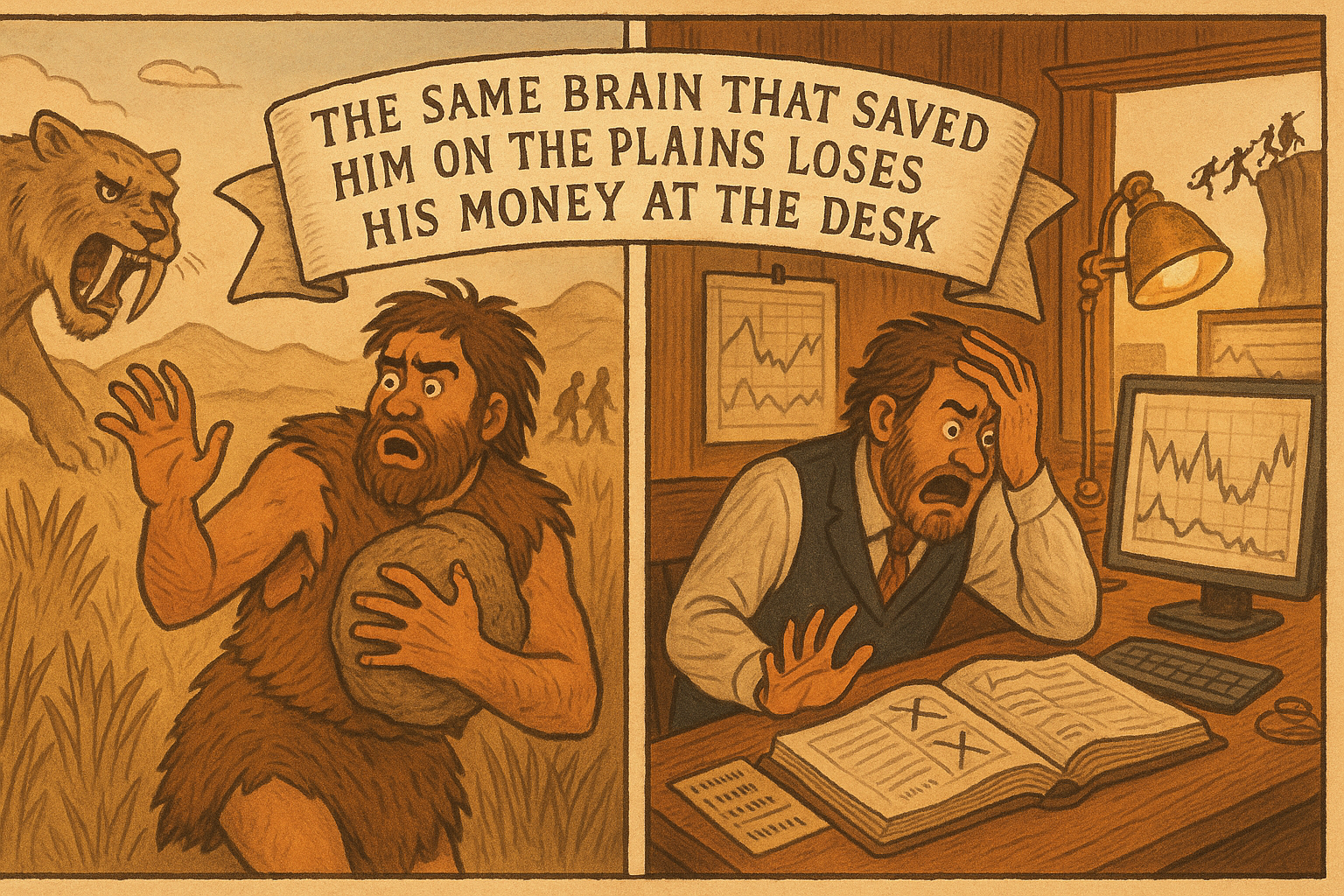
Your brain was built to keep a primate alive on a savanna, and almost none of what it was tuned for helps you trade. The instincts that made your ancestors survive, react fast to threats, avoid losses at all costs, see patterns in noise, follow the herd, are precisely the instincts that lose money in markets, and they are not bugs you can debug. They are the firmware, deep-wired by evolution, strong enough to override the rational analysis you are convinced you are doing. "Why Simple Algorithms Beat Smart Humans" claimed the human loses to the rule; this is the catalog of why, the specific flaws that make trading on instinct a losing proposition.
The biases are features that misfire
Behavioral finance grew out of one observation: real people do not make the cold, rational choices that classical economics assumes. They make systematically biased ones, and the biases are consistent enough to have names and to be reproduced in experiment after experiment. The unifying model is prospect theory, which says people do not evaluate outcomes against zero, they evaluate them as gains and losses against a reference point, and they weight losses far more heavily than equivalent gains. A loss of a hundred dollars hurts roughly twice as much as a gain of a hundred dollars pleases, and that single asymmetry drives a cascade of bad trading behavior.
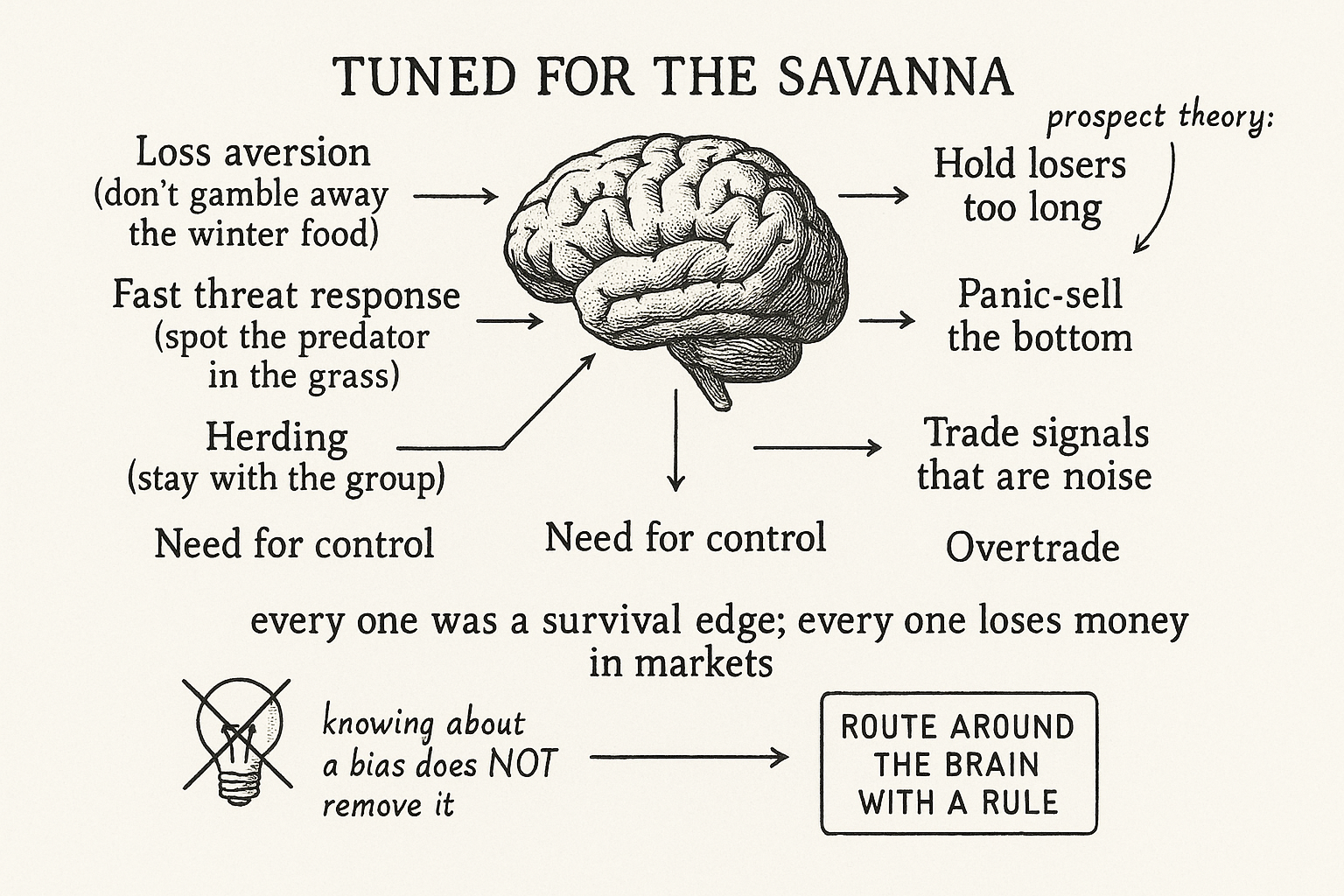
These instincts were adaptive once. Loss aversion kept you from gambling away the food that kept you alive through winter. Fast threat response kept you from being eaten. Pattern-seeing helped you find the predator in the grass, even at the cost of seeing predators that were not there. Herding kept you with the group that protected you. Every one of these was a survival advantage in an environment of scarcity and physical danger, and every one of them is a handicap in an environment of probabilistic payoffs and abstract risk, which is the environment of trading. The brain does not know the environment changed. It runs the old firmware on the new problem.
How each flaw shows up at the screen
The savanna instincts translate directly into trading errors, each with a specific cost. Loss aversion becomes the refusal to take losses, holding a loser long past the point the thesis broke, because crystallizing the loss makes it real and the brain will do almost anything to postpone that pain, the get-even-itis from "Get-Even-Itis: The Most Expensive Disease in Trading". The same asymmetry becomes taking winners too early, grabbing the sure small gain because a paper profit feels fragile, detailed in "Why Traders Take Profits Too Early and Losses Too Late". Pattern-seeing becomes finding trends and signals in random price noise, trading setups that are not there. Herding becomes buying what everyone is buying at the top and selling what everyone is selling at the bottom. The need for control becomes overtrading, the illusion from "The Illusion of Control in Active Trading". None of these feels like a bias from the inside; each feels like a reasonable decision, which is exactly what makes them dangerous.
You cannot fix the brain, so you route around it
The conclusion behavioral finance points to is uncomfortable: you cannot debug these flaws by knowing about them. Awareness of a bias does not remove it, because the bias operates below the level of conscious analysis and fires before your reasoning gets a vote. A trader who has read every book on cognitive bias still feels the same lurch of loss aversion when a position goes against him, and still, often, holds the loser. Knowledge is not the cure.
The cure is structural: build a rule that makes the decision for you, and remove your in-the-moment judgment from the loop, which is what the rest of this pillar is about. The rule does not feel loss aversion, does not see patterns in noise, does not herd. It is the prosthetic for a brain that was never designed for this task. And the same flaws that you are routing around in yourself persist in every other human in the market, so the rule that immunizes you also lets you harvest their mistakes, which is the only consolation evolution offers the systematic trader.
Visualizing the flawed brain
KEY POINTS
- The human brain was tuned by evolution for survival on a savanna, and the instincts that kept your ancestors alive are the same ones that lose money in markets. They are firmware, not bugs you can debug.
- Behavioral finance starts from the observation that real people make systematically biased choices, not the rational ones economics assumes. The unifying model is prospect theory.
- Prospect theory says people judge outcomes as gains and losses against a reference point and weight losses about twice as heavily as equal gains. That asymmetry drives a cascade of bad trading.
- The savanna instincts misfire at the screen: loss aversion becomes holding losers, the same asymmetry becomes selling winners early, pattern-seeing becomes trading noise, herding becomes buying tops, the need for control becomes overtrading.
- None of these feels like a bias from the inside; each feels like a reasonable decision, which is what makes them dangerous.
- Awareness does not cure a bias, because it fires below conscious analysis before your reasoning votes. The cure is structural: a rule that makes the decision and removes your in-the-moment judgment, which also lets you harvest everyone else's biases.
References
- Systematic Trading - Robert Carver (Amazon)
- Trading Systems - Urban Jaekle Emilio Tomasini (Amazon)
- The Disposition to Sell Winners Too Early and Ride Losers Too Long: Theory and Evidence
- A Dark Side of Hope: Understanding Why Investors Cling onto Losing Stocks
- Drawdowns
- Optimal Portfolio Strategy to Control Maximum Drawdown
- Volatility spillover among the sectors of emerging and developed
- Are Investors Reluctant to Realize Their Losses?
- AlphaCrafter: A Full-Stack Multi-Agent Framework for Cross ... - arXiv
- Maximum drawdown, recovery, and momentum - arXiv