6.21 Why Simple Algorithms Beat Smart Humans
An expert with twenty years of feel loses to a rule on an index card: knowledge isn't the bottleneck, consistency is. The rule stops your mistakes and exploits everyone still making theirs.
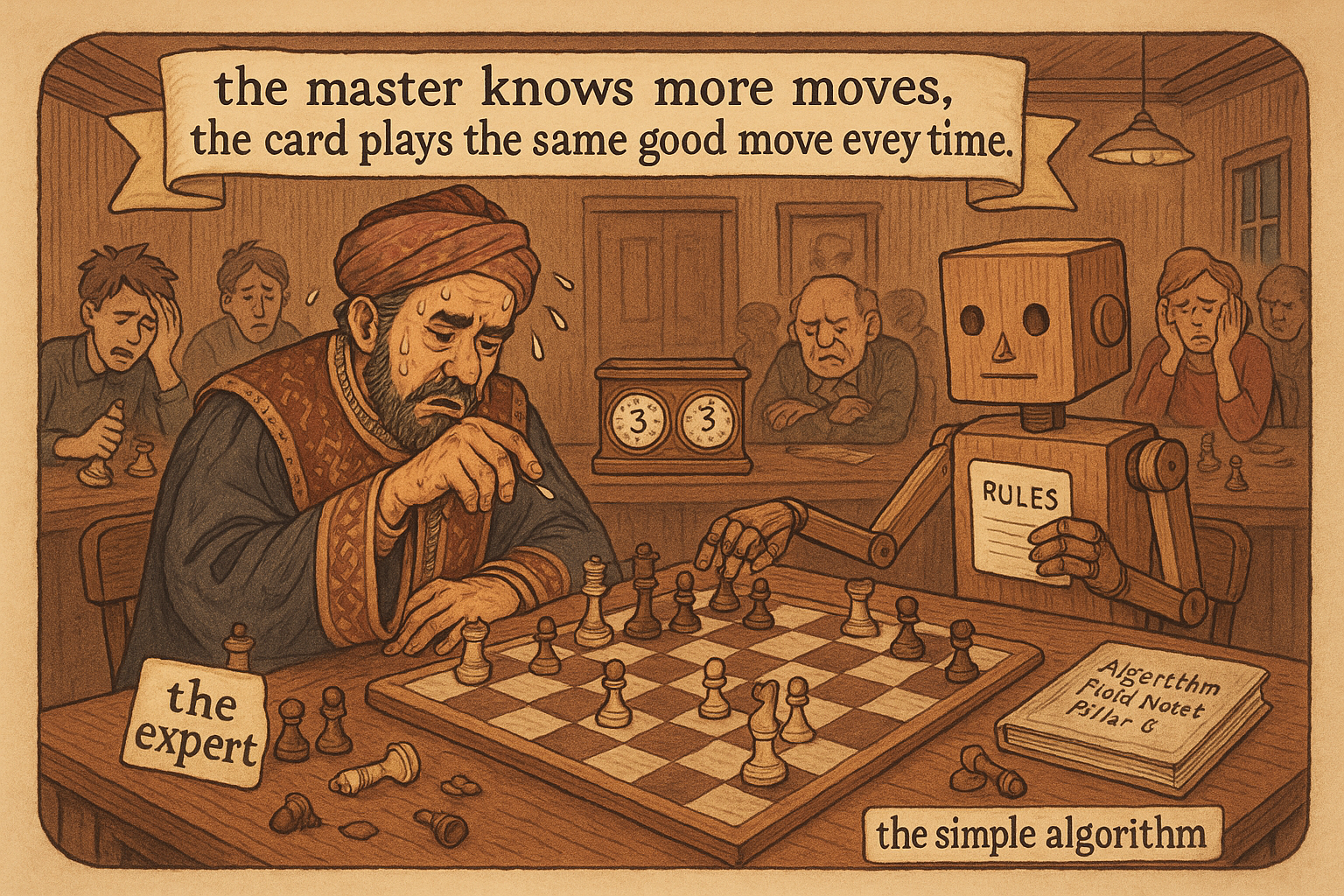
A trader with twenty years of experience, a deep understanding of the markets, and a genuine feel for price action will, on average, be beaten by a simple rule he could write on an index card. This is not an insult to the trader; it is a finding that holds across domains, from medical diagnosis to parole decisions to crop yields, and it holds because the human brain carries flaws that no amount of expertise removes. The expert knows more than the rule and trades worse than the rule, because knowledge is not the bottleneck. Consistency is, and the rule is consistent in a way the human cannot be. This opens the behavioral run in this pillar, and "The Flawed Human Brain in Trading" catalogs the specific flaws that make it true.
Knowledge is not the problem
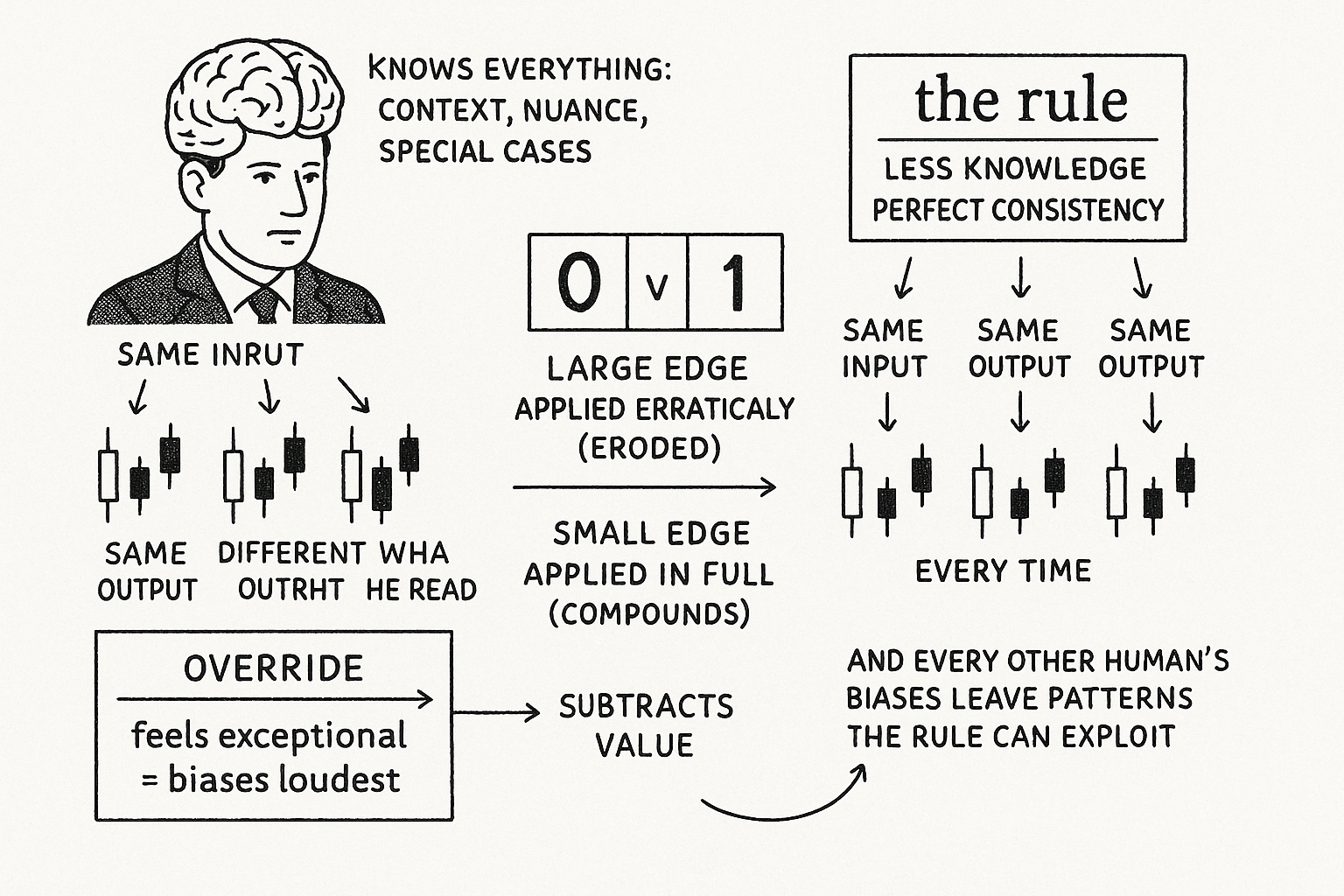
The intuitive objection is that a simple rule must be inferior to an expert, because the expert knows so much more, the context, the nuance, the special cases the rule ignores. That extra knowledge is real, and it does not help, because the expert cannot apply it consistently. The same trader, given the same setup on two different days, will trade it differently depending on his mood, his recent results, whether the last trade won or lost, what he read that morning. The knowledge is there; the application of it wobbles, and the wobble costs more than the knowledge gains.
A simple rule has no moods. Given the same input it produces the same output every time, which sounds like a limitation and is the entire advantage. The rule's consistency means its edge, however modest, gets applied in full on every occasion, while the expert's larger edge gets applied erratically, eroded by every inconsistency between what he knows and what he does under pressure. Across many decisions, the consistent small edge beats the erratic large one, because the erosion compounds.
The expert adds noise, not signal
The deeper finding is that human judgment laid on top of a rule usually makes it worse, not better. Give an expert a good statistical model and let him override it when his experience says the model is wrong, and his overrides, on average, subtract value. He overrides on the cases that feel exceptional, and feeling exceptional is exactly when his biases are loudest, so his interventions are concentrated in the moments he is least reliable. The rule was right and the override was the bias talking, dressed up as expertise.
This is why the recommendation is not to use the rule as a starting point for human refinement, but to use the rule and resist refining it. The whole case for systematic trading rests on an admission that even people who know finance deeply make bad financial decisions because they are human, and the fix is to systematize the decision and then stay out of its way. The expert's job is to design the rule, using all his knowledge, in a calm moment. The expert's job is not to second-guess the rule in the heat of the trade, because the second-guessing is where the flaws re-enter the system he built to escape them.
You also get to exploit the other humans
There is a second reason the simple rule wins, beyond your own consistency: everyone else is human too. The cognitive biases that wreck your judgment wreck the judgment of every discretionary trader in the market, and their biased decisions leave patterns in prices, the systematic over-holding of losers, the premature selling of winners, the overreaction and the herding. A rule that is immune to those biases can be built to exploit them in others. So the rule helps you twice: it stops you from making the mistakes, and it positions you to profit from everyone who still does. The discipline premium from "The Discipline Premium in Trading" is exactly this second effect, the money left on the table by the undisciplined for the disciplined to collect.
Visualizing rule vs expert
KEY POINTS
- A simple rule beats an experienced expert on average, across many domains, because knowledge is not the bottleneck. Consistency is, and the rule is consistent in a way the human cannot be.
- The expert's extra knowledge is real and does not help, because he cannot apply it consistently. The same setup gets traded differently depending on mood, recent results, and what he read that morning.
- A rule has no moods, so its modest edge gets applied in full every time, while the expert's larger edge gets eroded by the wobble between what he knows and what he does under pressure.
- Human judgment laid on top of a rule usually subtracts value. Overrides cluster on cases that feel exceptional, which is exactly when biases are loudest and the human is least reliable.
- The fix is to design the rule with all your knowledge in a calm moment, then stay out of its way. Second-guessing in the heat of the trade re-introduces the flaws the rule was built to escape.
- The rule wins twice: it stops your mistakes and positions you to exploit the biases of every discretionary trader still making theirs. That is the discipline premium.
A note on AI. The ideas, research, analysis, and conclusions in this article are my own. I use AI tools to help with editing and wordsmithing, because English is not my first language, and I am not shy about that. AI-generated ideas and AI-assisted writing are not the same thing: the first is empty slop from a generic prompt, the second is a tool for communicating years of real research more clearly. Judge the work by its substance, not by whether software helped polish the prose.