6.23 Get-Even-Itis: The Most Expensive Disease in Trading
Get-even-itis is holding a broken loser to avoid crystallizing the loss, and the break-even you await recedes faster than price can chase it. Set the exit when calm and let the rule sell.
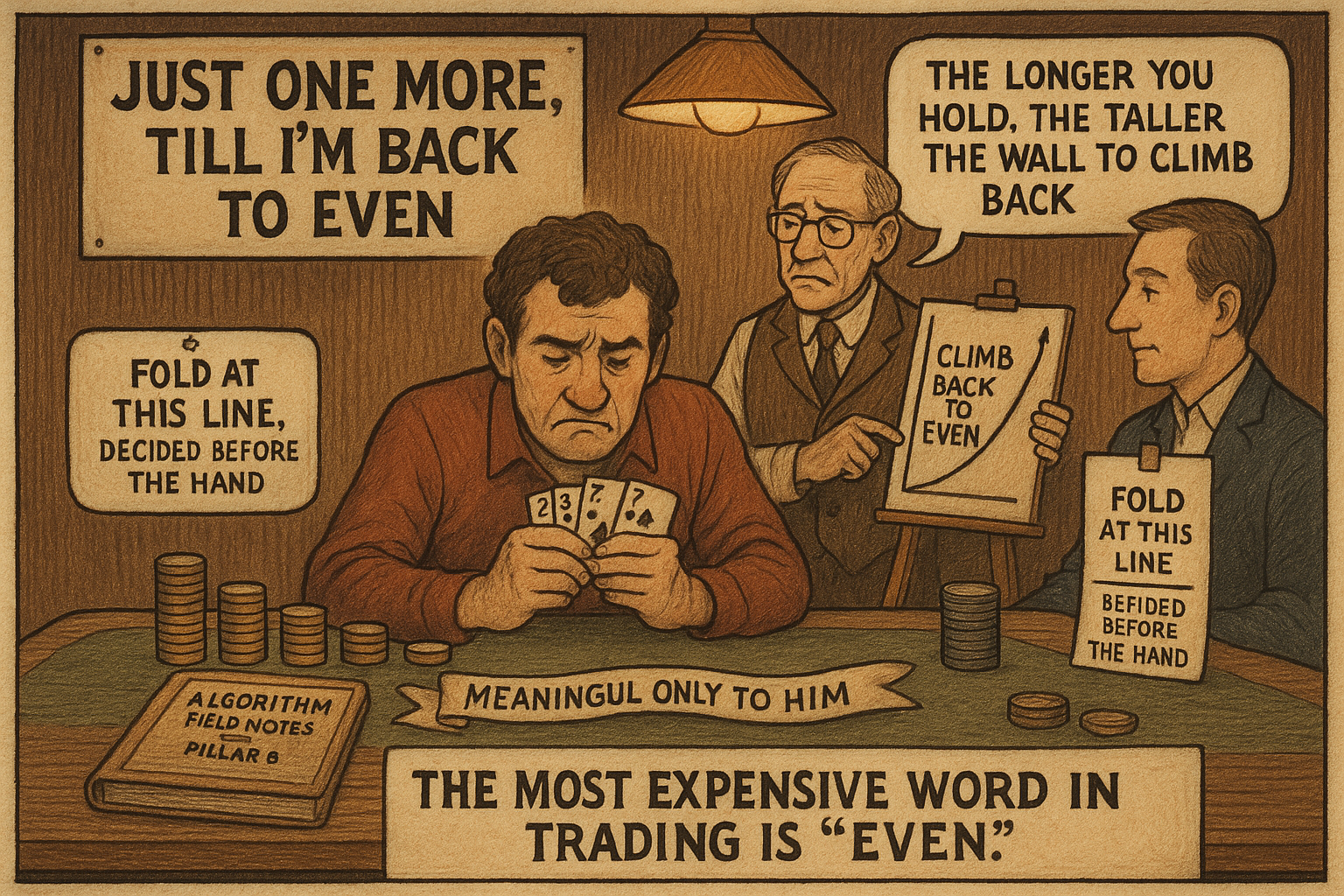
A position goes against you. The thesis that justified it has quietly broken, the reasons to be in the trade are gone, and you hold anyway, because selling now means admitting the loss, and admitting the loss hurts in a way that holding does not. You tell yourself you are waiting to get back to even, just to break even, then you will sell. That is get-even-itis, and it is the single most expensive behavioral disease in trading, because it converts small manageable losses into account-ending ones, one rationalization at a time. "The Flawed Human Brain in Trading" named loss aversion as the root; this is the specific way it bankrupts people.
A paper loss does not feel real
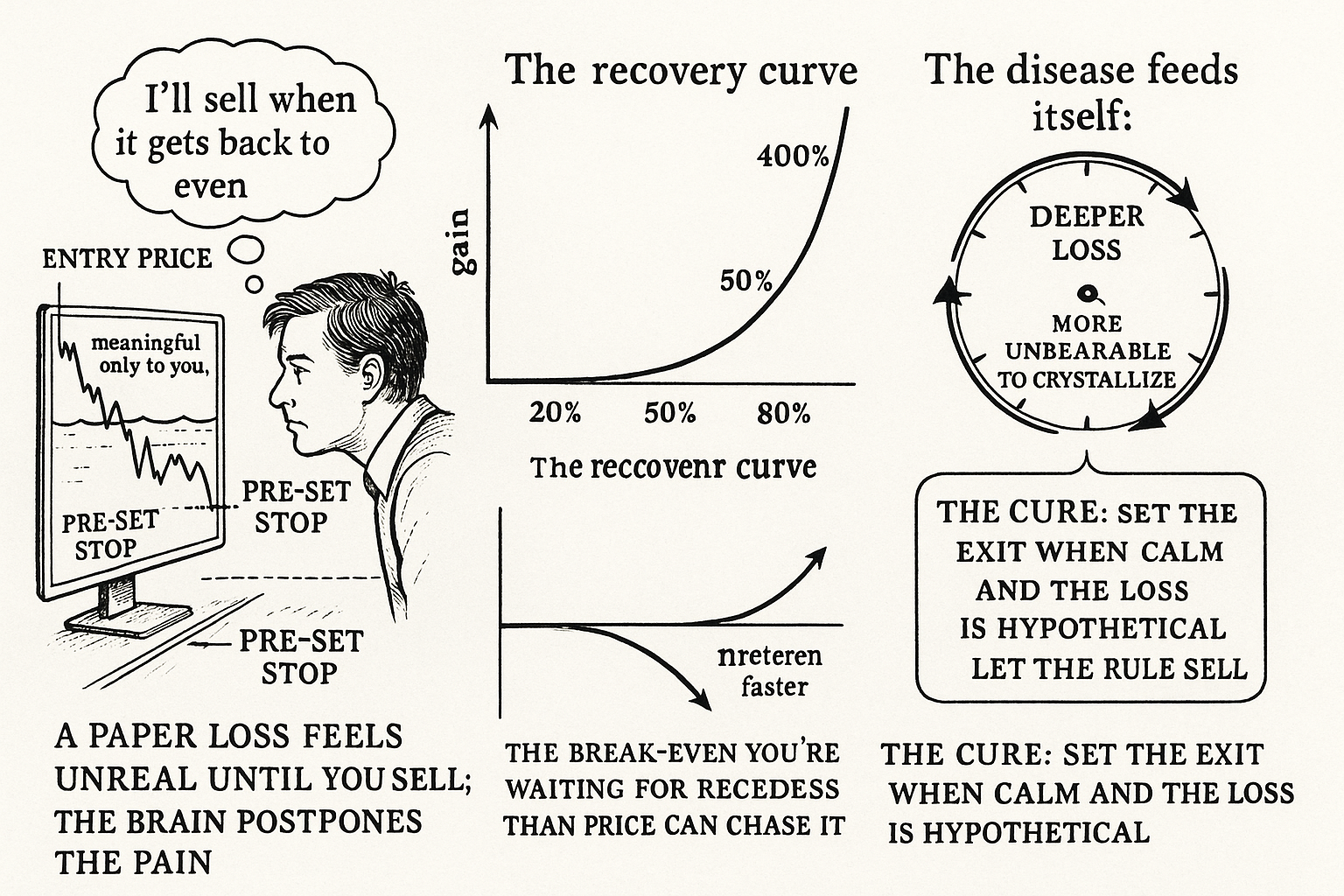
The mechanism is a quirk of how the brain registers losses. A paper loss, a position underwater but not yet sold, does not feel fully real, because the brain treats the loss as hypothetical until it is crystallized by the sale. Hold the loser and you preserve the fiction that you have not really lost; sell it and the loss becomes a fact, a number in the realized column, a thing that actually happened to you. The aversion to taking losses is powerful enough that people will accept a worse expected outcome, holding a position likely to fall further, in exchange for postponing the moment the loss becomes real.
This is why the trader fixates on getting back to even rather than on the trade's actual prospects. The break-even point has no significance to the market; the market does not know or care what price you paid. It has enormous significance to your brain, because reaching it would let you exit without crystallizing a loss, escaping the pain entirely. So you anchor on your entry price, a number that is meaningful only to you, and you make the hold-or-sell decision based on that anchor instead of on whether the position is still worth holding. The anchor is the disease, and the market punishes anchoring to a price it has already left behind.
The math turns the disease fatal
$$ \text{gain to recover} = \frac{1}{1 - L} - 1 $$
Get-even-itis is lethal because the recovery you are waiting for gets harder the longer you wait, in a viciously nonlinear way. A position down 20% needs a 25% gain to get back to even. Down 50%, it needs 100%, a double. Down 80%, it needs 400%. Every increment you hold a deteriorating loser, hoping for the round trip back to your entry, the round trip you need grows faster than the loss, so the break-even you are clinging to recedes faster than the price can plausibly chase it. The trader waiting to get even is waiting for an outcome that becomes less likely precisely because he waited, and the disease feeds itself: the deeper the loss, the more unbearable crystallizing it becomes, the longer he holds, the deeper the loss.
The cure is a rule that sells for you
You cannot beat get-even-itis with willpower in the moment, because the moment is when loss aversion is strongest and your reasoning is weakest. A trader staring at a loser, feeling the lurch of the unrealized loss, will rationalize holding every time, and "just to break even" is the rationalization that always sounds reasonable. The cure is to take the decision out of that moment entirely.
Set the exit before the trade, as a stop or a rule tied to the thesis, when you are calm and the loss is hypothetical and your judgment is clear. Then let the rule execute without consulting your in-the-moment feelings, because consulting them is how the disease re-enters. The rule does not care about your entry price, does not feel the paper loss as unreal, does not anchor on break-even; it sells when the condition is met, crystallizing the small loss that keeps you on the gentle part of the recovery curve from "Why Loss Control Is the Only Thing You Fully Control". This is the whole reason a disciplined framework forbids changing your forecast once a bet is open: the change is almost always get-even-itis wearing the costume of a fresh analysis. Pre-commit the exit, and remove yourself from the one decision your brain is guaranteed to get wrong.
Visualizing get-even-itis
KEY POINTS
- Get-even-itis is holding a losing position whose thesis has broken, just to get back to even, because selling crystallizes a loss the brain treats as not-yet-real while it stays on paper.
- A paper loss does not feel fully real because the brain treats it as hypothetical until the sale makes it a fact. People accept a worse expected outcome to postpone that moment.
- The trader anchors on his entry price, a number meaningful only to him and irrelevant to the market, and decides hold-or-sell based on the anchor instead of the position's actual prospects.
- The recovery math is viciously nonlinear: down 20% needs 25% back, down 50% needs 100%, down 80% needs 400%. The break-even recedes faster than price can chase it.
- The disease feeds itself: the deeper the loss, the more unbearable crystallizing it becomes, so the trader holds longer and the loss deepens.
- Willpower fails in the moment because loss aversion is strongest then. Set the exit before the trade when the loss is hypothetical, let the rule sell, and never change a forecast once a bet is open, since the change is usually the disease in disguise.
References
- Systematic Trading - Robert Carver (Amazon)
- Trading Systems - Urban Jaekle Emilio Tomasini (Amazon)
- How Long Does It Take to Recover from a Drawdown?
- When Do Systematic Strategies Decay?
- The Impact of Volatility Targeting (Digest summary)
- HOW LONG DOES IT TAKE TO RECOVER FROM A DRAWDOWN?
- Alpha Decay and Institutional Trading
- Capital Preservation Wealth | EI Blog
- The Impact of Volatility Targeting
- Machine Traders, Human Behavior, and Model (Mis)Specification