6.20 Why Loss Control Is the Only Thing You Fully Control
You can't control whether a trade wins, only how much you lose when wrong. Recovery is brutally asymmetric, so size, stops, and correlation decide survival more than any signal.
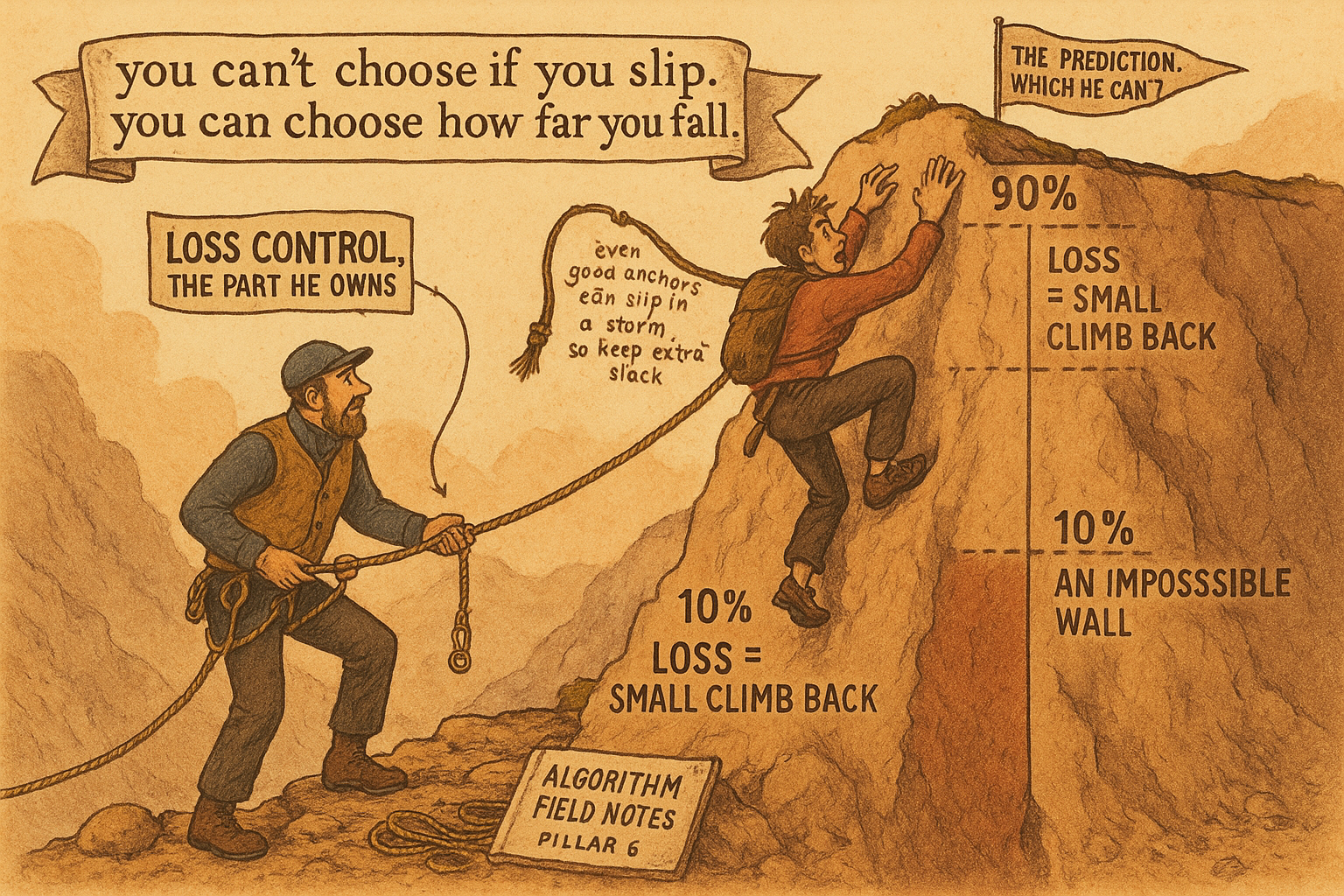
You do not control whether a trade wins. You do not control how far the market moves, when the trend comes, or whether your edge shows up this month. The one thing entirely in your hands is how much you lose when you are wrong, and that single controllable lever, position size, stops, and exits, determines survival more than any signal does. Traders pour all their effort into the part they cannot control, the prediction, and neglect the part they own completely, the loss. This closes the system-death run in this pillar, because the systems that die are the ones that lost control of their losses, not the ones with the worst signals.
The asymmetry of control
Split a trade into what you decide and what the market decides. You decide the entry, the size, where you cut a loser, and when you take a winner. The market decides everything else: whether the move comes, how big it is, how long it takes. Of your decisions, the entry gets all the attention and matters least, because once you are in the position the outcome is in the market's hands. The exit and the size are where your control actually lives, because they cap the damage regardless of what the market does. You cannot make a trade win, but you can guarantee that a loss stays within a bound you chose in advance.
This is why loss control, not forecasting, is the load-bearing skill. A great forecast with no loss control blows up on the one trade that goes wrong before the edge plays out, because an uncapped loss can erase a year of capped gains in a single position. A mediocre forecast with strict loss control survives, compounds its small edge, and stays in the game long enough for the edge to matter. Survival is a prerequisite for everything else, and survival is a function of the losses you allow, which is the one input you set yourself.
The math is brutally asymmetric
$$ \text{gain needed to recover} = \frac{1}{1 - L} - 1 $$
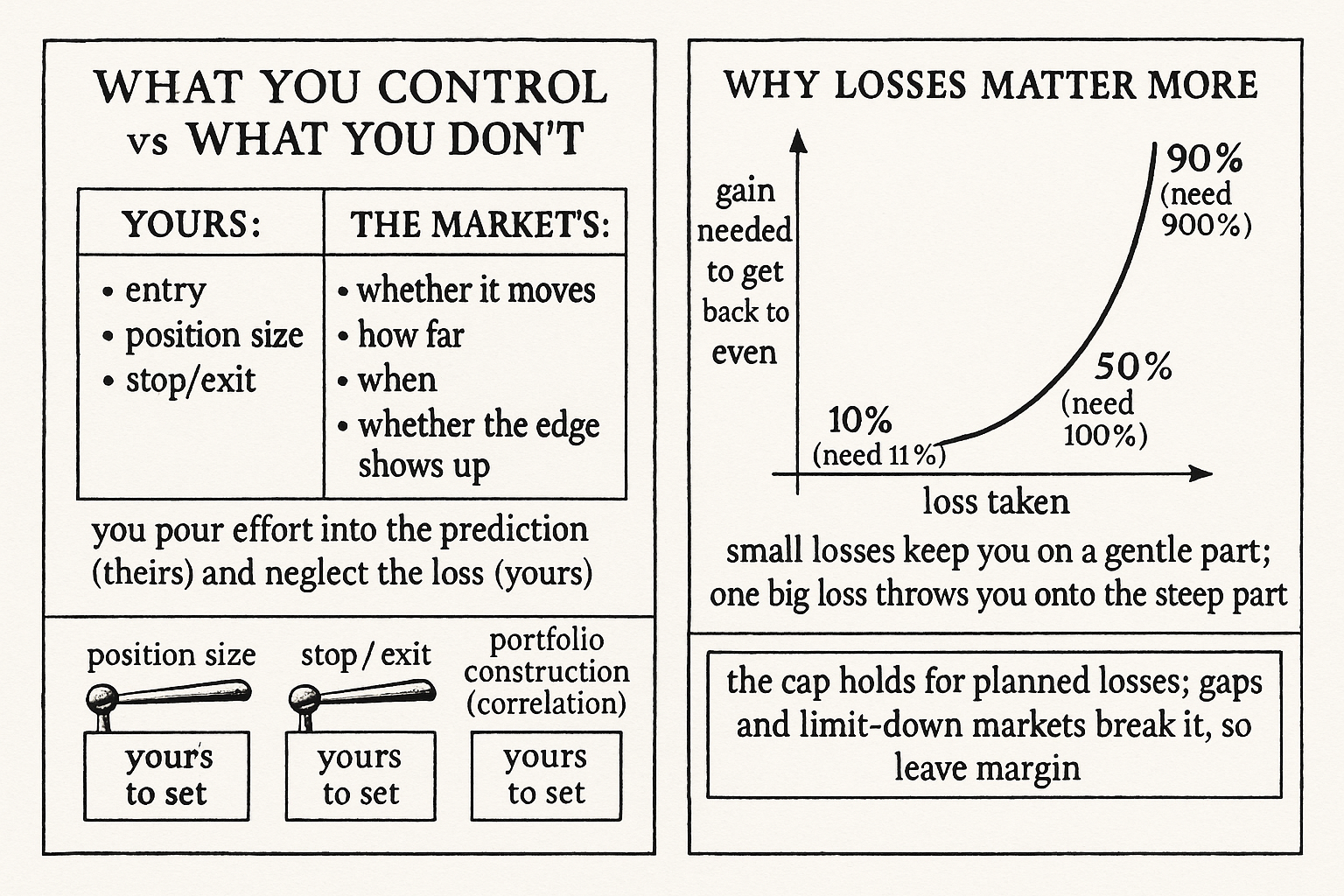
Loss control matters more than gain because recovery from a loss is harder than the loss itself. A drawdown of a given fraction requires a gain of one divided by one minus that fraction, minus one, just to get back to even. Lose 10% and you need 11% to recover, an almost-fair trade. Lose 50% and you need 100%, a doubling, to break even. Lose 90% and you need 900%. The curve steepens viciously as losses grow, so a large loss is not just twice as bad as a medium one, it is many times harder to undo. This asymmetry is the entire mathematical case for controlling losses tightly: keeping every loss small keeps you on the gentle part of the recovery curve, where getting back to even is plausible, and one uncontrolled loss throws you onto the steep part, where recovery requires returns you will never reliably produce.
Control it where you actually can
Loss control is implemented in the levers you set, not in hope. Position size is the first and largest, because it scales every loss directly; the volatility-based sizing from "Why Volatility-Adjusted Position Sizing Matters" is loss control, capping how much any single position can swing against you. The stop or exit is the second, bounding the loss on a position that moves against you before your thesis resolves. The portfolio construction from "Why Portfolio Construction Is Part of the Signal" is loss control at the book level, stopping correlated positions from turning into one giant concentrated loss. Each of these is something you decide and the market cannot touch, which is exactly why they are where your effort belongs.
The honest limit: loss control bounds the loss you planned for, not the loss the market can deliver. A gap through your stop, a limit-down market you cannot exit, a position that moves more between the close and the open than your stop ever contemplated, these break the cap, and they are the reason loss control is necessary but not sufficient. You set the size assuming a worst case, and the market occasionally serves a worse one, which is why the sizing leaves margin beyond the planned loss and why the tail articles in this pillar matter. Control what you can to the limit of your ability, and size for the days when even your controls slip, because the only thing more dangerous than no loss control is loss control you trust completely.
Visualizing loss control
KEY POINTS
- You do not control whether a trade wins or how far the market moves. The one thing fully in your hands is how much you lose when you are wrong, and that lever decides survival more than any signal.
- The entry gets all the attention and matters least, because once you are in, the outcome is the market's. The exit and the size are where your control lives, capping damage regardless of what the market does.
- A great forecast with no loss control blows up on the one trade that goes wrong before the edge plays out. A mediocre forecast with strict loss control survives and compounds. Survival is a prerequisite for everything.
- Recovery is asymmetric: a 10% loss needs an 11% gain, a 50% loss needs 100%, a 90% loss needs 900%. The curve steepens viciously, so a big loss is many times harder to undo than a medium one.
- Implement loss control in the levers you set: position size (scales every loss), stops and exits (bound a single position), and portfolio construction (stops correlated positions becoming one giant loss). Each is yours and the market cannot touch it.
- The cap holds for planned losses, not for gaps, limit-down markets, or overnight moves past your stop. Loss control is necessary but not sufficient, so size with margin beyond the planned loss and never trust the controls completely.
References
- Systematic Trading - Robert Carver (Amazon)
- Trading Systems - Urban Jaekle Emilio Tomasini (Amazon)
- Volatility Scaling in Multi-Asset Portfolios
- Strategic Hedge Fund of Fund Portfolio Construction
- Portfolio Construction Under Correlation Breakdowns and Tail Risk
- Regime-Aware Statistical Arbitrage: A Volatility Targeting Approach
- Risk Management Mastery: The Key to Successful Trading
- Behavioral Origins of Implied Volatility: Loss Aversion and Risk Preferences in Options Markets
- The Impact of Volatility Targeting
- Optimal Tax-Timing with Asymmetric Long-Term/Short-Term Capital