6.25 The Illusion of Control in Active Trading
Active trading pays you in the feeling of control, disconnected from whether the market moves your way. Near misses and fast feedback amplify it, so the most engaging styles are the least profitable.
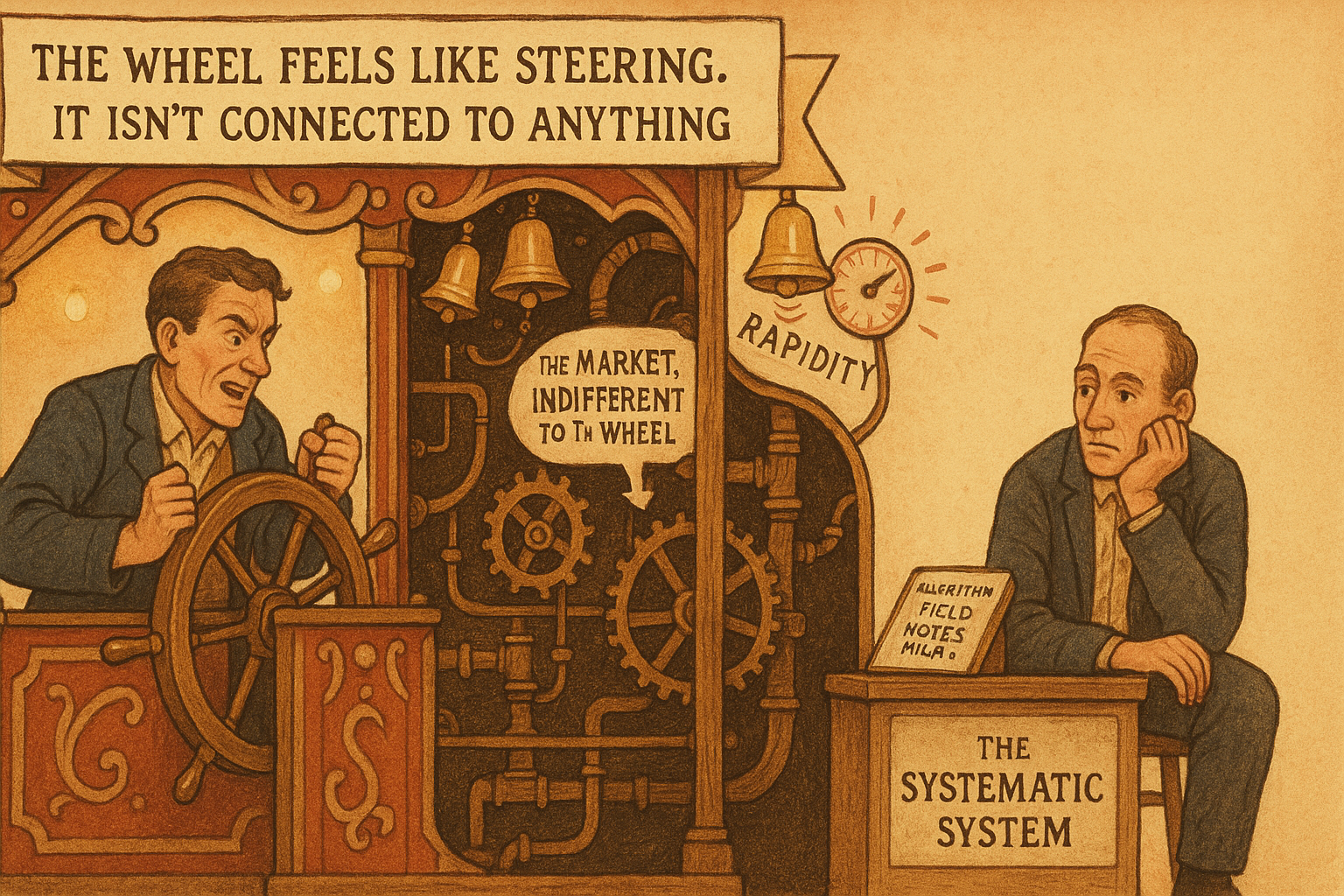
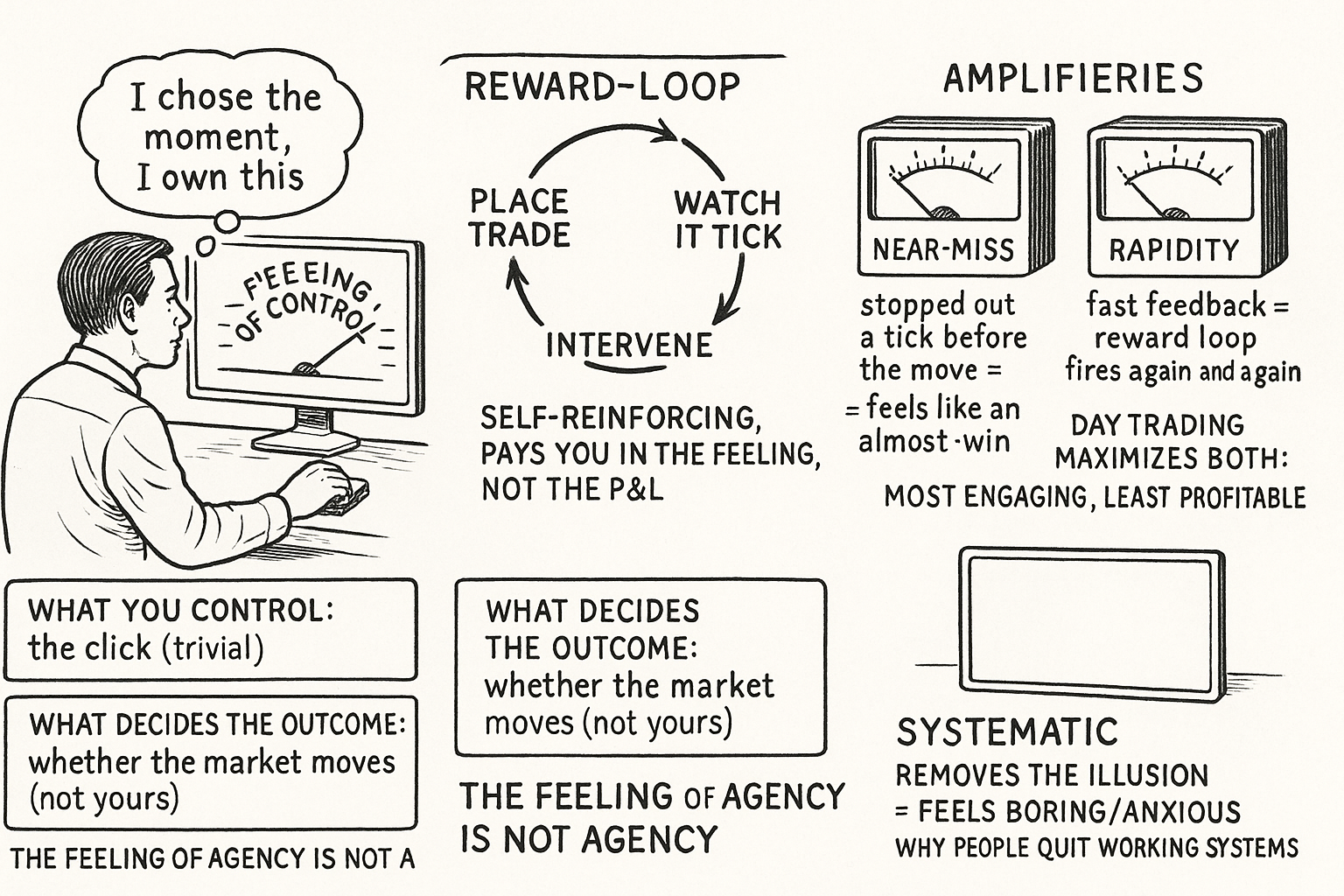
Active trading feels like control. You watch the screen, you decide the moment, you click the button, and the position is yours, chosen, timed, owned. That feeling is mostly an illusion, because the part you control, the click, is trivial, and the part that determines the outcome, whether the market moves your way, you do not control at all. The illusion is pleasant and expensive: it makes people trade more than they should, because trading scratches a psychological itch that has nothing to do with making money. "The Flawed Human Brain in Trading" listed this among the flaws; this is why it specifically sabotages active traders and why systematic trading feels so unsatisfying by comparison.
The feeling of agency is not the same as agency
Humans crave control, and the brain manufactures a sense of it from actions that change nothing about the odds. Roll dice harder for a high number, pick your own lottery numbers, press the elevator button twice, all give a feeling of influence over outcomes that are indifferent to your effort. Active trading is the same illusion with money attached. Choosing the exact entry, adjusting the position, timing the exit by feel, these acts deliver a vivid sense of agency, and that sense is largely disconnected from whether they improve your results. The market does not move because you chose your moment with conviction; it moves for reasons that have nothing to do with your sense of control.
The trap is that the feeling is rewarding on its own, independent of the P&L. Placing a trade, watching it tick, intervening to manage it, all engage the brain's reward system the way any sense of control does, so trading becomes self-reinforcing regardless of whether it makes money. The trader is being paid in the feeling of control, a currency the brain values, while losing the actual currency to costs and bad timing. He thinks he trades to profit; he partly trades because the activity itself feels good, and the feeling does not care about the result.
Near misses and speed pour fuel on it
Two features make the illusion especially potent in active trading, and both are strongest in fast, frequent trading. The near-miss factor: a trade that almost worked, stopped out by a tick before the move you predicted, feels like a near win, and near wins are more motivating than clear losses, the same mechanism that keeps gamblers feeding slot machines on outcomes that just missed. The rapidity factor: the faster the feedback, the more potent the engagement, because quick outcomes deliver the reward loop again and again in a short time. Day trading maximizes both, a stream of near misses arriving fast, which is why it is the most psychologically addictive and least systematically profitable way to trade. The structure that feels most engaging is the structure most engineered to exploit the illusion of control.
This connects the behavioral flaw to a concrete warning from "Near Misses and Revenge Trading": the trading styles that feel the most alive, that give the strongest sense of being in control, in the action, on top of every tick, are the styles where the illusion is doing the most work and the edge is doing the least. The engagement is the product being sold to you, and you are paying for it in costs and overtrading.
Systematic trading removes the illusion, which is why people hate it
The honest reason many people cannot stick to systematic trading is that it strips the illusion of control away, and they miss it. A rule-based system makes the decisions, executes on its own logic, and gives you nothing to do in the moment, no entry to time by feel, no position to nurse, no click that feels like agency. The feeling of control that active trading manufactured is simply absent, and its absence feels like boredom, helplessness, even anxiety, the sense that you should be doing something. That void is the subject of "Why Systematic Trading Feels Emotionally Unsatisfying", and it is the single biggest reason traders abandon working systems to go back to losing discretionary trading: not because the system failed, but because it deprived them of the feeling they were really trading for. Recognizing that the feeling of control was always an illusion is the first step to not needing it, and to letting the rule do the part you were never actually controlling anyway.
Visualizing the illusion
KEY POINTS
- Active trading feels like control, but the part you control (the click) is trivial and the part that decides the outcome (whether the market moves your way) you do not control at all.
- The brain manufactures a sense of control from actions that do not change the odds, like rolling dice harder or picking lottery numbers. Active trading is the same illusion with money attached.
- The feeling is rewarding on its own, independent of P&L. Trading engages the brain's reward system the way any sense of control does, so you get paid in the feeling of control while losing the actual currency to costs and bad timing.
- Two features amplify the illusion: the near-miss factor (an almost-win is more motivating than a clear loss) and the rapidity factor (faster feedback fires the reward loop more often). Day trading maximizes both.
- The styles that feel most alive and in-control are where the illusion does the most work and the edge does the least. The engagement is the product being sold to you.
- Systematic trading removes the illusion, leaving nothing to do in the moment, which feels like boredom or anxiety. That void, not system failure, is the biggest reason traders abandon working systems.
References
- Systematic Trading - Robert Carver (Amazon)
- Trading Systems - Urban Jaekle Emilio Tomasini (Amazon)
- Are Investors Reluctant to Realize Their Losses?
- Behavioral Finance - NBER
- Optimal Portfolio Strategy to Control Maximum Drawdown
- Trade Sizing Techniques for Drawdown and Tail Risk Control
- A PRIMER FOR INVESTMENT PROFESSIONALS
- Signature Decomposition Method Applying to Pair Trading - arXiv
- AlphaCrafter: A Full-Stack Multi-Agent Framework for Cross ... - arXiv
- Behavioral Finance: Theories and Evidence