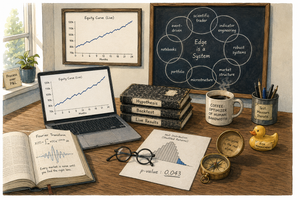
The Fourier transform demands an infinite, stationary, whole-cycle window that price never provides. The autocorrelation periodogram builds the spectrum from correlation instead, with less lag and no amplitude tilt.
Regress a stock on its index in logs, read the residual, then divide it by the fit's RMS error so a gap only counts when the prediction was trustworthy. A weighted divergence filter, not a trigger.
Long cycles are bigger, not just slower, so a raw spectrum reports them as dominant by default. Across several octaves you must compensate for this amplitude tilt or your cycle estimate lies.
A stock's link to its index is a regime, not a constant. Measure it with outlier-proof Spearman rank correlation, watch it break, and use the break to kill index signals or arm event trades.
Oscillators drift and whipsaw because raw price feeds them trend and noise at once. The roofing filter, a high-pass plus a SuperSmoother, strips both and passes only the tradeable cycle band first.
A threshold optimizer always loves the tightest setting, because a few lucky bars beat thousands of honest ones in-sample. Floor the trade frequency, then permute the returns to prove the edge isn't the search.
Markets have a color: the slope of their log power spectrum. White means no memory, brownian means random walk, pink means long memory. One number tells you whether price remembers its past.
Hold a position while an indicator stays above a threshold and there is no natural "trade." Group bars into holds and profit factor can hit infinity. Count bars with log returns and it stays honest.
Run price through a band-pass, count bars between zero crossings, double it: that's the dominant cycle, at a few bars' lag. But widen the passband, or a narrow filter measures its own tuned period.
Volume Momentum ignores price and asks one thing: is the tape hotter than its own baseline. Short volume over long volume, logged and CDF-squashed into a bounded regime gauge that tells you if your signals have fuel.
Q is the band-pass narrowness dial: center frequency over half-power bandwidth (30% gives Q~3.33). High Q isolates a pure cycle but rings and lags; low Q is fast but blurry. Pick Q from the job.
The volume-weighted MA ratio asks where the crowd transacted, not which way it pushed: VWMA over SMA, above one when expensive bars carried the volume. Log it, scale by root-lookback, compress, and it's model-ready.