9.31 Prediction Markets Live on Boundaries
Prediction-market prices cluster near 0 and 1, and that is exactly where the log-scoring arbitrage math breaks. Worse, it can fail silently: no crash, just a wrong trade with a confident profit number.
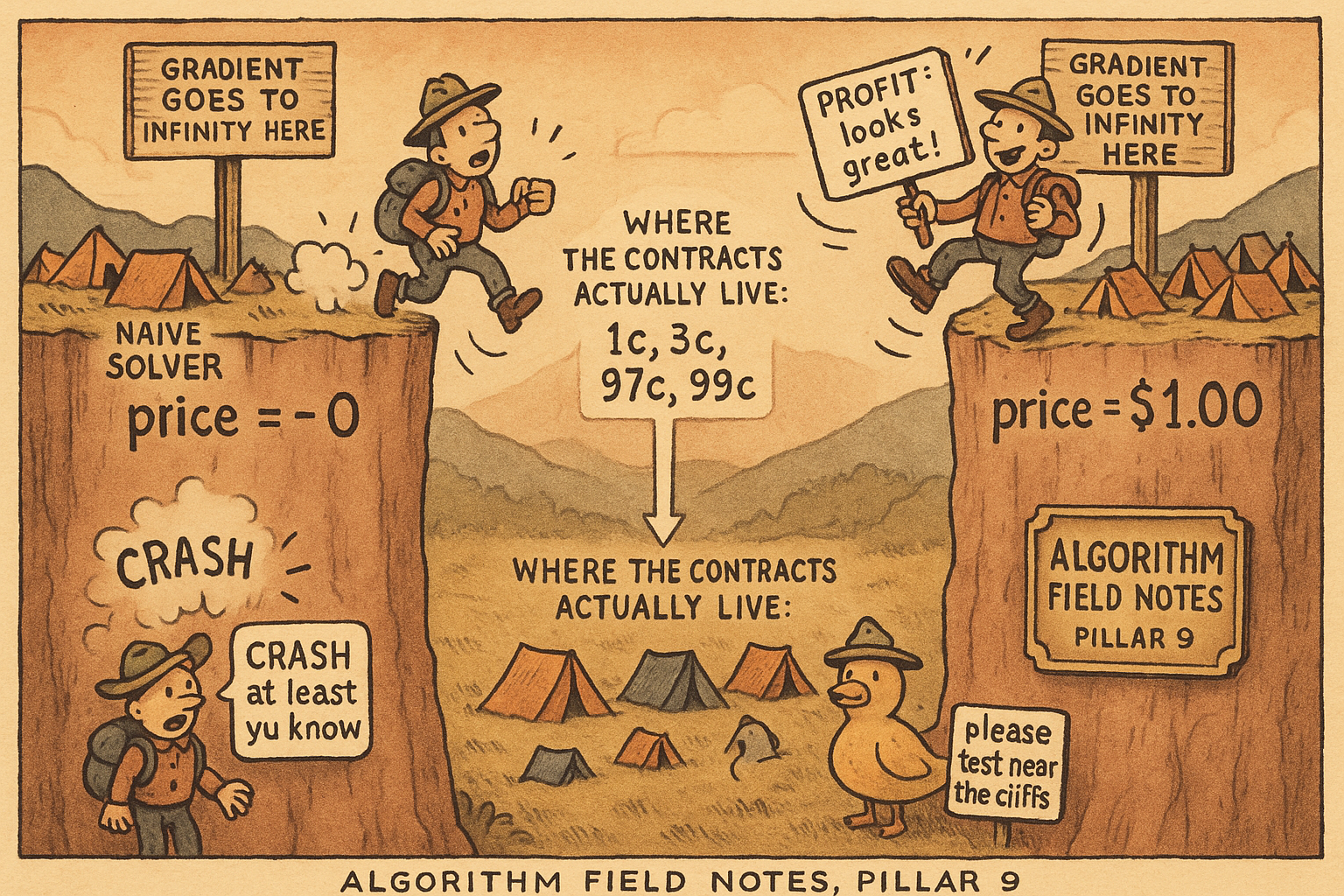
Open a prediction-market venue and scroll the board. Most contracts are not sitting at fifty cents having an honest fight. They cluster at the edges: 3 cents, 96 cents, 1 cent, 99 cents. Will the incumbent win a safe seat, will a scheduled event happen on schedule, will a range hold. The interesting mid-book races are the minority. Prices spend their lives pressed against zero and one, because most questions about the world are close to settled most of the time. That empirical fact is the reason the elegant arbitrage math from the article "Arbitrage Is Just Projection" can hand you a wrong trade and never tell you it did.
This is the numerical-analysis half of the story, narrowed to one point. The full fix, the contraction schedule, and the complete solver pipeline live in the article "Why Your Arbitrage Solver Crashes at 99 Cents: Barrier Frank-Wolfe." Here the question is smaller and nastier: why does the theory break exactly where the prices actually are, and why does it break without a warning.
The price scale lies about distance
A move from 50 cents to 60 cents and a move from 1 cent to 11 cents are both a dime. On the price ruler they look identical. In information terms they are nothing alike, and the market maker prices in information terms, not cents.
The natural scale is log-odds, the log of the probability over one minus the probability. Watch what a fixed price step does to it near the middle versus near the wall.