4.21 Why FX Traders Must Watch Gold, Rates, and Equities
A currency price is a relative number; the force that moves it lives off the chart. Watch rates, equities, and gold, take the trade only when a majority confirm, and respect the dollar smile.
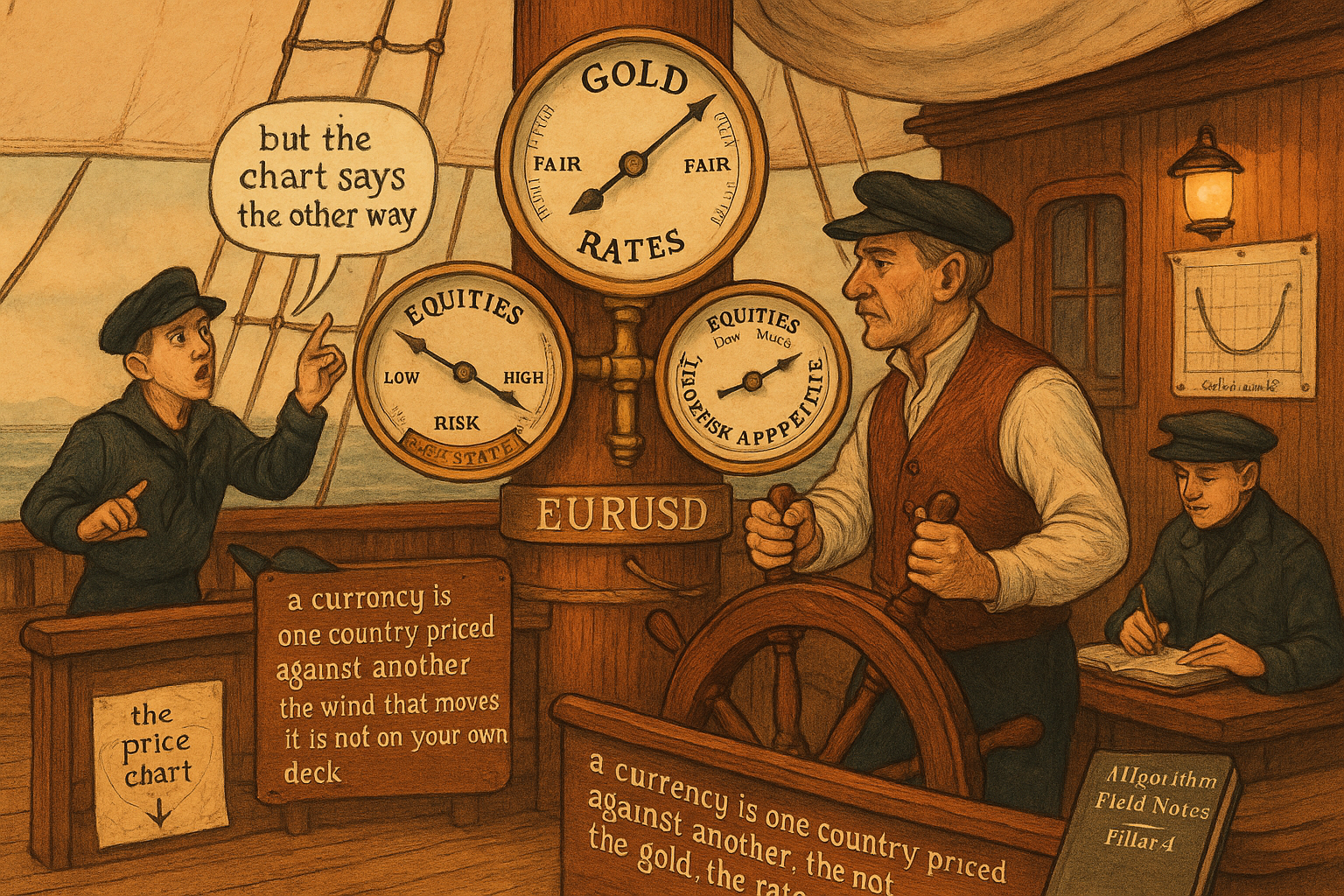
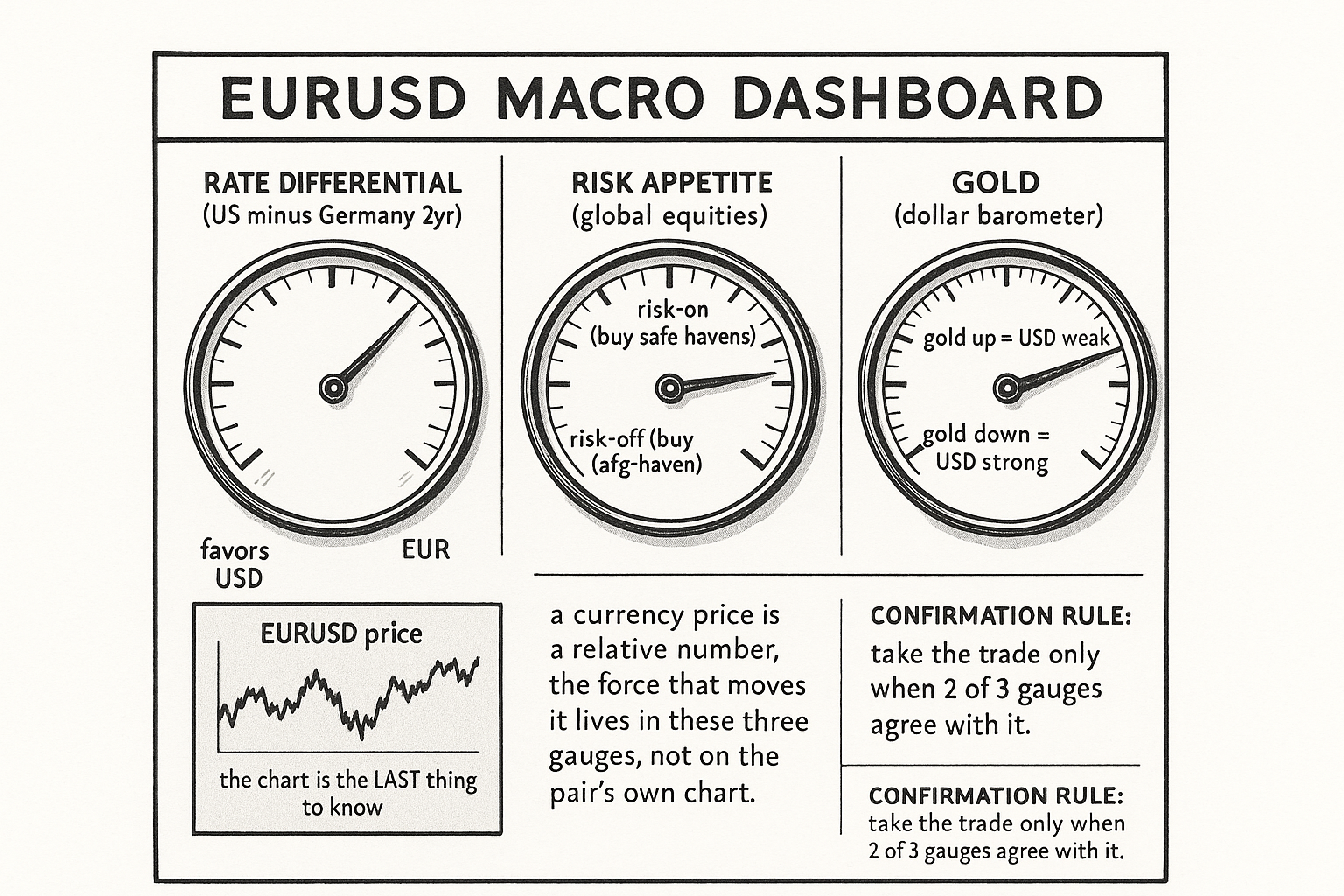
A trader is short EURUSD on a clean chart signal: lower highs, price under the 50-day average, a tidy downtrend. The position bleeds for a week. Pull up three charts the trader never looked at and the reason is obvious. The US-Germany two-year rate differential narrowed (the rate edge moved against the dollar), gold rallied hard (a dollar-weakness tell), and global equities ripped higher (risk-on, which sells the funding currencies the dollar now sits among). Three external markets were screaming "dollar down, EURUSD up" while the EURUSD chart still looked short. The chart was the last thing to know.
FX is the asset class where single-chart trading fails worst, because a currency price is a relative number with no standalone fundamentals. A stock has earnings; a bond has a coupon; a currency pair is one economy priced against another, and the thing that moves it lives outside the pair. Three external markets carry most of that information: rates, equities, and gold. Rates are the relative-return engine, equities are the risk-appetite gauge, and gold is the inflation-and-dollar barometer. An FX system that ignores all three is trading the shadow and not the object.
This article makes the case for the three drivers, shows the per-currency driver map, and turns the drivers into a confirmation filter. It applies the gold-dollar-rates triangle from "Gold, Dollar, and Rates: A Practical Intermarket Map" to the currency a trader actually holds, and it sets up the mechanical version in "Cross-Asset Confirmation for Trend Systems" and the gold-specific case in "Using Gold as an FX Indicator".
Driver one: rates, the most consistent mover
The single most reliable driver of a currency is its relative interest rate, and currencies react violently to unexpected central-bank shifts. Money flows toward the higher risk-adjusted yield, so a pair tends to follow the rate differential between its two legs: when the base currency's rates rise relative to the quote currency's, the pair appreciates. The level matters less than the change and the surprise; the market has already discounted the expected path, so the move comes from the revision.
$$ \Delta\text{Pair}_t \;\approx\; \beta \,\Delta\!\left(r_{\text{base}} - r_{\text{quote}}\right)_t \;+\; \gamma \,\Delta\text{RiskAppetite}_t \;+\; \delta \,\Delta\text{Gold}_t $$
The change in the pair over a period is approximated by three terms: the change in the rate differential between the base and quote currencies (driver one), the change in global risk appetite proxied by equities (driver two), and the change in gold (driver three), each scaled by a sensitivity. This is a schematic, not an estimated model; the coefficients drift and the relevant terms rotate over time. The value of writing it down is that it names the three things to watch and says the pair moves on their changes, not their levels.
Carry sits on top of the rate term. High-yield currencies structurally appreciate as the market piles into them to earn the differential, and that appreciation unwinds far faster than it built, the "up the escalator, down the elevator" pattern of carry. Low-yield currencies (the euro, the franc, the yen in recent cycles) become funding currencies and behave as safe havens, strengthening when carry trades unwind. A rate differential tells you the direction of the escalator; it does not tell you when the elevator drops, which is why the rate driver needs the risk-appetite driver beside it.
Driver two: equities, the risk-appetite gauge
Equities are the cleanest read on global risk appetite, and risk appetite drives FX regardless of domestic fundamentals. When equities rally, capital chases the high-beta and commodity currencies; when equities fall, capital flees to the safe havens. The pairings are well documented: the S&P 500 moves with AUDUSD, the Nikkei moves with USDJPY. A trader long a commodity currency is implicitly long global equities, whether or not the currency chart says so.
The regime warning is sharp here. In the 2008 crisis the correlation between FX and other asset classes jumped toward 1: everything risky sold together and everything safe was bought together, and the individual currency stories stopped mattering. Correlation feeds on itself in stress, rising until a regime shift snaps it. A risk-appetite filter built in calm markets behaves differently in a panic, when it becomes the only thing that matters, the acceptance the article "Why Systems Work Until They Don't" built into every relationship in this pillar.
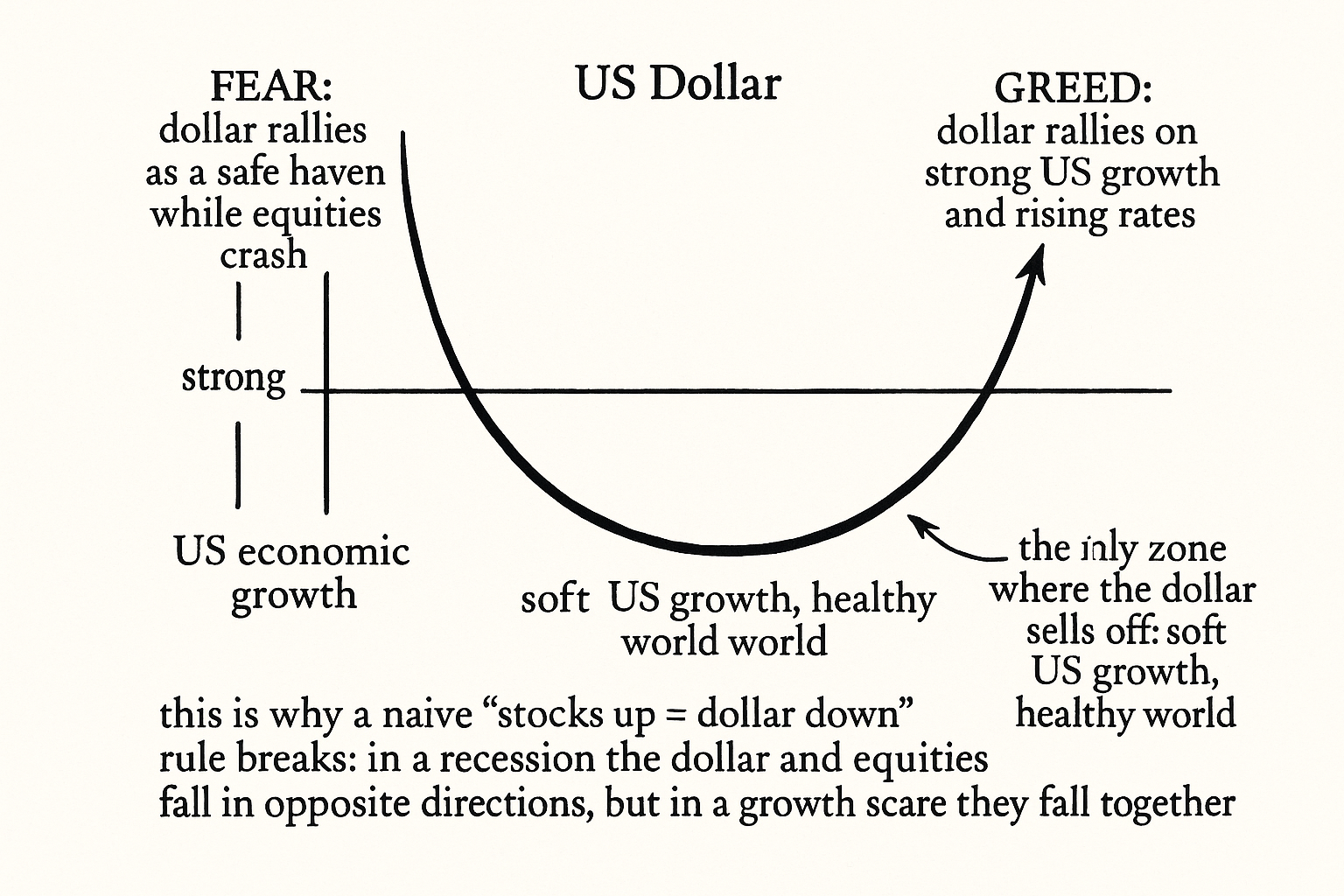
The dollar complicates the equity link, because the dollar does not behave like a simple risk asset. The dollar tends to rally when US growth is strong and again when the global economy is in recession, and to sell off only in the soft middle where US growth is moderate and global growth is fine. That U-shape, the "dollar smile", means the sign of the dollar-equity correlation depends on which side of the smile you are on: in a growth scare the dollar and equities fall together, but in a genuine global recession the dollar rallies as equities crash. A naive "stocks up, dollar down" rule gets the recession case backward.
Driver three: gold, the inflation-and-dollar barometer
Gold appears in almost every major currency's driver list, because it reads two things at once: the inflation-and-real-yield backdrop and the dollar itself. Gold trades inverse to the dollar, so gold strength is a direct dollar-weakness signal that shows up across every USD pair simultaneously. Gold also anticipates inflation, which feeds back into the rate driver through what it implies for central-bank policy. The gold-dollar-rates triangle is the reason this one instrument informs the whole currency complex, worked in full in "Gold, Dollar, and Rates: A Practical Intermarket Map".
For a currency trader the practical use is as a cross-check on the dollar leg of any pair. A long-dollar trade taken while gold is breaking higher is fighting a market that disagrees, the same divergence logic from "Intermarket Divergence as a Trading Filter" applied to the dollar. Gold tracks real yields rather than nominal ones, so the caveat from the triangle article carries over: in an inflation spike, nominal yields can rise while gold rallies, and a trader reading the nominal rate alone will be confused by gold's refusal to fall.
The per-currency driver map
Each currency has its own driver set, and watching the wrong external market for a given pair adds noise instead of signal. The map below is the working version, with gold and rates appearing almost everywhere and equities or commodities filling the third slot.
| Pair | Rate driver | Equity / risk driver | Gold / commodity driver |
|---|---|---|---|
| EURUSD | US-Germany 2-year differential | European bank stocks, Italy yields | gold, crude |
| USDJPY | US 2-10 year yields | Nikkei, S&P 500 | gold |
| AUDUSD | Australia-US differential | S&P 500 (risk appetite) | gold, copper, iron ore |
| USDCAD | US-Canada differential | Canadian oil equities | crude, gold |
| GBPUSD | UK-US differential | global risk appetite | crude |
The commodity currencies extend the gold idea to their own inputs: the Australian dollar tracks gold, copper, and iron ore; the Canadian dollar tracks crude, the link worked in "Crude Oil, Inflation, and FX". The principle from "Why One Indicator Should Not Be Used on Every Market" applies directly: there is no universal FX driver, only the right external market for the specific pair.
Turning three drivers into a filter
The operational payoff is a confirmation count. For a given FX signal, check whether the rate differential, the equity/risk proxy, and gold each agree with the position, and take only the trades where a majority confirm. A short-dollar trade confirmed by a narrowing rate differential, rising equities, and rising gold is backed by three independent readings; the same trade with all three disagreeing is the chart fighting the macro, and the chart usually loses that fight.
The confirmation count works for the same reason the bond filter worked in "Using Bonds to Filter Equity Signals": it splits the signals into a cleaner subset (drivers agree) and a dirtier subset (drivers disagree), and trading only the cleaner subset lifts the per-trade quality at the cost of fewer trades. The honest limit is the same too. The drivers are correlated with each other, so three agreeing readings are not three independent votes, and the relevant driver rotates over time, so a fixed confirmation rule needs the rolling re-estimation that "Why Cross-Asset Signals Beat Isolated Chart Reading" insisted on. Counting which driver leads right now is the harder, more valuable problem, and it is the subject of "Lead-Lag Relationships in Global Markets".
Visualizing the three-driver dashboard
Visualizing the dollar smile
KEY POINTS
- A currency price is a relative number with no standalone fundamentals, so the force that moves it lives outside the pair. Single-chart trading fails worst in FX.
- Three external markets carry most of the information: rates (the relative-return engine), equities (the risk-appetite gauge), and gold (the inflation-and-dollar barometer).
- Rates are the most consistent driver. Pairs follow the change and the surprise in the rate differential, not its level. Carry rides on top: high-yield currencies climb the escalator and drop down the elevator, while low-yield funding currencies act as safe havens.
- Equities read global risk appetite, which moves FX regardless of domestic fundamentals. The S&P 500 tracks AUDUSD, the Nikkei tracks USDJPY. In 2008 the FX-asset correlation jumped toward 1 and individual stories stopped mattering.
- The dollar smile breaks the naive equity link: the dollar rallies on strong US growth and again in a global recession (safe haven), selling off only in the soft middle. The sign of the dollar-equity correlation depends on which side of the smile you are on.
- Gold reads the inflation-and-real-yield backdrop and the dollar at once, and it appears in nearly every currency's driver list. Gold strength is a dollar-weakness signal across all USD pairs simultaneously.
- Each pair has its own driver set: EURUSD on the US-Germany differential and crude, AUDUSD on gold, copper, and iron ore, USDCAD on crude. There is no universal FX driver, only the right external market for the pair.
- The filter is a confirmation count: take the trade only when a majority of rate, equity, and gold readings agree. It splits signals into a cleaner subset and a dirtier one, lifting per-trade quality for fewer trades.
- The limits: the three drivers are correlated, so agreement is not three independent votes; the relevant driver rotates, so the rule needs rolling re-estimation; and the correlations spike in crisis then break at regime shifts.
A note on AI. The ideas, research, analysis, and conclusions in this article are my own. I use AI tools to help with editing and wordsmithing, because English is not my first language, and I am not shy about that. AI-generated ideas and AI-assisted writing are not the same thing: the first is empty slop from a generic prompt, the second is a tool for communicating years of real research more clearly. Judge the work by its substance, not by whether software helped polish the prose.