5.63 The Market Maker's Implied Volatility: Infer Risk From Quotes, Not Options
Maker-implied volatility inverts a market maker's quoted size into the short-horizon risk she is charging. Make when it exceeds realized vol; take or stand down when it is cheaper.
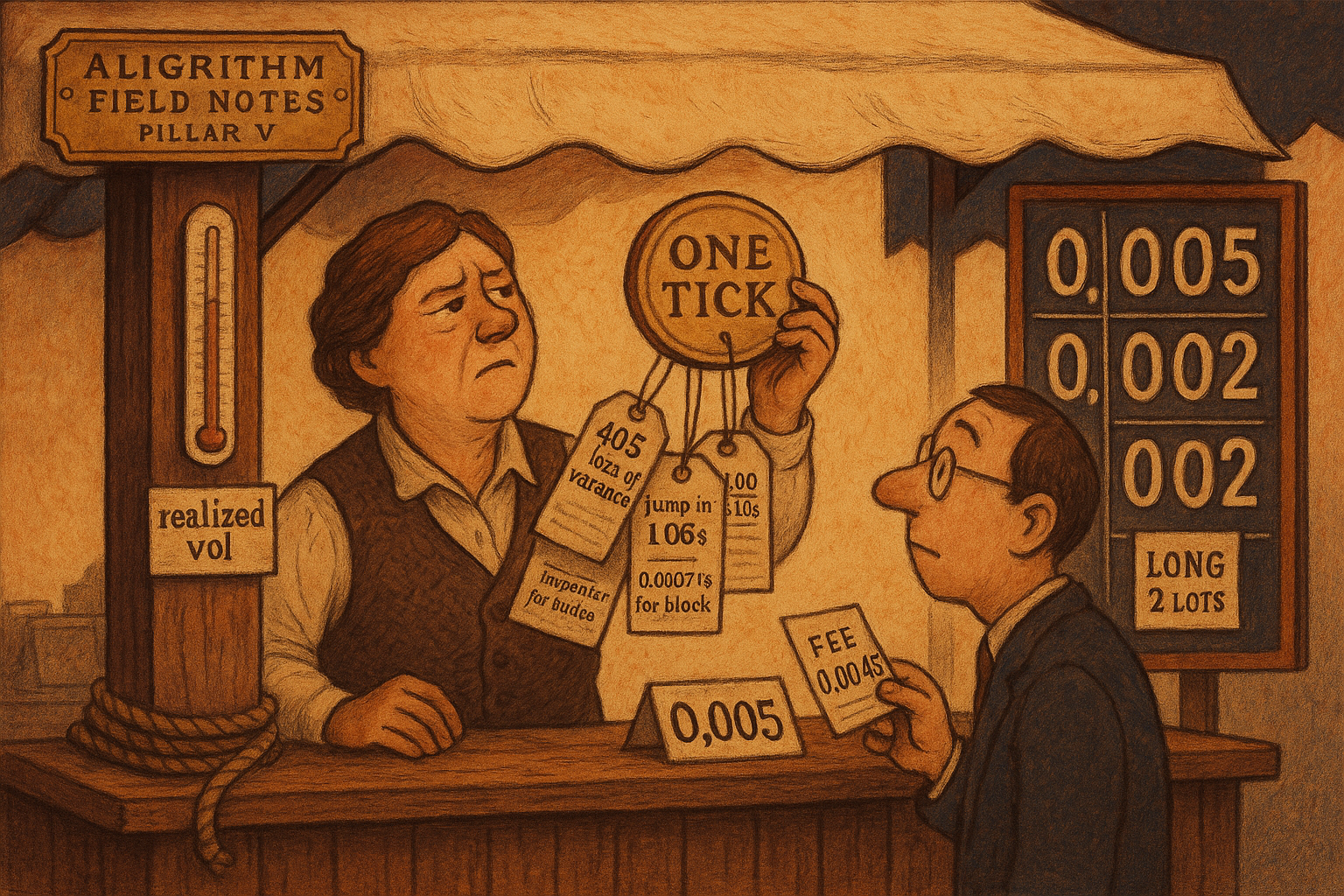
The BTC perpetual on Hyperliquid is a large-tick book: the spread sits on one tick, and the number that moves is the size resting on each side. Pulido, Rosenbaum and Sfendourakis give one market maker an efficient price with volatility σ and let her choose only that size. The tick that maximizes the volume she will trade in their exchange problem is 0.0032 when σ is 0.005, and 0.015 when σ is 0.015. Quoted size is a volatility. You back it out, you compare it with the volatility your fair value has been realizing, and you make when the quote is the richer of the two.
The last lot prices the volatility
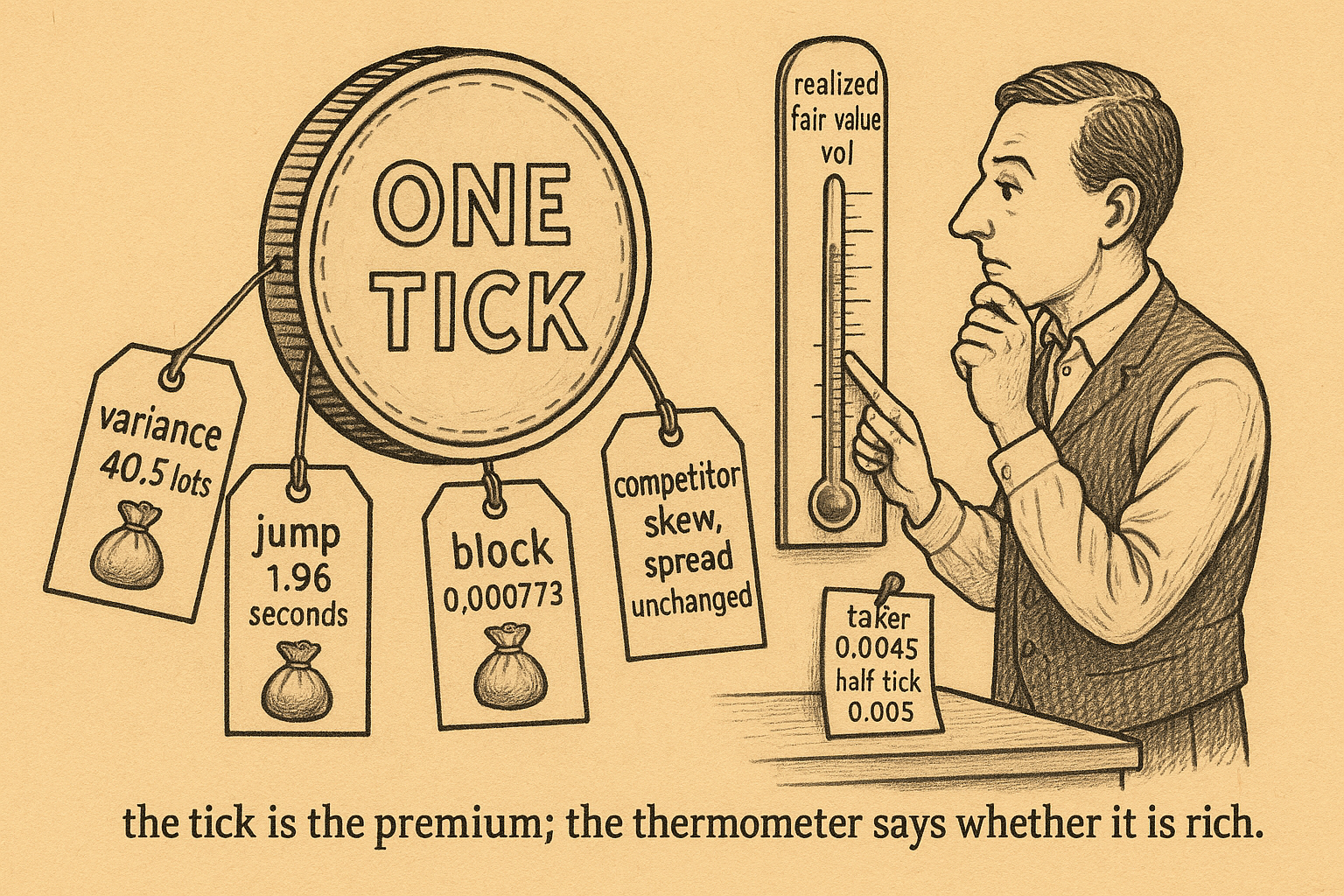
The indifferent posted size, at their middle volatility and a 10-second hold, is 40.5 lots.
Pulido, Rosenbaum and Sfendourakis work in price units, not percents. The efficient price follows dS = σ dW, with σ in price per square root of time. The tick is δ. On a large-tick name she posts at half a tick from the mid, so a fill on the ask pays δ/2 minus Y, where Y is the efficient price minus the mid. Equation (2) of their paper multiplies her utility by σ squared, times γ squared, times inventory squared, over 2, per unit time. γ is the risk aversion in her exponential utility, per unit of P&L. The utility is a negative exponential of γ times money, so you divide that multiplier by γ and you have a cash drain in price units per unit time. They do not write the cash form. It is the reading of equation (2) that has the same units as the tick.
$$ \frac{\gamma}{2}\,\sigma^{2}\,(2q-1)\,\tau \;=\; \frac{\delta}{2} - Y $$
The left side is the certainty-equivalent cost of the last lot in a quote of size q, posted from a flat inventory and held for a time τ. Going from q−1 lots short to q lots short raises the variance charge by the factor (2q−1). The right side is the cash the ask fill pays. She posts that lot when the two sides match. Solve it and the volatility in the quote is
$$ \sigma^{2} \;=\; \frac{\delta - 2Y}{\gamma\,(2q-1)\,\tau} $$
Their section 5.2 uses γ = 0.5, δ = 0.01, and an intensity of B = 0.1 at Y = 0, on a clock whose horizon is T = 3600. With that horizon plotted in seconds, B is a mean wait of 10 seconds for one market order on a side, and the inversion sets τ to that wait. The source does not set τ equal to 1/B. A fixed hold is the assumption you are adding.
At σ = 0.005 and inventory of one lot, the utility multiplier is (0.000025 × 0.25) / 2 = 0.000003125 per second. Divide by γ = 0.5 and the cash drain is 0.00000625 per second. Over 10 seconds the first lot costs 0.0000625, which is 1.25% of the half-tick 0.005. The lot that uses up the whole half-tick is the one with (2q−1) × 0.0000625 = 0.005. That factor is 80, so 2q − 1 = 80 and q = 40.5. Plug q = 40.5 and Y = 0 back into the solved form and you recover σ = 0.005. Same inputs, same outputs.
Y does not have to be zero, and leaving it out is how you invent volatility. At Y = 0.002 the ask pays 0.005 − 0.002 = 0.003. Then 0.003 / 0.0000625 = 48, so 2q−1 = 48 and q = 24.5. The volatility did not change. The fill got worse. If you invert that 24.5 as though Y were zero, σ squared = 0.01 / (0.5 × 48 × 10) = 0.00004167, and σ = 0.00645. That print sits 29% above the volatility she is using, because a gap of two-tenths of a tick was sitting in the size.
The dashed line is σ = 0.005. It meets the half-tick at 40.5 lots.
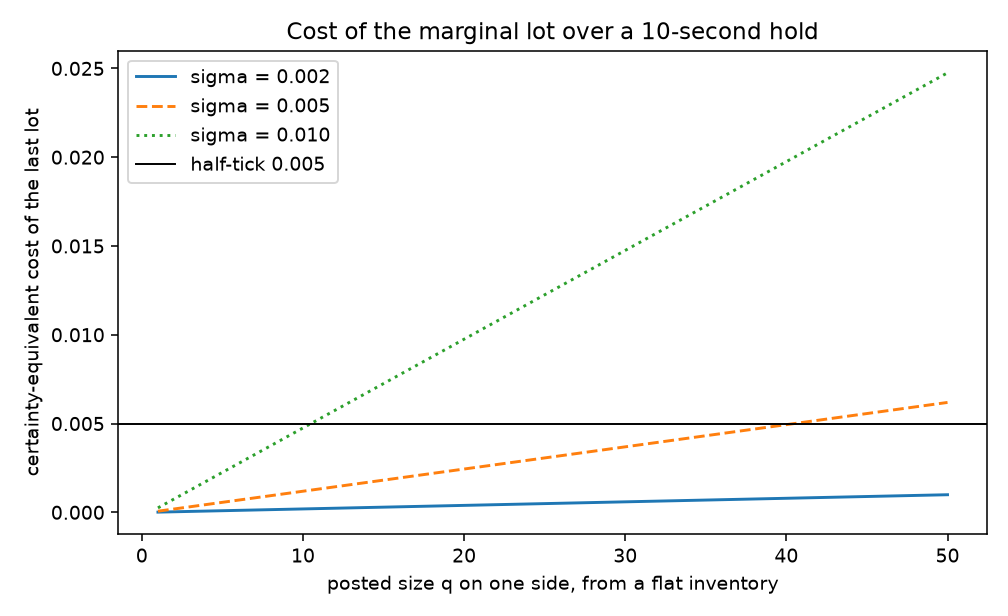
The dotted line is σ = 0.010, four times the variance, and it meets the half-tick at 10.5 lots. The solid line is σ = 0.002. At 50 lots it is still near 0.001, under the half-tick, so inside her inventory limit she posts the cap on both sides.
From a flat book her own constraint is that cap. Admissible size cannot exceed the inventory bound, which they set at 50. A quote of 50, read at Y = 0 with this 10-second hold, solves at σ = 0.00449. Any volatility below that also posts 50, because the cap is already binding. A print sitting on the cap is an upper bound on σ.
Their Figure 6 is the numerical solution of equation (2), with the same γ, the same three volatilities, and a random wait. The 40.5-lot cutoff is the fixed 10-second reading of that equation. Use 40.5 as the desk approximation. Expect the PDE quote to come out smaller once the offsetting fill is uncertain and Y moves. The direction is what that figure confirms: posted size falls as σ goes from 0.002 to 0.005 to 0.010.
The barrier clock is the jump
At σ = 0.005 the efficient price reaches the barrier in 1.96 seconds. At σ = 0.015 it reaches the barrier in 0.22 seconds.
The old article "The Worst-Kept Secret: Imbalance Is the MM's Optimal Response, Not Alpha" already shows that a tilted book is her inventory and her read of Y. The exit time is the piece you still have to compute. The mid sits still until the efficient price travels δ times (η + 1/2). With their δ = 0.01 and η = 0.2, that distance is 0.007. η is the uncertainty-zone parameter, and they estimate it as the number of price continuations divided by twice the number of alternations. The mean time for a Brownian motion to leave an interval of half-width 0.007 is the square of that half-width over σ squared. They do not print the exit time.
$$ \mathbb{E}[\tau_{\mathrm{hit}}] \;=\; \frac{\big(\delta\,(\eta+\tfrac{1}{2})\big)^{2}}{\sigma^{2}} $$
At σ = 0.005 the mean wait is 0.007 squared over 0.000025, which is 1.96 seconds. At σ = 0.015 it is 0.22 seconds. Hyperliquid builds a block every 100 to 200 milliseconds, so 1.96 seconds is 10 to 20 blocks and 0.22 seconds is one or two. The probability of hitting either barrier inside a single 0.15 second block is 0.00060 at σ = 0.005, about six blocks in ten thousand, and 0.46 at σ = 0.015. That probability is the exit calculation for their Brownian motion. The source does not print it.
One inconsistency in the source, kept as printed. The prose says the mid jumps by half a tick, δ/2, which would restart Y at 0.002 after an upper-barrier hit. Equation (3) restarts the value function at y+, defined as δ times (η − 1/2), which is −0.003, a full tick δ below the upper barrier. A half-tick jump does not land on y+. The source may have the jump size wrong in the prose, or the restart wrong in the boundary condition. The barrier distance 0.007 is the same in both readings, so the 1.96 seconds does not depend on which line you believe. The size of the move in the mid does. The old article "The Worst-Kept Secret: Imbalance Is the MM's Optimal Response, Not Alpha" followed the prose and called the jump half a tick. Compare maker-implied σ to the realized volatility of your fair value, the object in the old article "Why Fair Value Is the Core of Market Making", and the sticky mid will look quieter than the efficient price whichever jump size is the right one.
Competitor inventory leaves the spread where it was
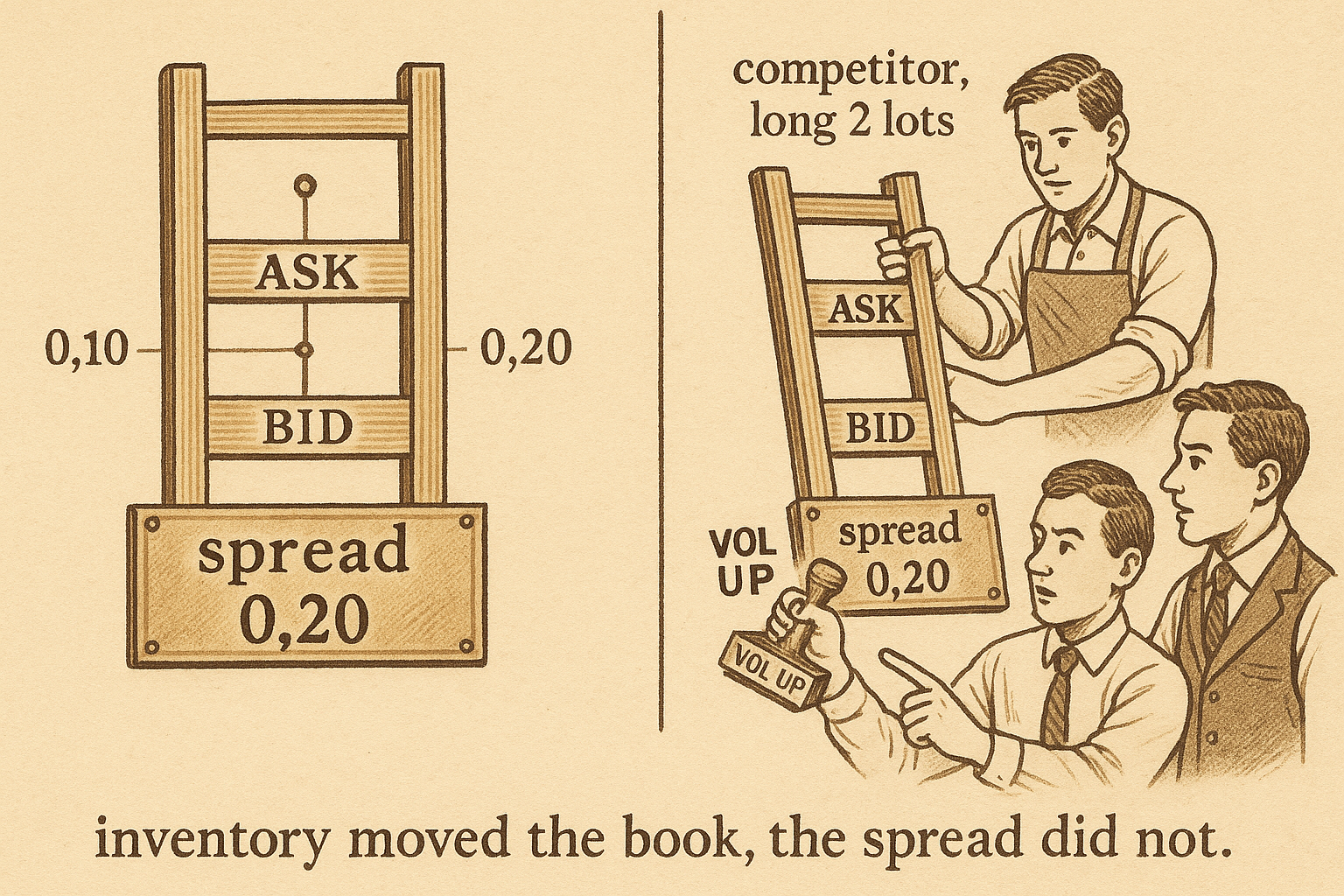
Two lots of competitor inventory move the ask by 0.10 and the bid by 0.10, and the spread stays 0.20.
Boyce, Herdegen and Sánchez-Betancourt give the competitor a linear rule. Ask depth is a base level ā minus β times his inventory, minus a noise term. Bid depth is b̄ plus β times his inventory, plus the same noise. β is the inventory slope in price per lot. In their numbers ā = b̄ = 0.1 and β = 0.05, so a flat competitor posts a spread of 0.20 on a price of 100. The old article "Market Making With Competitors You Can't See" derives the reference maker's closed form. The piece you invert from is their equation (3.6). Competitor inventory enters her ask with a minus and her bid with a plus.
$$ \Delta \delta^{a} \;=\; -\beta\,\Delta \tilde{Q}, \qquad \Delta \delta^{b} \;=\; +\beta\,\Delta \tilde{Q}, \qquad \Delta(\delta^{a}+\delta^{b}) \;=\; 0 $$
Take the competitor from flat to two lots long. His ask goes from 0.10 to 0.00. His bid goes from 0.10 to 0.20. The spread is 0.20 before and 0.20 after. The same cancelation is in her unconstrained quote: the β terms drop out of the sum, and so does the noise. What survives in the spread is β itself, the fill-rate slope κ, and a log ratio of her own value function at three adjacent inventories. κ is the exponential decay of her fill probability as she falls behind his price. Their matrix for that value function contains the inventory penalty and the arrival rates. It does not contain σ. They set the efficient-price volatility to 1 and then wrote a depth formula with no volatility in it. The linear mark-to-market, cash plus inventory times the price, has a second derivative of zero with respect to the price, so the σ squared term in the Hamilton-Jacobi-Bellman equation drops out before they solve it. The skew in equation (3.6) is competitor inventory scaled by β. Volatility is absent from that equation.
The mark does move. Her terminal inventory is valued on his mid, which falls by β times his inventory. Two lots cost her 0.10 in price units if she is long one. Their session volatility is 1 price unit over the whole horizon, so that mark is a tenth of a one-standard-deviation move, produced by two lots of someone else's position. Fold it into a realized-variance sum and you will call it σ. The old article "The Three Pillars of Market Making: Fair Price, Spread, Skew" splits the quote into fair price, spread, and skew for this reason. The spread, or the total size on a large-tick book, is the volatility object. The difference between the two sides is inventory, yours or his.
She steps inside him on 13 of 10,000 simulated paths, 0.13%. Most of the inside quote you invert is his rule of thumb, not her optimizer. On Hyperliquid the trade record carries both wallets and both pre-trade positions. Albers, Cucuringu, Howison and Shestopaloff print one BTC fill at 67189 where one side starts the trade short 56.15982. A bid-heavy book in front of a short like that is the skew term above. Subtract it, using his own past quotes regressed on his past position to get β, before you solve the size for σ.
A block you cannot cancel is part of the same premium
Over a 0.15 second block at σ = 0.005, the expected adverse move is 0.000773.
Hyperliquid processes passive orders first inside a block, cancellations second, and taker orders last. That protects a maker against someone who arrived in the same block. The next block is unprotected. The proposer is chosen unpredictably, and two messages sent together can land blocks apart. The old article "Adverse Selection Explained for Traders" is this lag, priced. Model the unprotected interval as a length t of their Brownian motion, and the expected move against a resting quote is the positive part of a normal increment.
$$ \mathbb{E}[(\Delta S)_{+}] \;=\; \sigma \sqrt{\frac{t}{2\pi}} $$
With t = 0.15 and σ = 0.005, the square root of t over 2π is 0.1545, and the expected adverse move is 0.0007725. That is 0.155 of the half-tick 0.005. They do not print this expectation. It is their efficient-price volatility evaluated on Albers, Cucuringu, Howison and Shestopaloff's block interval. Subtract it from the half-tick before you solve for size. The cash left for inventory risk is 0.005 − 0.0007725 = 0.0042275. Divide by the 0.0000625 first-lot cost and the factor (2q−1) falls from 80 to 67.64, so the indifferent size falls from 40.5 lots to 34.3. The cancel you cannot send inside the block removes about six lots from the quote you would have shown on variance alone.
About 89% of the order-status records in their public sample are rejects, including cancels that did not land. The losers of the latency race are in the file. A wallet with a high rate of failed cancels is quoting a σ that assumes a block shorter than the one it is getting. Treat that wallet's size as a low-volatility quote only after you have widened t to the blocks its cancels miss.
The preferred tick tracks σ, until the last point
Look at the point at σ = 0.015. The preferred tick equals the volatility, after the step from 0.005 to 0.010 had kept the tick at 0.64 of σ.
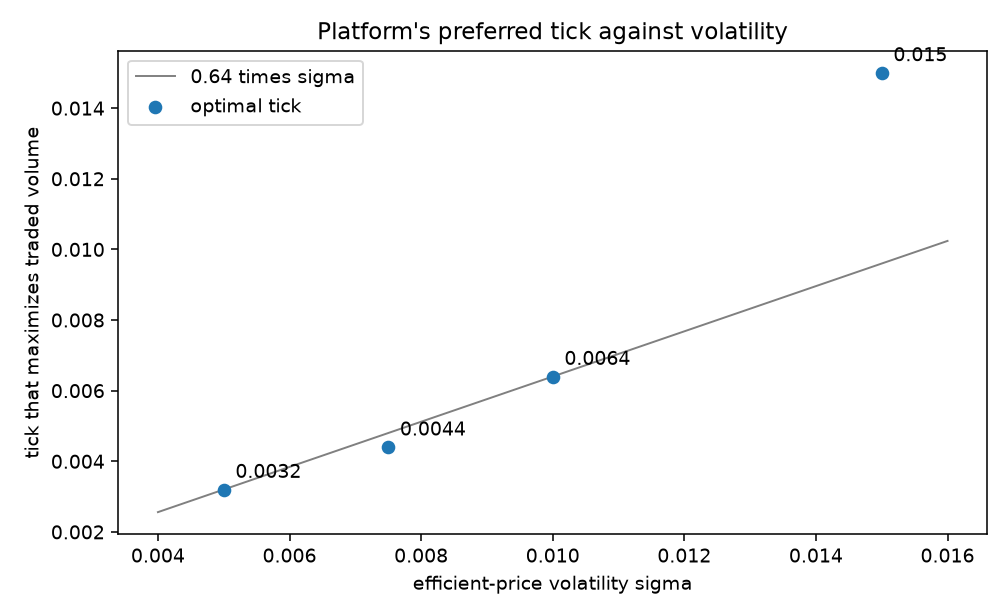
The three ticks on that curve are 0.0032, 0.0064, and 0.015. The rest of their grid is one number: at σ = 0.0075 the optimal tick is 0.0044, which is 0.59 of σ. The 0.64 line fits the doubling from 0.005 to 0.010. This tick grid uses another parameterization: horizon T = 240, exponential intensities with coefficients 1.5 and 200, and a terminal penalty of 0.005 times inventory squared. They also set η = 0.2 times the square root of 0.1 over δ, and they say they only keep ticks for which η is below 1/2. Under that formula η falls below 1/2 only when δ is above 0.016, and at the tick 0.0032 the same formula gives η of about 1.12. Every optimum they report sits at or below 0.015. The constraint and the square root do not reconcile with the ticks in the figure. The source may have the ratio inside the square root backwards. The four ticks stay as printed. They are the check that the object the exchange optimizes moves with σ. The 0.64 line only marks the doubling from 0.005 to 0.010.
Boyce, Herdegen and Sánchez-Betancourt's horse race is a different comparison. The closed form scores 3.64, the Euler scheme 3.66, and PPO 3.14, with standard deviations 2.57, 2.56, and 2.76. The paper calls the step from 3.64 to 3.66 a 0.5 percent increase. The gap divided by 3.64 is 0.55 percent. σ is absent from that test. The old article "Better Inputs Beat Deeper Nets: Crypto LOB Direction" is the baseline the inversion has to beat on a real book: XGBoost at 0.57 accuracy on 148,340 five-level rows, against a 0.73 cell the old article treats as an upper bound because the smoother can see its label. One day, 2025-01-30. The published score is a classification accuracy.
Fade the quote, then make the markout clear the fee
Join as a maker when the volatility you invert sits above the trailing volatility of your fair value, and take or stand down when it sits below.
You need four quantities, in this order. Your inventory, or the pre-trade position on the wallet you are reading, so the skew comes out before the size does. The residual size at a print where the two sides match once that skew is gone, which is the q in the inversion, at Y = 0. The holding time τ, measured as the reciprocal of the recent fill rate on the offsetting side. Use their B = 0.1 only when your own fill rate is 0.1 per second. And the trailing volatility of fair value over a window of that same length.
$$ \sigma_{\mathrm{trail}}^{2} \;=\; \frac{1}{h}\sum_{i=1}^{n}(F_{i}-F_{i-1})^{2} $$
F is the fair value, h is the window length in the same time unit as σ, and the sum runs over the increments inside the window. Three increments of +0.005, −0.005, and +0.005 over h = 10 give a sum of squares of 0.000075, a variance rate of 0.0000075, and σ trail of 0.00274. Against a maker-implied 0.005 the gap is positive, which is the make signal. A quote of 50 lots does not produce a 0.005. It produces an inequality, σ at or below 0.00449 under the toy parameters, and you do not trade an inequality as a point.
The referee is the markout, the object in the old article "Markouts: The Truth Serum of Market Making".
$$ m_{h} \;=\; \varepsilon\,(P_{t+h}-p) $$
ε is +1 on a buy and −1 on a sell, P is the mid, and p is your fill. Positive means the mid went your way. Buy one lot at the bid, p = P − 0.005, and a mid that does not move pays a markout of 0.005, the half-tick, before fees. A mid that drops by 0.005 pays a markout of zero: you earned the half-tick and gave it back. Run the same sign on the change in the inside spread, or on the change in total inside size when the spread is stuck at one tick. The gap, maker-implied σ minus σ trail, has to forecast both series. The old article "Why Forecast Accuracy Is Not Enough in Market Making" is why Wang's 0.57 classification score does not settle it.
None of the four papers runs that regression. Boyce, Herdegen and Sánchez-Betancourt's 3.64 is a gross criterion. Pulido, Rosenbaum and Sfendourakis' maker is alone on the venue. Wang reports an accuracy. The fee schedule that does exist is Hyperliquid's. Makers pay 1.5 basis points and takers pay 4.5, before VIP tiers. On the price near 10 in Pulido's sample path, 4.5 basis points is 0.0045, against a half-tick of 0.005, and 1.5 basis points is 0.0015. On the BTC fill at 67189, the same schedule is 30.24 dollars per bitcoin to take and 10.08 to make. The top tier flips the maker to a 0.3 basis point rebate, 2.02 dollars per bitcoin, and cuts the taker to 1.44 basis points, 9.68 dollars per bitcoin. I am against crossing the spread on this gap. Taking spends a fee the size of the half-tick on the toy book, and the papers give you no measured markout to set against it. Making has more room, 0.0015 of fee against 0.005 of half-tick, and it still needs the regression out of sample, on a fair-value volatility, after you have removed the wallet's inventory and the blocks it failed to cancel. Until the gap beats trailing volatility and the top-of-book imbalance on the markout, the quote is a risk report, not a side.
KEY POINTS
- Invert the last lot, not the mid. At σ of 0.005, γ of 0.5, and a 10-second hold, the half-tick is used up at 40.5 lots. The first lot costs 0.0000625, which is 1.25% of the half-tick.
- Put Y in before you solve. A gap of 0.002 cuts the indifferent ask from 40.5 lots to 24.5, and inverting 24.5 as if Y were zero prints σ of 0.00645 against a true 0.005.
- Strip competitor inventory on the skew. Two lots at β of 0.05 move the ask by 0.10 and the bid by 0.10, and the spread stays 0.20. Equation (3.6) has no σ in it.
- Charge the block you cannot cancel. At σ of 0.005 and 0.15 seconds the expected adverse move is 0.0007725, and the indifferent size falls from 40.5 lots to 34.3.
- Do not trade the gap on a study these papers did not run. Their preferred tick goes from 0.0032 at σ of 0.005 to 0.015 at σ of 0.015, the LOB baseline to beat is 0.57 accuracy on 148,340 rows, and a 4.5 basis point taker fee is 0.0045 against a half-tick of 0.005.
References
- The Worst-Kept Secret: Imbalance Is the MM's Optimal Response, Not Alpha
- Market Making With Competitors You Can't See
- Better Inputs Beat Deeper Nets: Crypto LOB Direction
- The Three Pillars of Market Making: Fair Price, Spread, Skew
- Why Fair Value Is the Core of Market Making
- Markouts: The Truth Serum of Market Making
- Why Forecast Accuracy Is Not Enough in Market Making
- Adverse Selection Explained for Traders
- Understanding the worst-kept secret of high-frequency trading, Pulido, Rosenbaum, and Sfendourakis
- Market Making with Exogenous Competition, Boyce, Herdegen, and Sánchez-Betancourt
- An Open Book: Level 4 Order Book Data from the Hyperliquid Exchange, Albers, Cucuringu, Howison, and Shestopaloff
- Exploring Microstructural Dynamics in Cryptocurrency Limit Order Books: Better Inputs Matter More Than Stacking Another Hidden Layer, Wang
A note on AI. The ideas, research, analysis, and conclusions in this article are my own. I use AI tools to help with editing and wordsmithing, because English is not my first language, and I am not shy about that. AI-generated ideas and AI-assisted writing are not the same thing: the first is empty slop from a generic prompt, the second is a tool for communicating years of real research more clearly. Judge the work by its substance, not by whether software helped polish the prose.