Markets do not repeat in exact shapes, regimes, or participants. What survives are deeper statistical properties: momentum, mean reversion, volatility clustering, fat tails, and lead-lag behavior. The edge is in measuring the rhyme, not memorizing the pattern.
Most traders focus on predicting markets instead of controlling risk. But survival, not prediction, is what compounds capital. Position sizing, drawdown limits, stop placement, and kill criteria matter more than being right about direction.
Using math, code, or machine learning does not automatically make trading scientific. A strategy becomes scientific only when it is falsifiable, benchmarked, tested against a null hypothesis, and replicable. Most retail “quant” content fails all four.
Most traders confuse a rule, a strategy, and a portfolio as the same thing. They are not. A rule generates forecasts, a strategy manages risk and sizing, and a portfolio allocates capital across systems. Mixing the layers is why many traders diagnose the wrong problem.
Most traders do not lose because their ideas are bad. They lose in the gap between signal and execution. Costs, sizing, psychology, bias, concentration, and strategy decay quietly destroy profitable systems long before the idea itself fails.
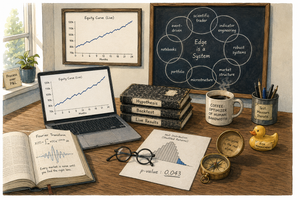
Most traders think systems predict markets. They don’t. A trading system is closer to a recipe: a repeatable process with defined inputs, rules, and outputs. This article explains why the prediction mindset destroys traders, and why robust systematic trading starts with process, not prophecy.