9.2 A Good Trade Is Not a Correct Prediction — The Five Invariants
Winning a prediction-market bet does not make it a good trade. Grade the decision before resolution against five invariants: named edge, bounded downside, real-liquidity execution, error-aware sizing, and robustness to competition.
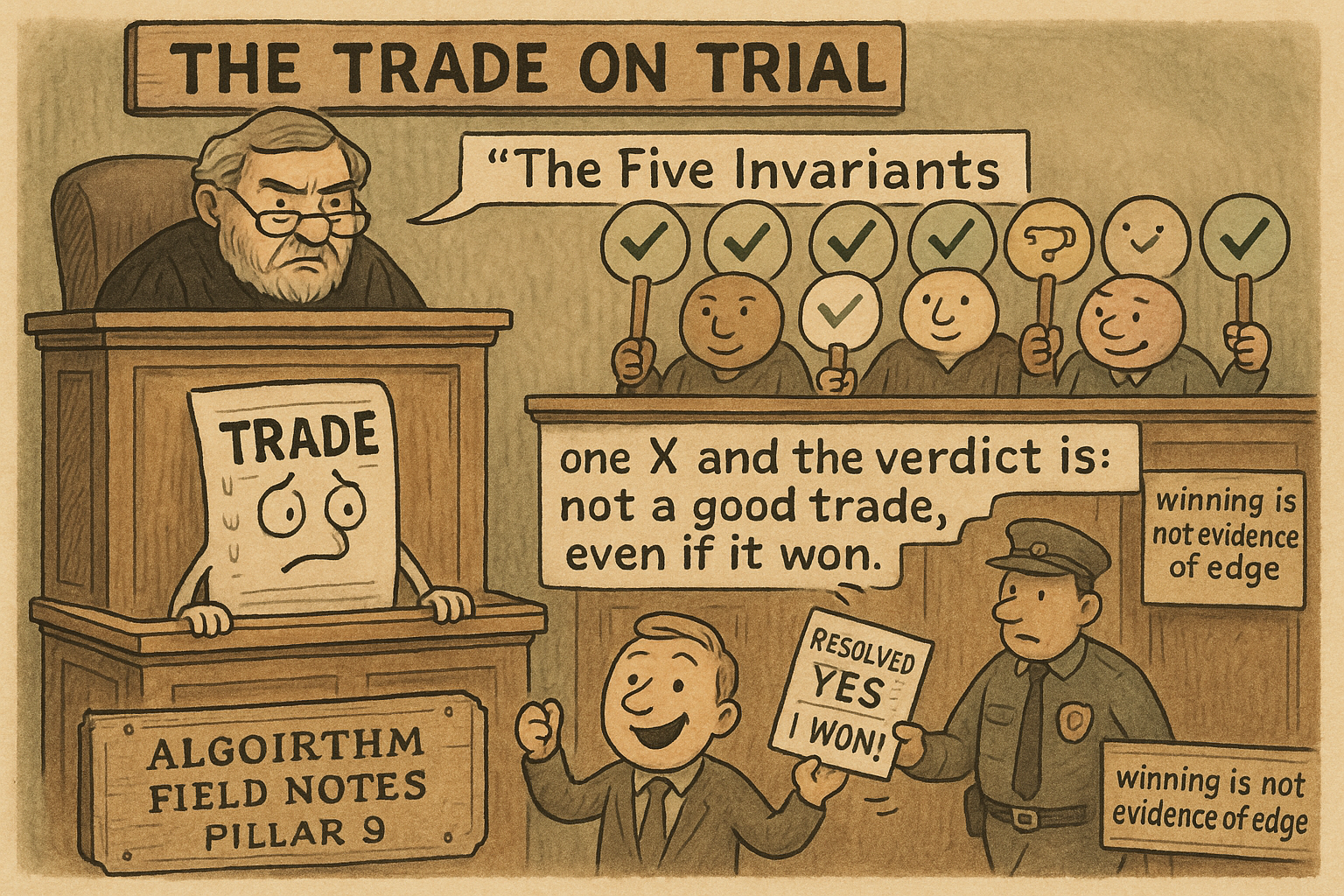
A trader buys "Candidate A wins" at $0.62, the candidate wins, and the trader collects. Good trade? You cannot tell. The outcome says nothing about whether the decision had an edge, because a single resolution is one draw from a distribution, and one draw carries almost no information. The old article "Why Trading Is a Probability Business, Not a Certainty Business" made this point for price series. Prediction markets sharpen it: the contract either pays $1 or $0, so the temptation to grade yourself by the result is stronger, and the error is more expensive.
Define a good trade by its structure before resolution, not by its payout after. A good trade satisfies five invariants at the same time. Miss one and the trade is not good, regardless of how it resolves. The five double as a pre-trade checklist and as an index to the rest of this pillar, because each later article builds the tool that answers one of them.
Invariant 1: a named source of edge
State why expected value is positive before you size or execute, in one sentence, naming a mechanism. "I believe A will win" is not a mechanism. "The YES and NO prices sum to $0.92, so buying both locks $0.08 against a $1.00 payout" is a mechanism. "The margin market and the winner market price a combination that lies outside the marginal polytope" is a mechanism.
The mechanisms in this pillar are structural inconsistency, execution advantage, microstructure mispricing, temporal lag, and informational edge, ranked from cleanest to most dangerous in the article on the nine sources of edge. A conviction is not on the list. If you cannot name the source, you are not trading an edge, you are donating to someone who can name theirs.
Invariant 2: bounded downside
Know your worst case in dollars before entry. For a structural arbitrage the worst case is not the market moving against you, because a completed arbitrage cannot. The worst case is execution failure on one leg: you buy YES, the market moves, and you never fill NO at the price you needed, so a locked profit becomes a naked directional bet. For a directional position the worst case is the full loss of what you deployed.
If you cannot write the maximum loss as a number, the trade is not defined well enough to take. This is the same discipline the old article "The Trader's Real Job: Control Losses, Not Predict Everything" argues for in ordinary markets, ported to a venue where the payoff is binary and the leg risk is specific.
Invariant 3: executable under real liquidity
Theoretical profit is computed at the quoted price. You do not trade at the quoted price. You trade against the depth of the book, and sweeping the book moves the average price you pay. Check three things before believing any edge number.
$$ \text{VWAP}(S) = \frac{\sum_{k} q_k \, p_k}{\sum_k q_k}, \qquad \text{filling size } S \text{ up the ask ladder } (q_k \text{ at price } p_k) $$
Read that as: the volume-weighted average price for an order of size S is the total dollars paid divided by total shares bought, summed as you eat successive levels of the book at rising prices. If the book is 500 shares at $0.32, 300 at $0.34, and 200 at $0.38, then buying 900 shares costs 500 times 0.32 plus 300 times 0.34 plus 100 times 0.38, which is $300, a VWAP of $0.333, not the $0.32 top-of-book quote. The 1.3-cent slippage is real money that never appeared in the theoretical edge. Model VWAP at your target size on every leg, confirm the depth exists, and confirm partial-fill risk is acceptable. The article on execution as part of expected value builds this out, and it connects to the old article "TWAP and VWAP Are Execution Models, Not Just Indicators."
Invariant 4: sized to survive error
Your edge estimate is wrong by some amount, always. Size for that. The position must account for estimation error in the edge, the probability that execution fails, correlation with what you already hold, and a drawdown limit. A workable ceiling: no single trade should be able to cause more than a 5% portfolio drawdown.
The reason sizing dominates is the asymmetry of the growth rate around the optimal fraction.
$$ G(f^* + \Delta) \approx G(f^*) - \frac{\Delta^2}{2\sigma^2} $$
Read that as: if you deviate from the growth-optimal bet fraction f-star by an amount delta, your long-run growth rate drops by roughly delta-squared over twice the variance, so the penalty grows with the square of the sizing error. Underbetting slows you down but keeps you alive. Overbetting past a threshold turns the growth rate negative, which is certain ruin no matter how good the edge was. The article on Kelly under model error works the numbers; the old article "Why Volatility-Adjusted Position Sizing Matters" makes the parallel case for continuous markets.
Invariant 5: robust to competition
An edge you cannot capture before it disappears is not your edge. Structural arbitrage on Polymarket can close inside one Polygon block, roughly two seconds, and the decision-to-mempool window that matters is closer to 30 milliseconds. A system with 500-millisecond latency chasing a 30-millisecond window is not trading, it is providing exit liquidity to the two or three bots that got there first. Assess your latency against the opportunity's lifetime, and assess crowding: the more systems on the same trade, the faster the edge decays and the worse your fills. The article on regimes and crowding quantifies the winner-take-most concentration.
The pre-trade checklist
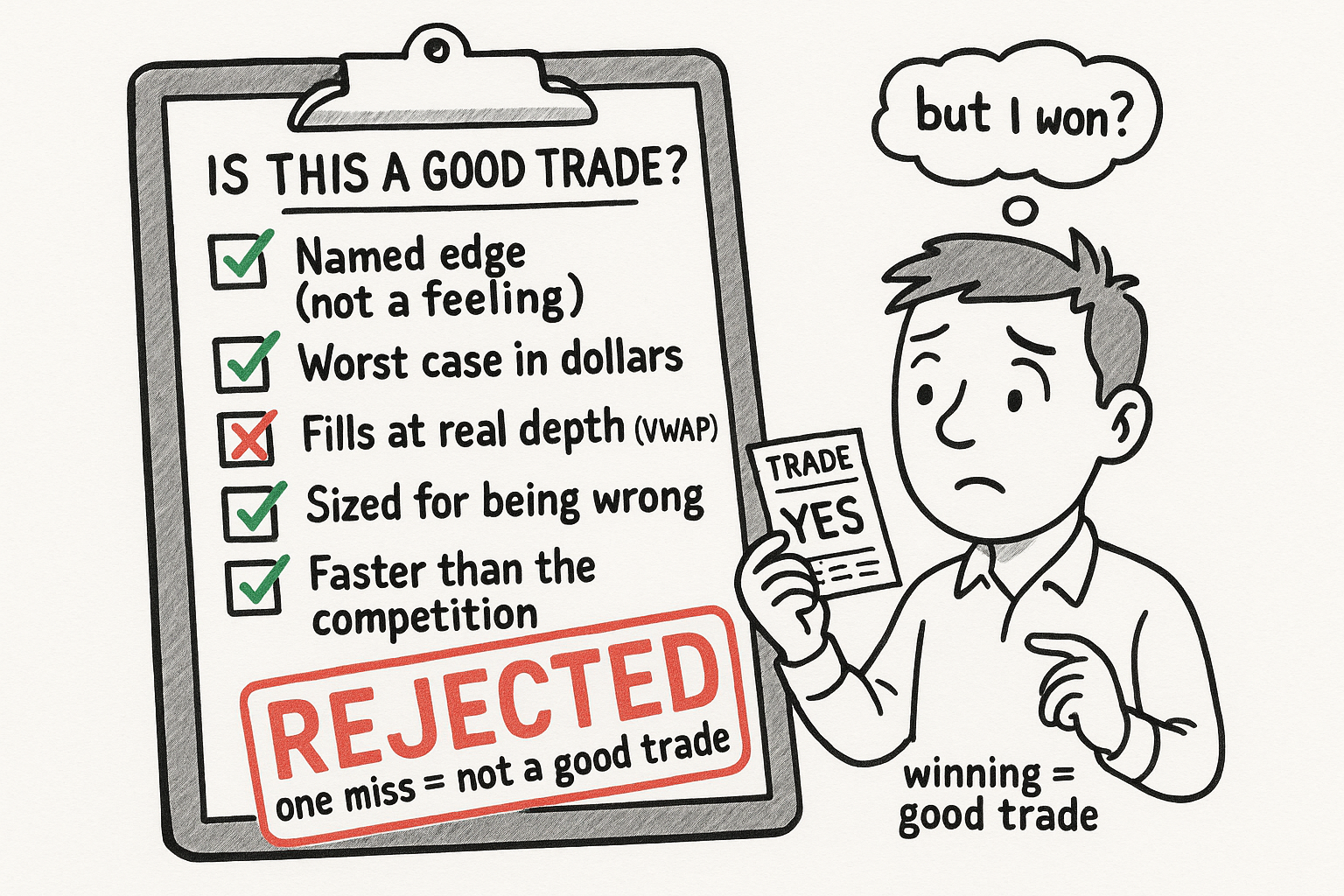
The five invariants collapse into five questions. Answer all five before execution. Any unknown is a fail.
$$ \begin{aligned} &\text{1. Source of edge: what is it, how is it quantified?}\\ &\text{2. Worst case: maximum loss in dollars?}\\ &\text{3. Fill probability: depth checked, VWAP modeled?}\\ &\text{4. Size: from Kelly or a constrained variant?}\\ &\text{5. Competition: latency assessed, crowding manageable?} \end{aligned} $$
Read that as: five plain questions, one per invariant, each demanding a concrete answer rather than a feeling. If any answer is "I do not know," the trade fails the checklist. This is not bureaucracy. Each question guards a specific way traders lose money, catalogued in the article on the six ways to lose on Polymarket.
What a good trade is not
Four things masquerade as good trades and are not. A prediction that resolved correct, which may be luck. A position that made money, which may be survivorship bias over a short horizon. A bet sized by conviction rather than a framework. A trade whose edge you cannot name. The old article "Trading Systems Are Recipes, Not Predictions" makes the general version of this case; the binary payoff of prediction markets makes each failure cleaner to see and harder to excuse.
Grade the decision, not the draw. Over a hundred trades the draws average out and the structure shows through. The trader who logs whether each entry passed all five invariants, and reviews that log instead of the equity curve, learns something. The trader who counts wins learns noise.
KEY POINTS
- A good trade is defined before resolution by its structure, not after by its payout. One binary resolution is a single draw and grades nothing.
- Invariant 1, named edge: state the mechanism in one sentence. A conviction is not a mechanism. No name means no edge.
- Invariant 2, bounded downside: know the worst case in dollars. For arbitrage the worst case is a failed leg turning a lock into a directional bet.
- Invariant 3, executable: compute VWAP at your real size on every leg. Top-of-book quotes lie once you sweep depth; the slippage is money missing from your theoretical edge.
- Invariant 4, sized for error: the growth penalty is quadratic in sizing error, and overbetting past a threshold guarantees ruin while underbetting only slows you. Cap any trade at a 5% portfolio drawdown.
- Invariant 5, robust to competition: an edge that closes in one Polygon block is not yours if your latency is half a second. Assess speed and crowding.
- The five invariants are a pre-trade checklist and an index to the pillar. Any unknown answer is a rejection.
A note on AI. The ideas, research, analysis, and conclusions in this article are my own. I use AI tools to help with editing and wordsmithing, because English is not my first language, and I am not shy about that. AI-generated ideas and AI-assisted writing are not the same thing: the first is empty slop from a generic prompt, the second is a tool for communicating years of real research more clearly. Judge the work by its substance, not by whether software helped polish the prose.