5.14 Microprice: Better Than Mid Price?
The plain mid ignores resting sizes. The weighted mid and microprice lean the center toward the thin side, where price is headed, giving a maker a fair value that already respects the book.
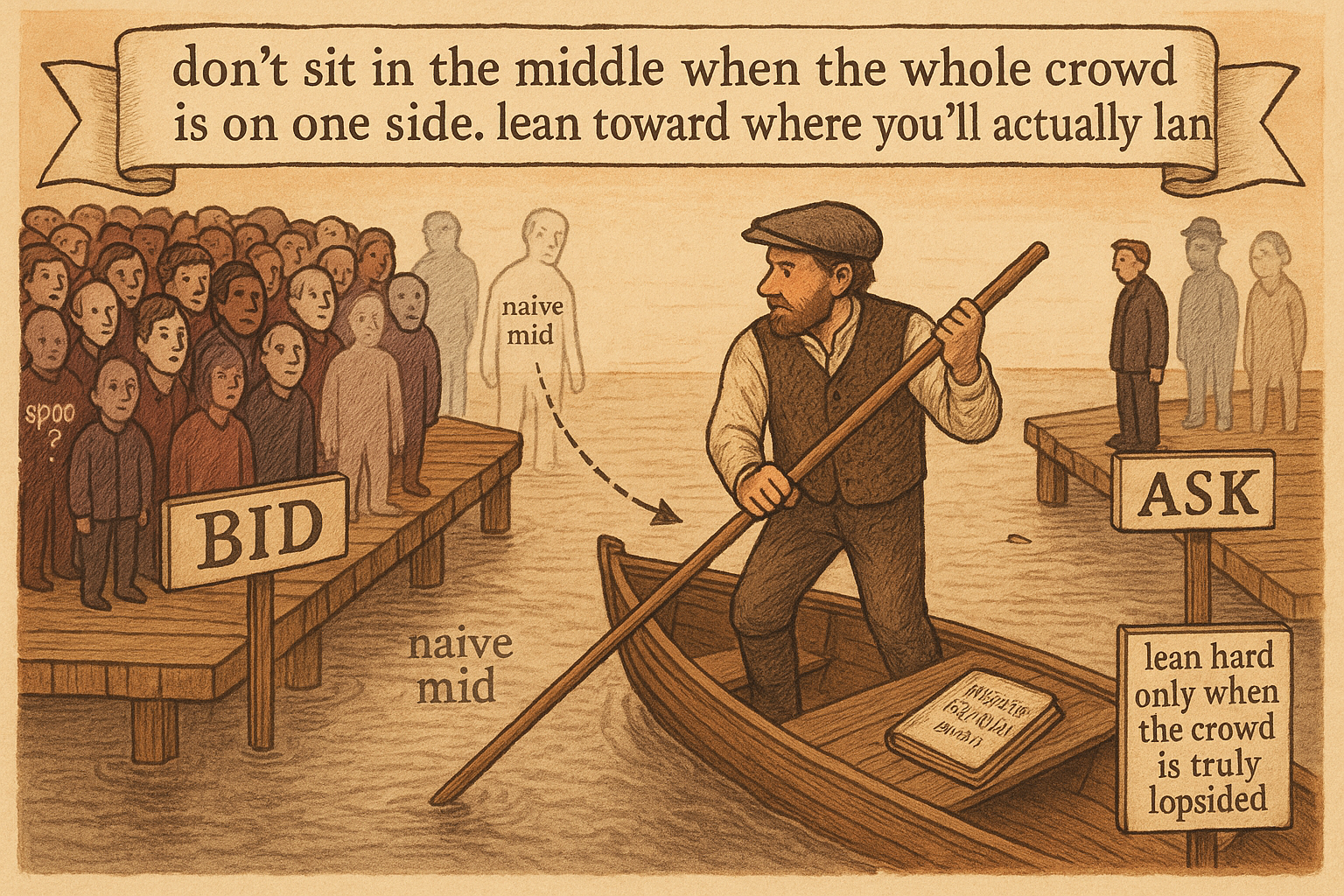
The mid price, the average of the best bid and the best ask, is the default center everyone reaches for. It throws away information sitting in plain view: the sizes resting at the bid and the ask. When a thousand units rest on the bid and ten on the ask, the mid treats the situation as balanced even though the price is far more likely to climb than fall. The weighted mid, and its refinement the microprice, fix that by leaning the center toward the side the book says price will move.
This article builds on "Order Book Imbalance: The First Microstructure Feature to Test", which established that book lopsidedness predicts the next move. The microprice is the natural way to fold that prediction directly into your fair value.
The weighted mid
The plain mid weights the best bid and best ask equally. The weighted mid weights each price by the size resting on the opposite side, so the heavier side pulls the center toward the lighter side.
$$ \text{weighted mid} = \frac{P_a \cdot V_b + P_b \cdot V_a}{V_a + V_b} $$
Here P_a and P_b are the best ask and best bid prices, and V_a and V_b are the sizes resting at the ask and the bid. The ask price is weighted by the bid volume and the bid price by the ask volume. The reasoning: if the size at the bid is much larger than the size at the ask, the ask side is the one likely to get cleared and the price is likely to move up toward the ask, so the center should sit closer to the ask. Weighting the ask price by the large bid volume does exactly that, pulling the weighted mid up toward the ask. The weights are crossed on purpose, the big side pushes the center away from itself, toward where the price is headed.
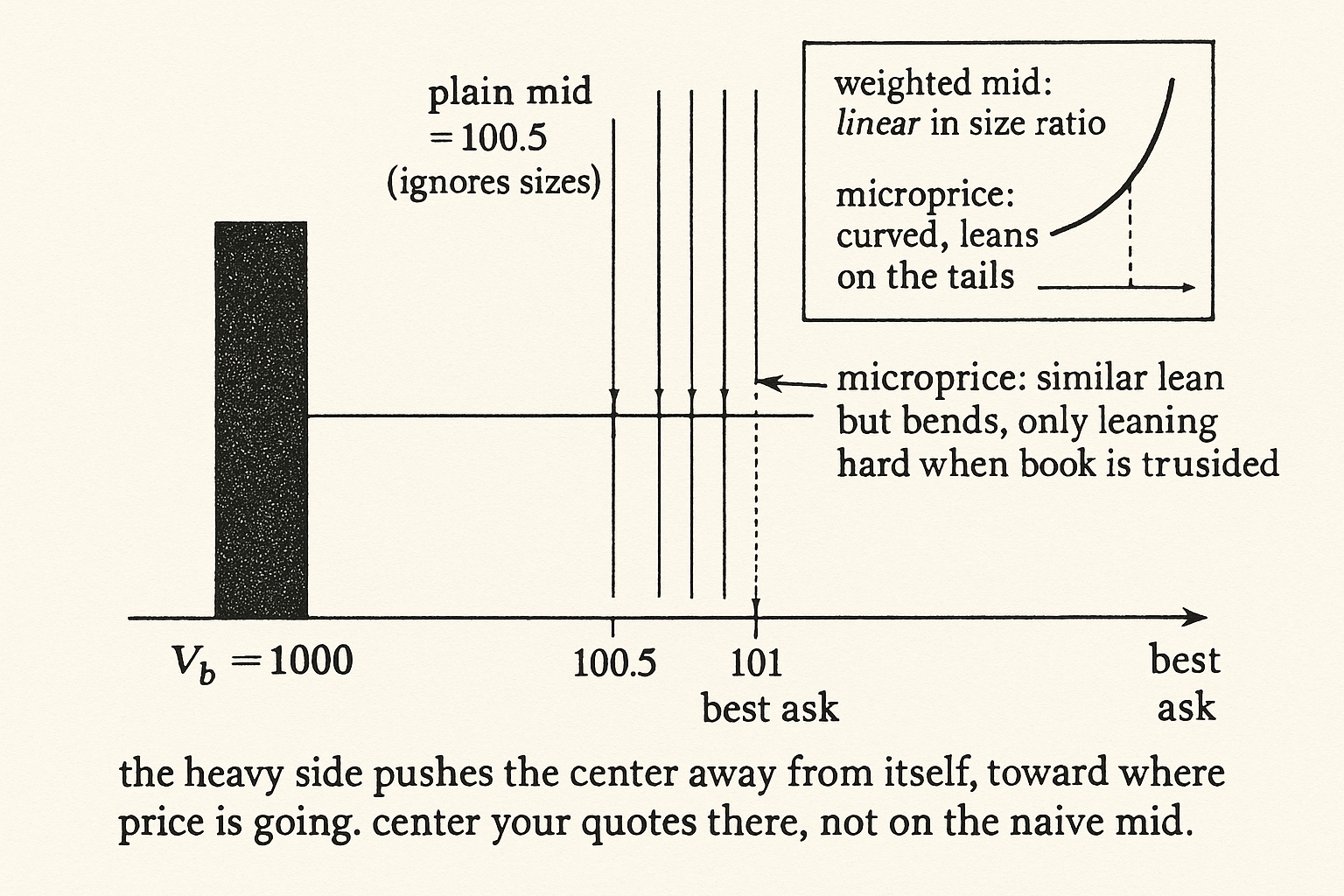
A quick numerical check: with a bid at 100 holding 1000 units and an ask at 101 holding 10 units, the plain mid is 100.5, but the weighted mid lands near 100.99, almost at the ask, because the heavy bid says the price will climb. That shift, from 100.5 to nearly 101, is the information the plain mid discarded.
Microprice as the improvement
The weighted mid is a good improvement on the plain mid, and the microprice is a good improvement on the weighted mid. The weighted mid uses only the top-of-book sizes and a linear weighting. The microprice refines the idea by accounting for the fact that the imbalance itself predicts the future mid, and that the relationship is not linear, the same tails-matter pattern from the imbalance article. It estimates where the mid will actually be conditional on the current imbalance, rather than just taking a size-weighted average of the current quotes.
In practice the microprice is the expected future mid given the current book state, built to respect that imbalance is most informative on the tails. Where the weighted mid moves linearly with the size ratio, the microprice bends, leaning hard toward one side only when the book is genuinely lopsided and staying near the plain mid when the book is roughly balanced. That curvature is the same spline-shaped relationship the imbalance article fit, now expressed as a price rather than a raw feature.
Why a maker wants this as the center
For a market maker the microprice is not an academic nicety, it is the fair value you quote around. Center your spread on the plain mid when the book is lopsided and you are systematically late: the price is about to move toward the thin side, and you are quoting symmetrically around a center that ignores it, handing the informed trader the mispriced side from "Adverse Selection Explained for Traders". Center on the microprice and your quotes already lean toward the predicted move, so the option you hand the taker is no longer mispriced and your markouts improve.
This is the most direct way book imbalance enters fair value. Rather than computing imbalance as a separate feature and bolting a skew onto the mid, the microprice bakes the imbalance prediction into the center itself. You can still add the other predictions, signed trade flow, volatility, cross-exchange leads, on top, but the microprice is the clean starting center that already respects what the resting sizes are telling you.
The limits
The microprice inherits every weakness of imbalance. Spoofed size distorts it, a fake stacked bid pulls the microprice up toward the ask exactly as a real one would, so the sizes feeding it should be filtered for sturdiness from "Spoofing, Sturdy Liquidity, and Book Pressure". It is a short-horizon estimate, useful for the next move, not a multi-minute fair value. And the choice of how many levels to include and how to fit the curvature are decisions you have to test, not constants handed to you. The microprice is a better center than the mid, not a perfect one, and it is only as honest as the book sizes you trust.
Visualizing the microprice
KEY POINTS
- The plain mid averages the best bid and ask equally and throws away the resting sizes. When one side is far heavier, the price is likely to move toward the thin side, and the mid ignores that.
- The weighted mid weights each price by the opposite side's volume, so the heavy side pulls the center toward the lighter side, where price is headed. The weights are crossed on purpose.
- Worked case: bid 100 with 1000 units, ask 101 with 10 units gives a plain mid of 100.5 but a weighted mid near 100.99, almost at the ask. That shift is the information the plain mid discarded.
- The microprice improves on the weighted mid by respecting that imbalance predicts the future mid non-linearly, leaning hard only when the book is genuinely lopsided and staying near the plain mid when balanced.
- For a maker the microprice is the fair value to quote around. It bakes the imbalance prediction into the center, so quotes already lean toward the move and the option handed to takers is no longer mispriced.
- Limits: spoofed size distorts it, so filter for sturdiness; it is a short-horizon estimate, not a multi-minute fair value; and the level count and curvature fit are choices to test.
A note on AI. The ideas, research, analysis, and conclusions in this article are my own. I use AI tools to help with editing and wordsmithing, because English is not my first language, and I am not shy about that. AI-generated ideas and AI-assisted writing are not the same thing: the first is empty slop from a generic prompt, the second is a tool for communicating years of real research more clearly. Judge the work by its substance, not by whether software helped polish the prose.