5.12 Spoofing, Sturdy Liquidity, and Book Pressure
Half the big orders in crypto are spoofs that vanish on approach. Lean on one and the price runs through your fill. Filter for sturdy size, and trade the turn a spoof's disappearance creates.
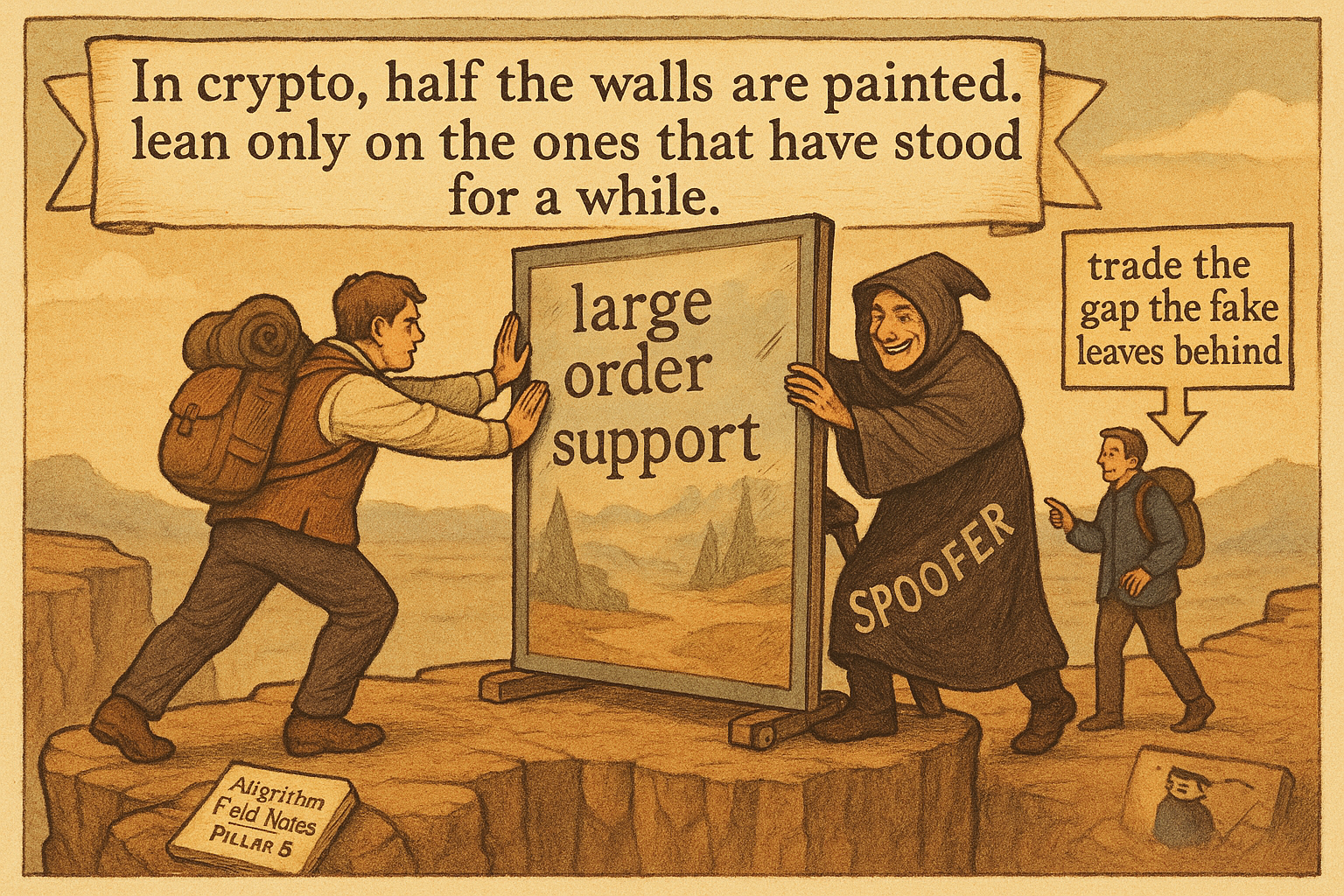
Every placement trick in the last two articles rests on one assumption: that the large order you are sitting in front of is real. In crypto that assumption is dangerous. Spoofing is real and common, large orders posted with no intention of filling, designed to create the appearance of pressure and then yanked the instant someone reacts. Place in front of a spoof and the wall you thought was protecting your markouts vanishes the moment you need it, and the price turns toward exactly where the fake order was.
This article handles the hazard that "Order Placement Alpha: The Forgotten Edge" and "How to Use Order Book Density for Better Limit Orders" both flagged. The job is to tell sturdy liquidity from a spoof, and to understand what happens to the price when a large order disappears.
Why a vanishing order moves the price
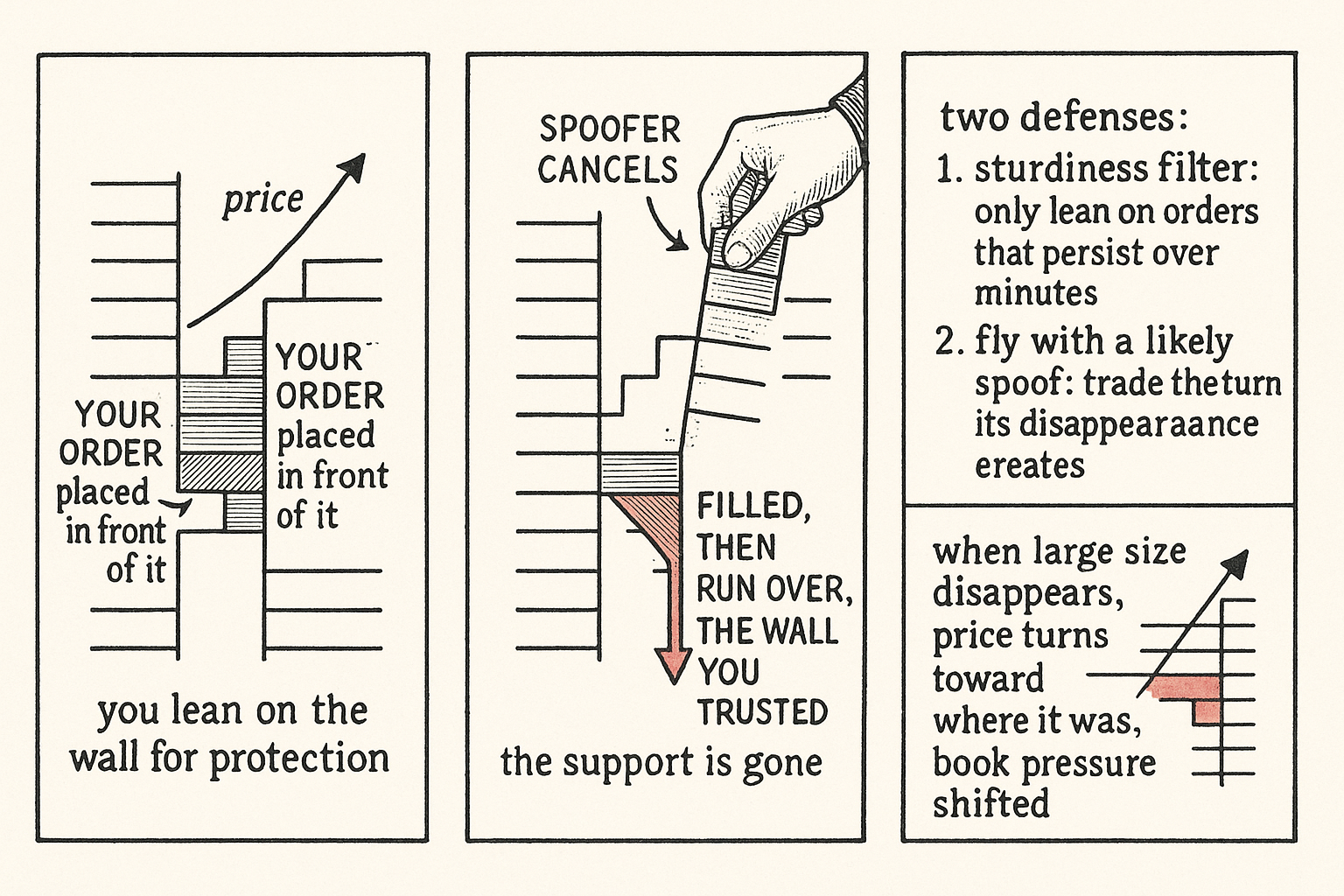
Start with the mechanics of book pressure, because they explain both the danger and the opportunity. A large resting order is weight on one side of the book. While it sits there, it holds the price, because anyone wanting to push through that side has to consume it first. When that large order disappears, whether filled or cancelled, the weight is gone and the price suddenly turns toward where the order was, because the book pressure has shifted aggressively in that direction.
Picture a large bid sitting below the price. It acts as support; the price rests above it. Pull that bid and the support is gone, and the price drops toward the level the bid was defending. A spoofer who never intended to buy posts that bid to make the book look supported, lets others lean on it, then cancels, and the price falls. The disappearance of size is itself a price-moving event, and a spoofer manufactures that event on purpose.
The danger to your placement
This is precisely why placing in front of a spoof is worse than useless. The whole point of sitting in front of a large order, from the order-placement article, is that a taker who fills you cannot push the price through the wall behind you, so your markout stays flat. If that wall is a spoof, it disappears the instant it would have protected you. You get filled, the spoofed order vanishes, the book pressure shifts toward where it was, and the price runs against your fill, the exact adverse markout you placed there to avoid. You took on the toxicity you were hedging against, because you trusted a wall that was never load-bearing.
So placement that leans on resting size demands a filter: which orders are sturdy and which will evaporate quickly. Without that filter, density-based placement is leaning on liquidity that fails under load.
Telling sturdy from spoofed
The sturdiness logic watches how orders behave over time rather than trusting their displayed size. A few signals separate the two. Sturdy liquidity persists: a level that holds its size across the multi-minute average density from the placement article is more likely real than a wall that appears and vanishes in seconds. Spoofs flicker: they tend to post, sit briefly to be noticed, and pull as soon as the price approaches or as soon as flow reacts. Tracking the lifetime and the cancel behavior of large orders, how long they rest and whether they pull on approach, builds a probability that a given wall is sturdy versus spoofed, and you only lean your placement on the ones that score sturdy.
Turning the spoof against the spoofer
The disappearance dynamic also cuts the other way, and there is an edge in it. If you have an order that is likely to be spoofed, you can have the opposite effect by flying with it, following it around. Identify a large order you judge to be a spoof, anticipate that it will be pulled and that the price will then turn toward where it sat, and position for that turn rather than leaning on the order as support. Instead of placing in front of the fake wall and getting run over when it vanishes, you trade the predictable move that its disappearance creates. The spoofer is manufacturing a price-moving event on a schedule you can read, and reading it turns their manipulation into your signal.
Visualizing book pressure
KEY POINTS
- Every placement trick assumes the large order you sit in front of is real. In crypto, spoofing (large orders posted with no intent to fill, then pulled) makes that assumption dangerous.
- A large resting order is weight that holds the price. When it disappears, filled or cancelled, the price turns toward where it was because book pressure has shifted. The disappearance of size is itself a price-moving event.
- Placing in front of a spoof is worse than useless: the protective wall vanishes the instant it would help, you get filled, and the price runs against you, the exact adverse markout you placed there to avoid.
- Placement on resting size requires a filter separating sturdy liquidity from orders that will evaporate.
- Sturdy liquidity persists across the multi-minute average density; spoofs flicker, posting briefly and pulling on approach. Track order lifetime and cancel-on-approach behavior to score sturdiness, and lean only on sturdy orders.
- The disappearance dynamic is also an edge: identify a likely spoof, anticipate it will be pulled and that price turns toward where it sat, and trade that turn instead of leaning on the order.
A note on AI. The ideas, research, analysis, and conclusions in this article are my own. I use AI tools to help with editing and wordsmithing, because English is not my first language, and I am not shy about that. AI-generated ideas and AI-assisted writing are not the same thing: the first is empty slop from a generic prompt, the second is a tool for communicating years of real research more clearly. Judge the work by its substance, not by whether software helped polish the prose.