2.38 Causal Wavelet Filters and the Mexican Hat
A wavelet is a band-pass whose width scales, so one Mexican Hat (the 2nd derivative of a Gaussian) scans every cycle at once. Compact support makes it usable; the resolution tradeoff makes it honest.
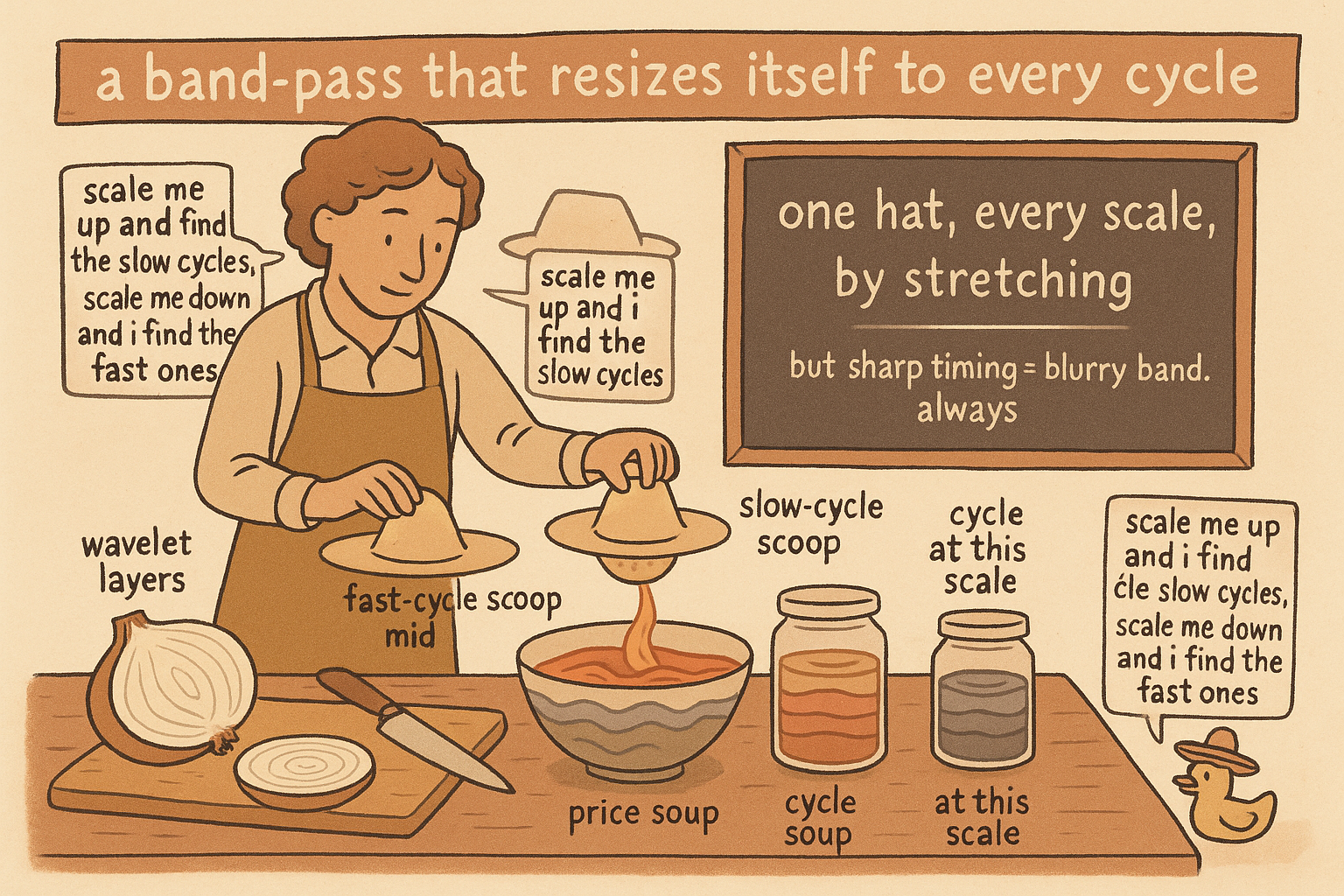
The old article "Band-Pass Filters: The Most Underused Tool in Technical Analysis" built band-pass filters with fixed-period recursions to isolate one cycle. The old article "Dominant Cycle Estimation Without Astrology" measured which cycle to isolate. Wavelets attack the same problem from a different angle: instead of one band-pass tuned to one period, a wavelet is a band-pass whose width scales with the cycle it examines, so a single family of filters dissects the market at every scale at once. The price for that elegance is the same Fourier resolution tradeoff in new clothing, and the Mexican Hat is the cleanest place to see both the power and the cost.
A wavelet is a band-pass; its scaling function is the low-pass father
Wavelet analysis was built for signals of short duration, the bursts and transients that Fourier analysis, which assumes long stationary signals, handles badly. That makes it a natural fit for market data, where structure appears and dissolves rather than ringing forever like a tuning fork. The key fact for a filter-minded trader is plain: a wavelet is a band-pass filter. It passes a band of cycle speeds and rejects the rest, exactly like the recursions from the old band-pass article, but with a shape that stretches and shrinks.
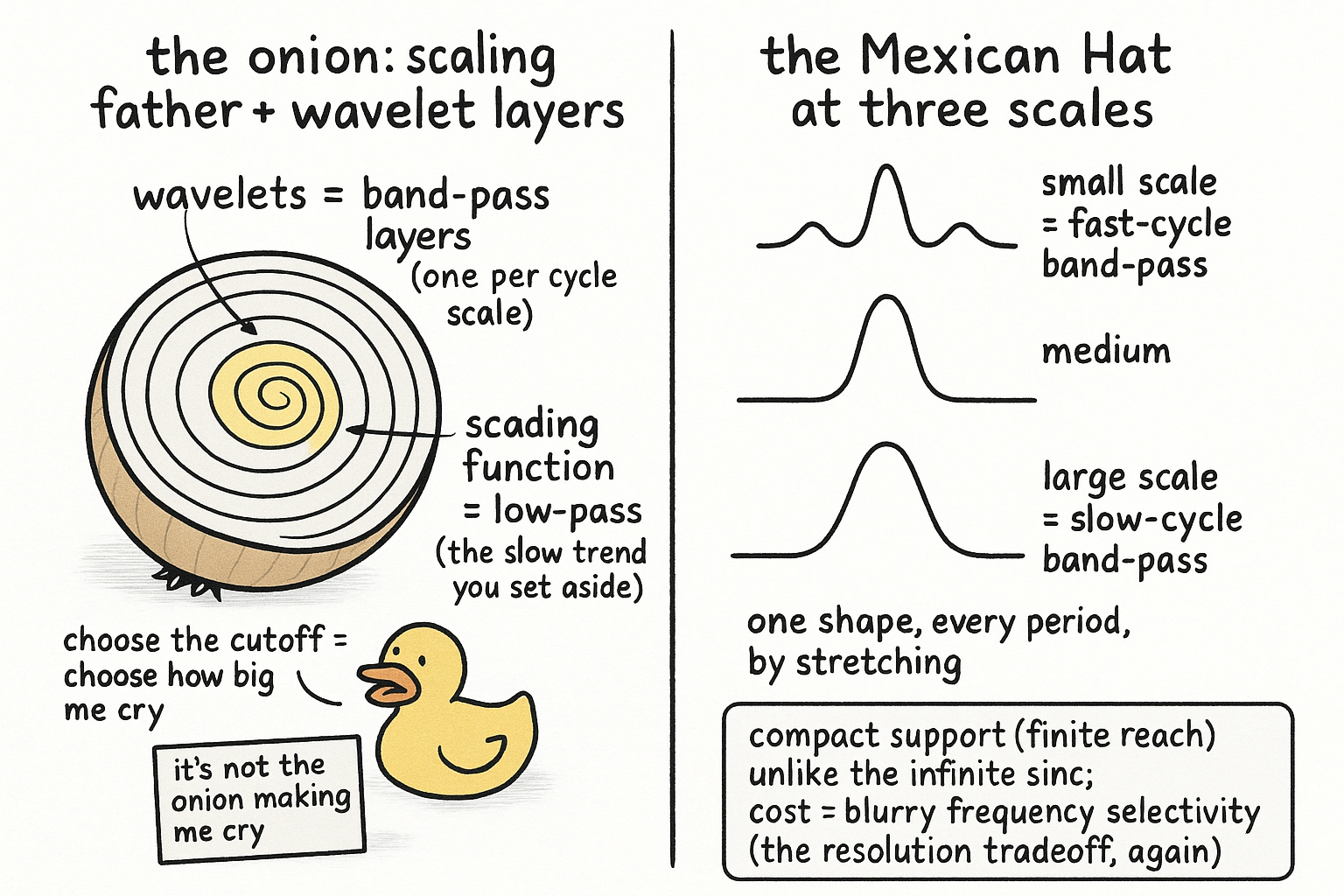
Every wavelet has a partner called its scaling function, and the scaling function is a low-pass filter, the father of the family. It keeps everything below a chosen cutoff. The signals it removes, the faster content above the cutoff, are precisely what the wavelets analyze. Think of the price as an onion of twelve layers. Choose a cutoff and you split it into a core of, say, four layers and the eight outer layers. The core is the scaling function, the slow trend you decided to set aside. The outer layers are the wavelets, each a band-pass capturing one scale of cycle. Together, father and wavelets reconstruct the whole onion and tell you which scales carry the action.
The Mexican Hat, the second derivative of a Gaussian
The sinc from the old low-pass work was the ideal brick-wall filter, and its fatal flaw was infinite length: its tails never reach zero, so it needs infinitely many bars. The Mexican Hat is the deliberate opposite, a wavelet built to have compact support, finite reach in time.
$$ \Psi(t) = (1 - 2t^2)\, e^{-t^2} $$
It is the second derivative of a Gaussian bump, which gives it its shape: a central peak with two symmetric dips on either side, the silhouette that earns the name. Because the Gaussian decays fast, the wavelet effectively dies out over a finite stretch, unlike the sinc that rings on forever. That compact support is the practical advantage: a Mexican Hat filter uses a bounded window of bars, so you can run it without the infinite-tail problem. Its frequency response is a band-pass, a hump that passes a middle band and rejects both the slow trend and the fast noise, with the band's center set by how much you stretch the wavelet.
Scale is the dial, and it does the cycle scan for you
The reason a wavelet beats a single fixed band-pass is the stretch parameter, the scale. Stretch the Mexican Hat wide and it becomes a band-pass centered on a slow cycle. Squeeze it narrow and the same shape becomes a band-pass centered on a fast cycle. Run a whole range of scales and you get a band-pass at every period at once, a scan across the cycle spectrum from one wavelet shape. Where the old band-pass article fixed the center period by hand and the dominant-cycle article measured one period to target, the wavelet sweeps all of them and shows you where the energy sits across scales and across time together.
That is the genuine edge for market data: a wavelet scan reveals that a 20-bar cycle was strong last month and a 40-bar cycle dominates now, localized in time, which a single Fourier spectrum smears together. For the econophysics and geometry questions this sits next to, that scale-by-scale view is the right lens for self-similar, multi-scale price structure.
The cost is the resolution tradeoff, again
None of this repeals the law that the dominant-cycle and evanescent-cycle articles kept enforcing. A wavelet faces the same uncertainty tradeoff as every spectral tool: a filter narrow in time is wide in frequency, and a filter narrow in frequency is wide in time. The Mexican Hat's compact support, the thing that makes it usable, is exactly what blurs its frequency selectivity, so it tells you when a cycle burst happened with decent timing but smears which precise period it was. Squeeze it for sharp timing and the band gets broad; stretch it for a sharp band and the timing smears. You do not escape the tradeoff by switching from a recursion to a wavelet; you relabel it.
And the deeper caution from the old article "Why Market Cycles Are Evanescent" applies in full. A wavelet scan can show you a beautiful localized cycle that was real and is already gone, because market cycles drift in period, decay in amplitude, and lose phase coherence. The wavelet is a sharper microscope for a substrate that keeps dissolving under the lens. Use it to characterize structure that exists, gate any cycle-mode logic on the structure persisting, and never mistake a clean wavelet ridge for a promise about the next bar.
KEY POINTS
- A wavelet is a band-pass filter, like the recursions in the old article "Band-Pass Filters: The Most Underused Tool in Technical Analysis," but its width scales, so one family dissects the market at every cycle scale at once.
- Every wavelet has a scaling function, its low-pass father, which keeps the slow trend below a chosen cutoff; the content it removes is what the wavelets analyze. The onion picture: core equals scaling function, outer layers equal wavelets.
- The Mexican Hat, the second derivative of a Gaussian, has compact support (finite reach in time), the deliberate opposite of the infinite-length sinc, so it is runnable as a bounded-window band-pass.
- Scale is the dial: stretch the wavelet for a slow-cycle band, squeeze it for a fast-cycle band. Sweeping scales scans all periods at once and localizes when each cycle was strong, which a single Fourier spectrum smears.
- The cost is the resolution tradeoff in new clothing: sharp timing means a broad band, sharp band means smeared timing. Compact support buys usability by blurring frequency selectivity.
- The old article "Why Market Cycles Are Evanescent" still rules: a clean wavelet ridge can be a real cycle that already died. Gate cycle-mode logic on persistence; never read a ridge as a forecast.
A note on AI. The ideas, research, analysis, and conclusions in this article are my own. I use AI tools to help with editing and wordsmithing, because English is not my first language, and I am not shy about that. AI-generated ideas and AI-assisted writing are not the same thing: the first is empty slop from a generic prompt, the second is a tool for communicating years of real research more clearly. Judge the work by its substance, not by whether software helped polish the prose.