2.50 Band-Pass Q and Selectivity
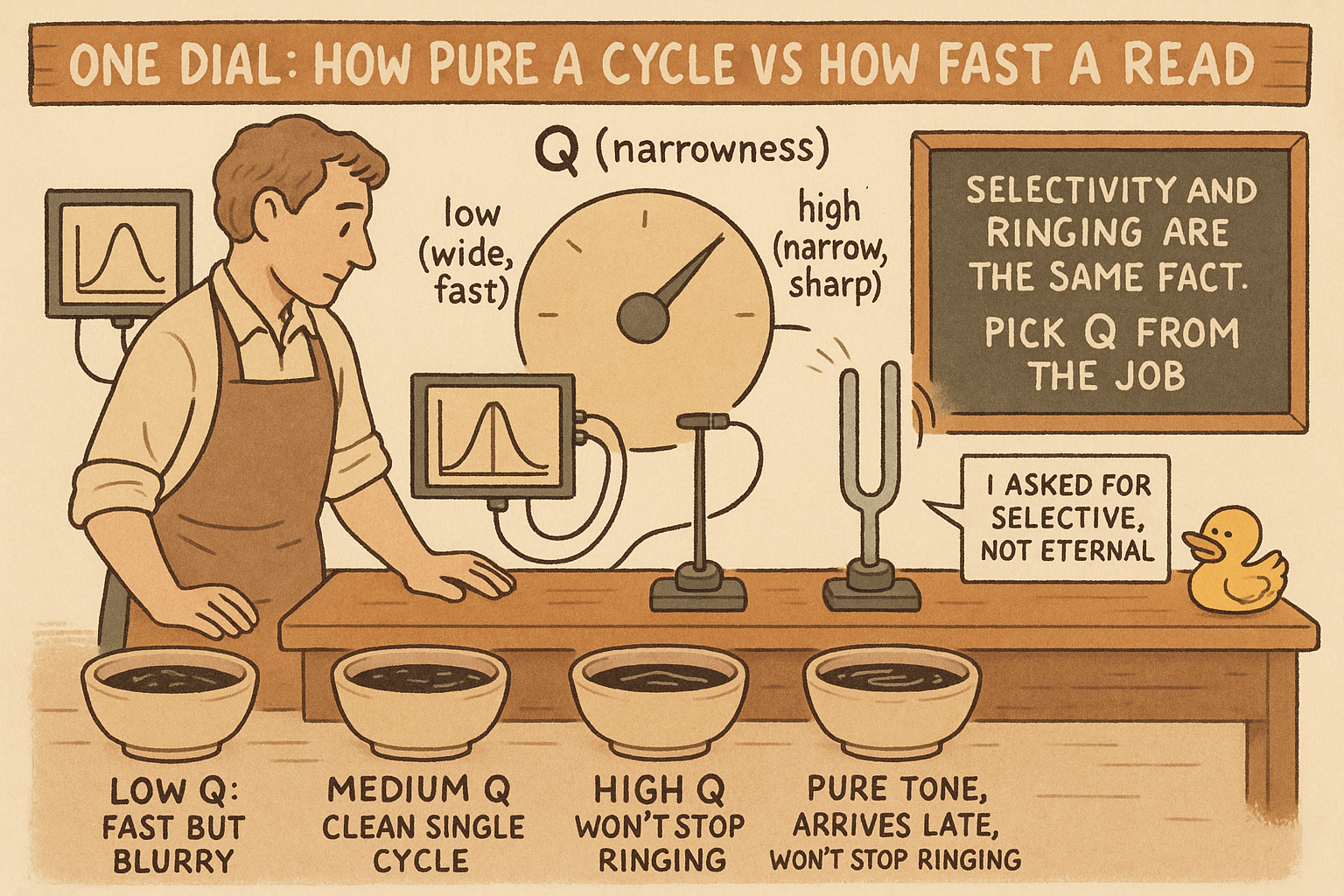
Q is the band-pass narrowness dial: center frequency over half-power bandwidth (30% gives Q~3.33). High Q isolates a pure cycle but rings and lags; low Q is fast but blurry. Pick Q from the job.
The old article "Band-Pass Filters: The Most Underused Tool in Technical Analysis" built the band-pass and named its two dials: a center period and a bandwidth. This article is about the second dial, because it is the one traders set badly. Bandwidth has a standard summary number, the quality factor Q, and Q is the single knob that controls the tradeoff every cycle tool lives or dies on: how cleanly the filter isolates one cycle versus how fast and stable it responds. Set Q without understanding it and you either pass mud or chase a ringing ghost. Understand it and you can pick the right narrowness for the job.
Selectivity, and the number that measures it
Selectivity is the degree to which a filter rejects the frequencies you did not want. A highly selective band-pass passes a narrow slice of cycles around its center and crushes everything else; a poorly selective one passes a wide smear. The quality factor Q puts a number on selectivity, defined as the center frequency divided by the bandwidth measured at the half-power points.
$$ Q = \frac{\text{center frequency}}{\text{bandwidth at half-power}} = \frac{1}{\text{fractional bandwidth}} $$
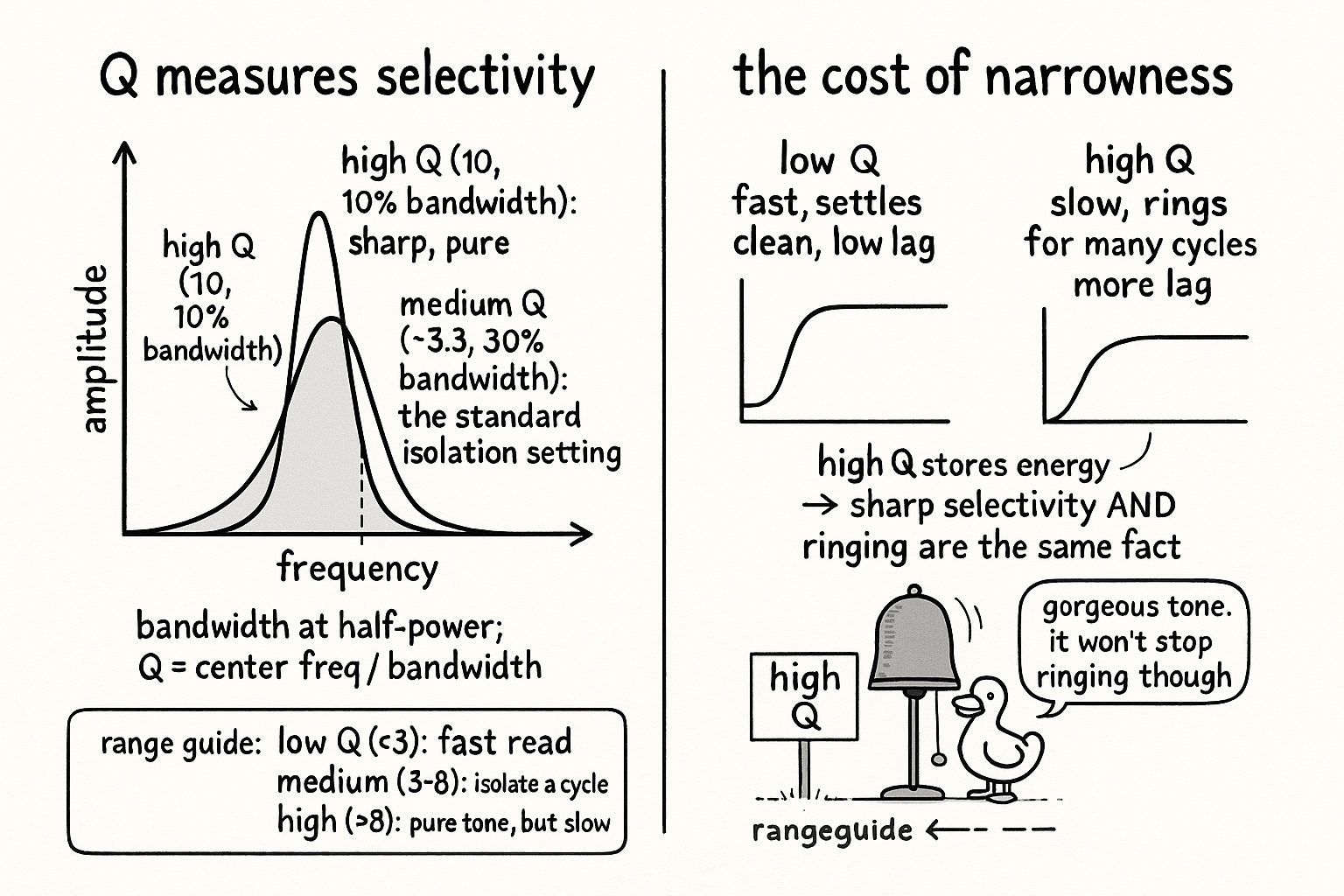
The bandwidth at the half-power points is the width of the band between the two frequencies where the filter's power has fallen to half, the 0.707-amplitude points from the critical-period article. Express that width as a fraction of the center frequency and Q is its reciprocal. So a band-pass set to a 30 percent bandwidth has a Q of about one over 0.3, roughly 3.33. A narrow 10 percent bandwidth gives Q of 10; a wide 50 percent gives Q of 2. Higher Q means narrower, more selective, more sharply tuned.
There is a second, equivalent definition that exposes what Q physically is, borrowed from resonant systems.
$$ Q = 2\pi \, \frac{\text{energy stored}}{\text{energy dissipated per cycle}} $$
A high-Q filter stores a lot of energy relative to what it loses each cycle, which is precisely why it rings: energy you put in keeps sloshing around for many cycles before it dies. That is the same fact as sharp selectivity, seen from the time domain instead of the frequency domain.
Q is the selectivity-versus-responsiveness dial
Now the tradeoff, which is the reason Q matters. The two definitions are two views of one thing, and they pull in opposite directions for a trader.
High Q buys you a narrow, sharply selective band: the filter isolates one cycle period and rejects neighbors hard, so the output is a clean single cycle. But the same narrowness means the filter stores energy for many cycles, so it responds slowly to changes, rings after a shock, and carries more lag. Tune Q high and you get a beautiful clean cycle that arrives late and keeps oscillating after the real cycle has died.
Low Q buys you the opposite: a wide, gently selective band that responds fast, rings little, and lags less, at the cost of passing a broader smear of cycles, so the output is not a clean single tone. Tune Q low and you get a fast, honest, but blurry read.
This maps directly onto the Q ranges the old article "Band-Pass Filters: The Most Underused Tool in Technical Analysis" laid out. Low Q, under about 3, is broad and fast with little ringing, the right choice when you need a quick, stable read more than a pure tone. Medium Q, roughly 3 to 8, is the standard cycle-isolation setting, narrow enough to pull out one cycle without ringing badly. High Q, above 8, is narrow and pure but slow and prone to ringing, useful only when you genuinely need a single isolated tone and can tolerate the lag. There is no universally correct Q, only a Q matched to whether your job rewards selectivity or responsiveness, and the two are a strict trade. Pick Q from the job, then check the lag and ringing it costs before you rely on the output, because a high-Q filter's clean appearance is exactly what tempts traders into paying lag they did not budget for.
KEY POINTS
- Selectivity is how hard a band-pass rejects the cycles you did not want. The quality factor Q measures it: center frequency divided by the half-power bandwidth, which equals one over the fractional bandwidth.
- A 30 percent bandwidth gives Q of about 3.33; 10 percent gives Q of 10; 50 percent gives Q of 2. Higher Q means narrower and more sharply tuned.
- The energy definition, Q equals two pi times energy stored over energy dissipated per cycle, shows what Q physically is: a high-Q filter hoards energy, which is why it rings.
- Q is one dial with two opposing effects. High Q isolates a pure cycle but responds slowly, rings, and lags more. Low Q responds fast with little ringing but passes a blurry smear of cycles.
- The ranges from the old article "Band-Pass Filters: The Most Underused Tool in Technical Analysis": low Q (under 3) for fast stable reads, medium Q (3 to 8) for standard cycle isolation, high Q (over 8) for a pure tone you can wait for.
- There is no universally right Q, only one matched to whether the job rewards selectivity or responsiveness. Pick from the job, then check the lag and ringing before trusting the clean-looking output.
A note on AI. The ideas, research, analysis, and conclusions in this article are my own. I use AI tools to help with editing and wordsmithing, because English is not my first language, and I am not shy about that. AI-generated ideas and AI-assisted writing are not the same thing: the first is empty slop from a generic prompt, the second is a tool for communicating years of real research more clearly. Judge the work by its substance, not by whether software helped polish the prose.