6.15 Why Percent Profitable Is Overrated
An 80% win rate can lose money and a 36% win rate can print it. The win rate is half a number, useless without the payoff ratio, and optimizing for it quietly destroys real systems.
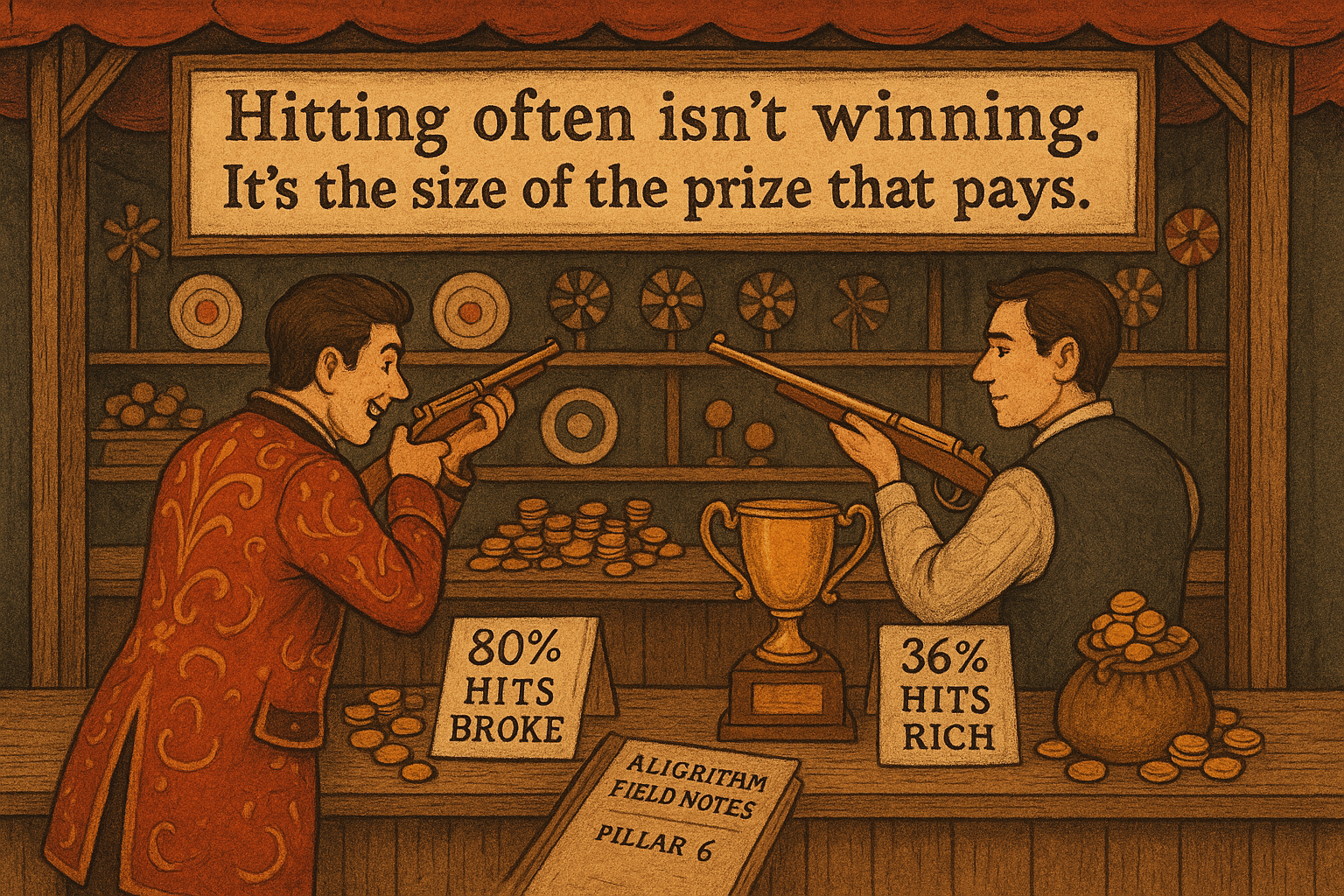
Win rate is the metric beginners worship and professionals barely glance at. A system that wins 80% of the time feels safe, smart, and worth bragging about, while one that wins 35% feels broken. Both feelings are usually wrong, because the percentage of profitable trades, on its own, tells you nothing about whether a system makes money. "Expectancy: The Most Important Formula in Trading" already showed the arithmetic; this article is about why the win rate is the most psychologically seductive and least informative number on the report, and why chasing it actively damages systems.
The win rate is half a number
The percentage of profitable trades measures one thing: how often you are right. It says nothing about how much you make when right or lose when wrong, and those sizes are the other half of the result. A win rate without the average win-to-loss ratio beside it is a sentence with the verb removed. You can read it and feel something, but you cannot act on it, because the same win rate sits on top of a great system and a terrible one depending on what the winners and losers are worth.
The two numbers also trade off against each other in a way that makes a high win rate suspicious rather than reassuring. Systems engineered for a high percentage of winners usually get there by taking profits early and giving losers room, which produces many small wins and occasional large losses, the exact shape that quietly destroys accounts. Systems with low win rates often get there by cutting losers fast and letting winners run, producing many small losses and occasional large wins. The win rate is partly a readout of which of these two postures the system takes, and the comfortable-looking high number frequently marks the dangerous posture.
The breakeven line depends entirely on the ratio
$$ P_{\text{win}}^{\text{breakeven}} = \frac{1}{1 + R}, \quad R = \frac{\text{avg win}}{\text{avg loss}} $$
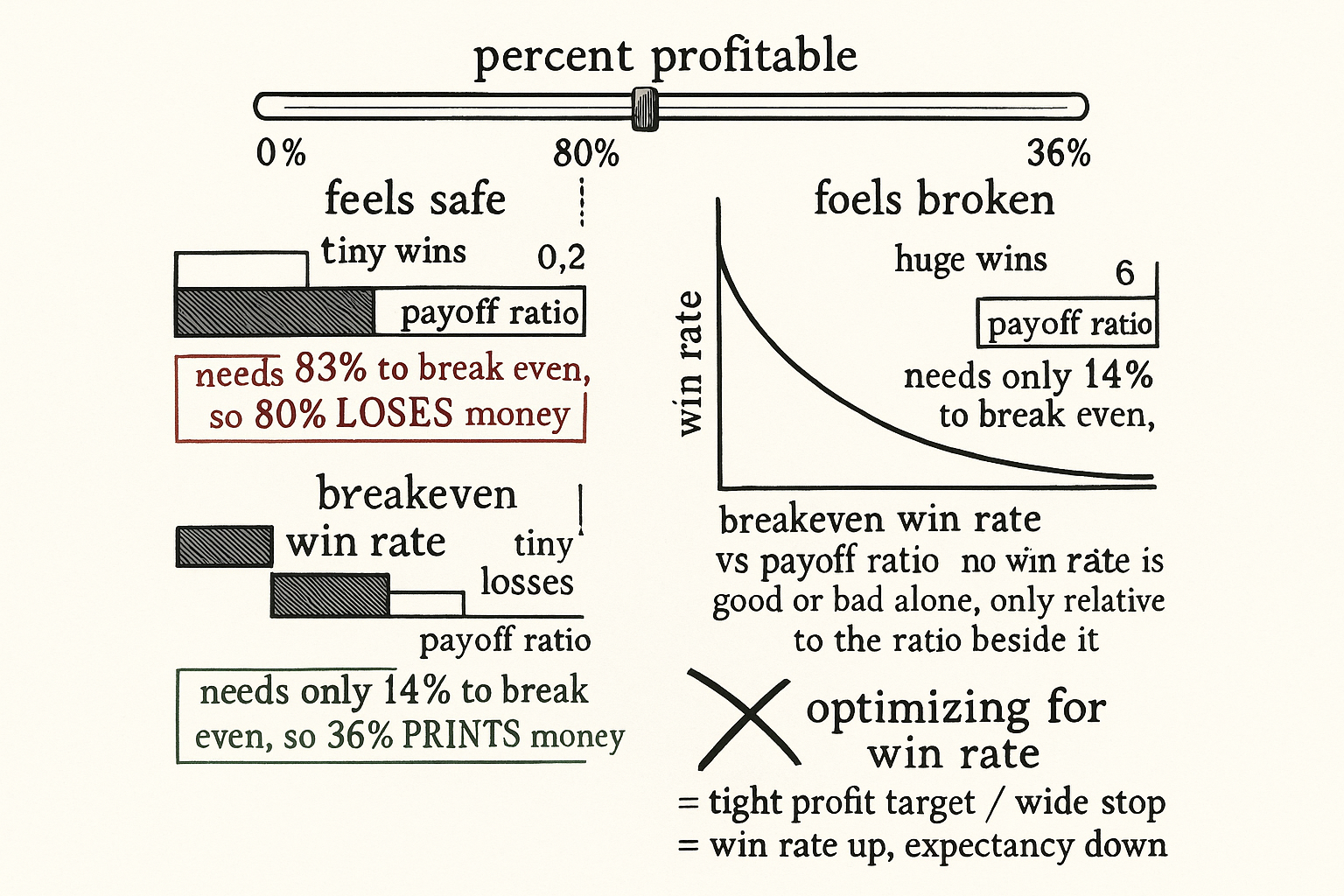
The win rate you need just to break even depends on the win-to-loss ratio. With a payoff ratio of 1, where winners and losers are the same size, you need to win more than half your trades. With a ratio of 6, the trend-following case where the average win is six times the average loss, the breakeven win rate is one divided by one plus six, about 14%, so a system winning 36% of the time is hugely profitable. With a ratio of 0.2, where winners are a fifth the size of losers, the breakeven win rate is one divided by 1.2, about 83%, so an 80% win rate is still a losing system. There is no win rate that is good or bad in isolation; there is only a win rate relative to the payoff ratio it sits next to.
Chasing win rate breaks systems
The seduction is not harmless, because optimizing for the win rate degrades real systems. Add a tight profit target to a trend follower and the win rate climbs, the metric you were chasing improves, and the expectancy collapses because you have amputated the large winners that paid for all the small losses. Move a stop further away to avoid getting tagged out and the win rate climbs again while the average loss balloons, trading a better-looking percentage for a worse actual result. Each of these is a move that makes the seductive number go up and the number that matters go down, which is why win-rate optimization is one of the most reliable ways to ruin a working strategy.
Judge a system on expectancy and the payoff ratio, and treat the win rate as context, useful for understanding the system's posture and for knowing whether you can psychologically tolerate a long string of small losses, never as a goal. A trader who cannot sit through a 35%-win-rate system's frequent losses will abandon a profitable strategy, so the win rate matters for your behavior, covered in "Why Systematic Trading Feels Emotionally Unsatisfying", and not for the system's edge. The edge lives in expectancy; the win rate just tells you how hard the edge will be to hold onto.
Visualizing the win-rate trap
KEY POINTS
- Win rate measures only how often you are right, never how much you make when right or lose when wrong. On its own it cannot tell you whether a system makes money.
- A win rate without the average win-to-loss ratio beside it is unusable. The same percentage sits on a great system and a terrible one depending on the payoff sizes.
- High win rates are often produced by taking profits early and giving losers room, the many-small-wins, occasional-huge-loss shape that destroys accounts. Low win rates often mark the safer cut-losers-let-winners-run posture.
- The breakeven win rate is one over one plus the payoff ratio. At a ratio of 6 you break even at 14%, so 36% is hugely profitable; at a ratio of 0.2 you break even at 83%, so 80% still loses.
- Optimizing for win rate breaks systems. A tight profit target raises the win rate and collapses expectancy by amputating the large winners; a wider stop raises the win rate and balloons the average loss.
- Judge systems on expectancy and payoff ratio. Treat win rate as context for the system's posture and for whether you can psychologically tolerate long strings of losses, never as a goal.
A note on AI. The ideas, research, analysis, and conclusions in this article are my own. I use AI tools to help with editing and wordsmithing, because English is not my first language, and I am not shy about that. AI-generated ideas and AI-assisted writing are not the same thing: the first is empty slop from a generic prompt, the second is a tool for communicating years of real research more clearly. Judge the work by its substance, not by whether software helped polish the prose.