2.49 The Decycler Oscillator: Spotting Trend Transitions
Subtract a long-cutoff high-pass from a short-cutoff one and you get the decycler oscillator, a band-pass whose zero crossings flag trend transitions. Use it to classify the regime, not as a trigger.
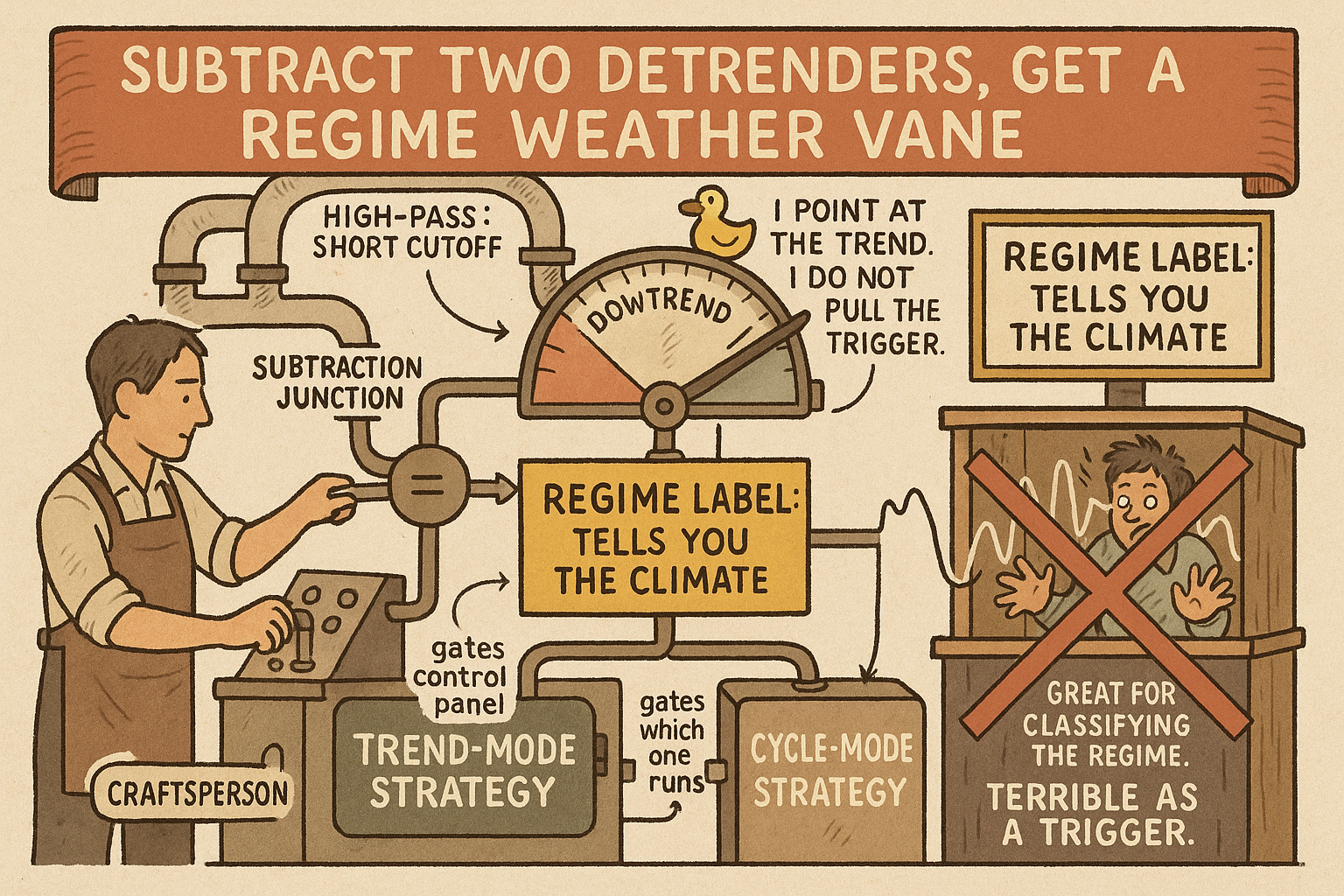
The old article "Decyclers: Extracting Trend by Removing Cycle Energy" built the decycler: instead of smoothing price until the cycle fades, subtract the cycle out directly, leaving a clean trend line at low lag. This article uses the same subtraction trick twice over to build something different, a regime detector. Take two high-pass filters at different cutoffs, subtract one from the other, and you get an oscillator that crosses zero when the market flips between trending up and trending down. It is a useful classifier and a dangerous signal, and the difference between those two uses is the whole point of the article.
A reminder: the decycler subtracts the cycle away
The decycler comes from subtracting a high-pass filter's output from the input. The high-pass keeps the fast cycle and noise; remove it from the price and what survives is the slow trend.
$$ H_{\text{decycler}}(z) = 1 - H_{\text{HPF}}(z) = \frac{(\alpha/2)(1 + z^{-1})}{1 - (1-\alpha)z^{-1}} $$
Algebraically that is a one-pole low-pass, so the decycler is not a new filter, it is a low-pass wearing better clothes. The clothes matter, as the old article "Decyclers: Extracting Trend by Removing Cycle Energy" argued: the dial is an interpretable cycle-cutoff period, remove everything shorter than 30 bars, instead of an opaque smoothing constant. The decycler gives you a trend line whose meaning you can state in plain language.
The oscillator: difference two high-pass filters
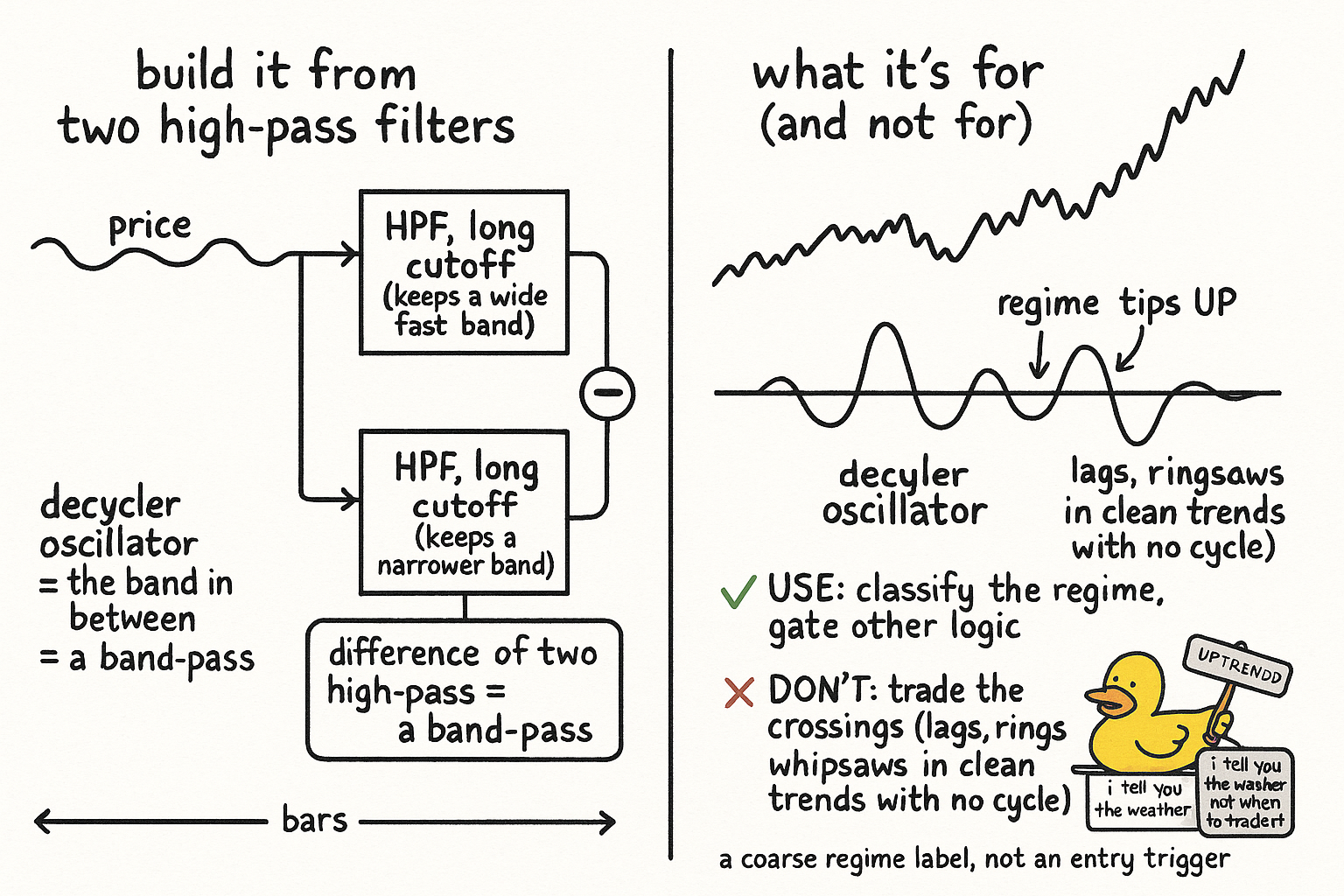
The decycler oscillator is built by subtracting the output of a high-pass filter with a short cutoff period from the output of a high-pass filter with a longer cutoff period.
$$ \text{decycler oscillator} = H_{\text{HPF, short cutoff}} - H_{\text{HPF, long cutoff}} $$
Think about what each high-pass keeps. The short-cutoff high-pass keeps everything faster than a short period, a wide band of cycles. The long-cutoff high-pass keeps only everything faster than a longer period, a narrower band. Subtract the narrow band from the wide band and what remains is the slice in between, the band of cycles between the two cutoffs. So differencing two high-pass filters is a band-pass, and the decycler oscillator passes a chosen middle band of trend-transition speeds while rejecting both the very slow drift and the very fast noise.
The output oscillates around zero, and its zero crossings are the event you care about. When the oscillator crosses from below zero to above, the medium-term motion has tipped from down to up; the reverse crossing marks the flip from up to down. It is built to mark the transition between uptrends and downtrends, which a single moving average reports late and a single decycler line does not flag at all.
Classifier, not signal: where this earns its keep and where it kills you
Here is the line that decides whether the decycler oscillator helps or hurts. It is a regime classifier, not a tradeable entry signal, and treating it as the latter is how you lose money with a tool that works.
As a classifier it answers a coarse, honest question: is the medium-term structure currently leaning up or down? That label is useful upstream, gating a trend-following system on so it stands aside when the oscillator says the regime is against it, or switching a strategy between trend-mode and cycle-mode logic. Used that way, its lag and its bluntness are tolerable, because you are reading a slow-changing state, not timing a fill.
As a signal it fails the way every cycle tool fails. The decycler oscillator is a band-pass, so it inherits the band-pass's habits: it lags the actual turn, it rings, and it manufactures false crossings when the market is trending cleanly with no cycle in the band it watches, the exact failure the old article "Decyclers: Extracting Trend by Removing Cycle Energy" flagged when it said the oscillator wins only when a clear cycle band exists. Trade its zero crossings directly and you buy late, sell late, and whipsaw through every trend that does not happen to oscillate at its tuned band. And like everything in this pillar it is backward-looking: a zero crossing reports that the regime already changed, it does not predict the next one. Use it to label the regime and gate other logic, never as the trigger that pulls the trigger.
KEY POINTS
- The decycler subtracts a high-pass filter's output from the input, leaving the trend; algebraically it is a one-pole low-pass with an interpretable cycle-cutoff dial, from the old article "Decyclers: Extracting Trend by Removing Cycle Energy."
- The decycler oscillator subtracts a long-cutoff high-pass from a short-cutoff high-pass. Differencing two high-pass filters keeps the band in between, so the oscillator is a band-pass on the trend-transition band.
- Its zero crossings mark regime flips: below-to-above signals the medium-term motion tipping from down to up, and the reverse marks up to down, a transition a single moving average reports late.
- It is a regime classifier, not a tradeable signal. As a classifier it gives a coarse up-or-down state useful for gating trend-following or switching trend-mode and cycle-mode logic.
- As a signal it fails like any band-pass: it lags the turn, rings, and whipsaws when the market trends cleanly with no cycle in its band, so it wins only when a clear cycle band exists.
- It is backward-looking: a zero crossing reports the regime already changed. Use it to label the regime and gate other logic, never as the entry trigger.
A note on AI. The ideas, research, analysis, and conclusions in this article are my own. I use AI tools to help with editing and wordsmithing, because English is not my first language, and I am not shy about that. AI-generated ideas and AI-assisted writing are not the same thing: the first is empty slop from a generic prompt, the second is a tool for communicating years of real research more clearly. Judge the work by its substance, not by whether software helped polish the prose.