2.33 The Butterworth Filter for Traders
The Butterworth is the maximally flat low-pass: slow cycles pass with no ripple, each pole cuts noise harder. The bill is lag, about one EMA's worth per pole, so two poles is the sweet spot.
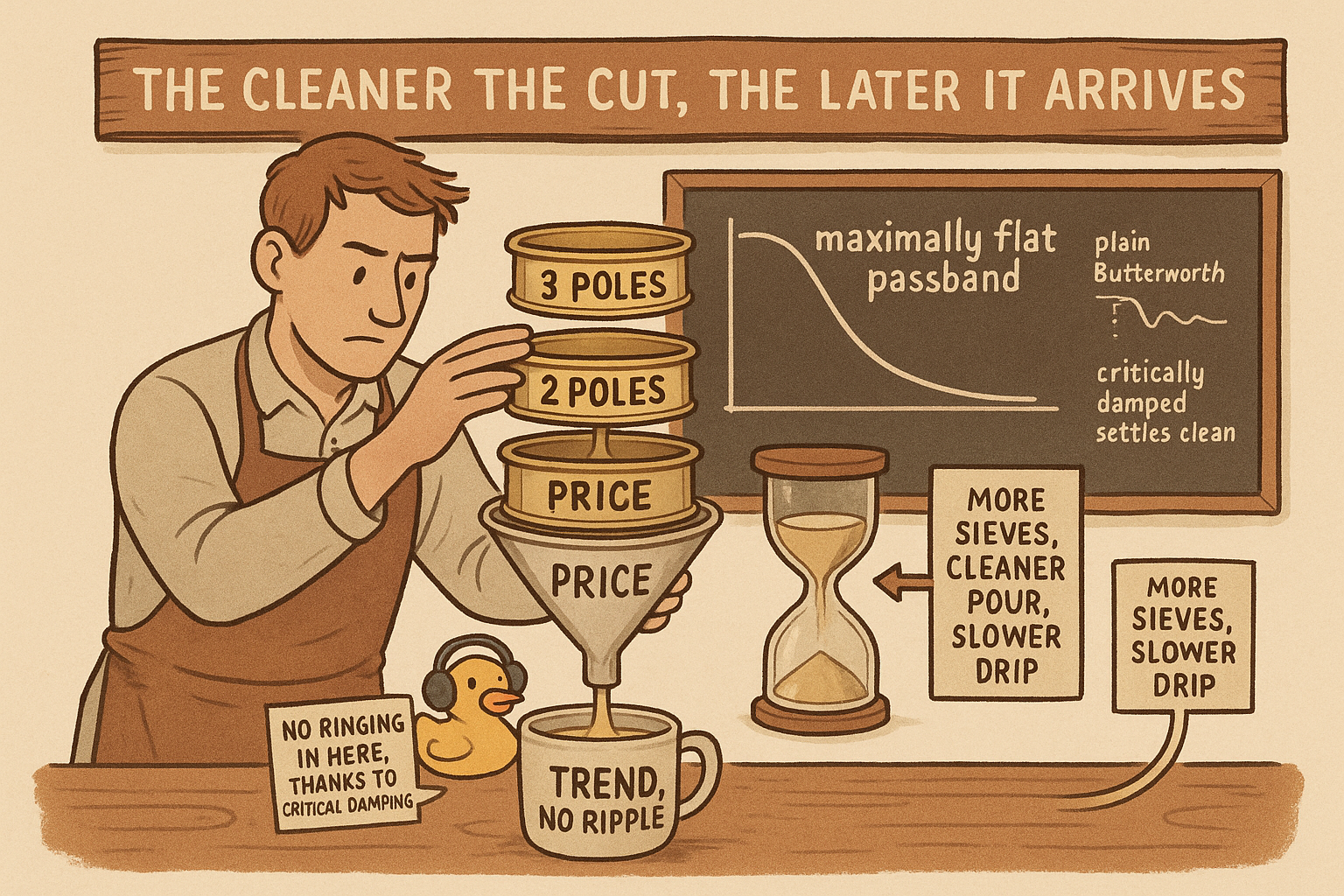
The old article "The Trader's Guide to Low-Pass Filters" gave you the recipe for the one- and two-pole smoothers that do most of the trend-extraction work, and noted in passing that the super-smoother is a critically damped two-pole Butterworth. This is the Butterworth itself, the filter electrical engineers reach for first when they want a smoother whose passband has no ripple. It buys you one specific property the EMA cannot give: a maximally flat passband, so the slow cycles you want to keep come through at full size with no bumps, while everything past the cutoff falls away faster the more poles you add. The catch is the same tax every causal smoother pays, and the Butterworth pays it harder with each pole.
Maximally flat, by construction
The Butterworth is defined in the continuous domain by a transfer function whose denominator is a polynomial of order N, with the order setting the number of poles.
$$ H(s) = \frac{1}{s^N + a_{1}s^{N-1} + \cdots + a_{N-1}s + a_N}, \qquad s = \frac{j\omega}{\omega_c} $$
The variable s is the cycle speed scaled by the cutoff speed omega-c, the point where the filter has dropped to the half-power level. The coefficients a are fixed numbers that depend only on the order N, tabulated once and reused. The defining feature is what the magnitude does: it decreases monotonically as the cycle speed rises, with no ripple anywhere in the passband. The slow cycles you want come through flat and untouched, which matters for a trend filter because ripple in the passband would distort the very trend you are trying to read. Among the standard filter families this flatness is the Butterworth's signature, and it is the reason Ehlers ported the two- and three-pole versions to price data.
More poles, sharper cut, more lag
The order N is the dial, and it controls the sharpness of the boundary between what passes and what dies.
$$ |H(\omega)| = \frac{1}{\sqrt{1 + (\omega/\omega_c)^{2N}}} $$
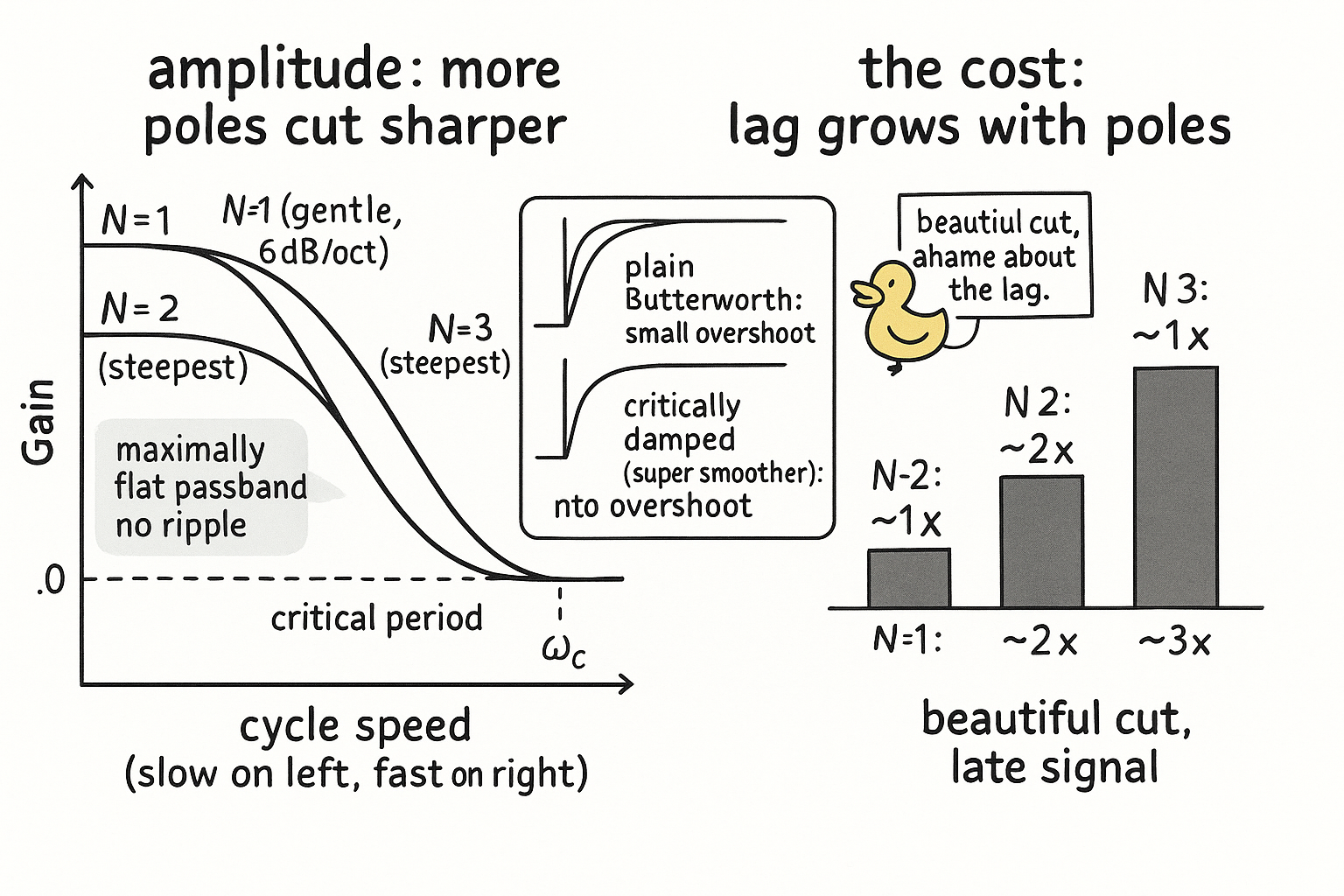
Read the exponent. With N equal to 1 the magnitude falls off gently, the same six-decibels-per-octave slope as a single EMA. Raise N to 2 and the falloff doubles to twelve per octave; raise it to 3 and the transition band, the stretch of cycle speeds between full pass and full stop, narrows again. A higher order means a cleaner separation, a filter that holds the trend at full gain closer to the cutoff and then drops the noise harder past it. For cycle-detection pipelines where a sloppy cutoff lets the wrong band leak through, that sharpness is worth paying for.
The payment is lag, and it climbs with every pole. Each pole adds roughly one EMA's worth of delay at the same critical period, so a two-pole Butterworth lags about twice a one-pole EMA tuned to the same cutoff, and a three-pole lags about three times. This is the same structural delay the old article "The Trader's Guide to Low-Pass Filters" priced for the pole count, and it does not go away because the magnitude response looks elegant. Past a few poles the lag makes the filter useless for real-time trading: the cut gets beautiful and the signal arrives too late to act on. For most daily-frequency work two poles is the sweet spot, and three is the ceiling.
The critically damped variant avoids the ringing
A plain Butterworth above one pole has a subtle vice. The poles sit at locations that produce a small overshoot and ringing in the step response, so when price gaps the filter output briefly swings past the new level and oscillates before settling. On a step-sensitive job like breakout or regime-change detection, that overshoot manufactures false signals. The super-smoother from the old low-pass article is the repair: it moves the two poles to conjugate, critically damped locations that give the same twelve-per-octave rolloff with no overshoot and a monotonic settle. So the two-pole Butterworth and the super-smoother share a rolloff slope and differ in step behavior, and for trading you usually want the critically damped version because clean settling beats a marginally different passband shape.
This leaves a short rule for choosing a Butterworth on price data. Use two poles as the default when you want a sharper cut than an EMA gives and can absorb double the lag. Reach for three only in cycle-detection pipelines where the cleanliness of the boundary earns its keep and the extra lag is acceptable. Stop there, because beyond three poles the lag dominates. And prefer the critically damped coefficients whenever the downstream logic reacts to steps, so a gap does not ring its way into a false trade.
KEY POINTS
- The Butterworth is the engineer's default low-pass: its passband is maximally flat, so the slow cycles you keep pass at full size with no ripple, which is what a trend filter needs.
- It is defined by an order-N denominator polynomial with fixed tabulated coefficients; the magnitude falls off monotonically with cycle speed and has no bumps.
- The order N is the dial. Each pole steepens the rolloff (6 dB/octave per pole) and narrows the transition band, giving a cleaner split between the trend kept and the noise killed.
- The price is lag, climbing roughly one EMA's worth per pole, the same structural delay the old article "The Trader's Guide to Low-Pass Filters" priced. Two poles is the daily sweet spot, three the ceiling, beyond that the signal arrives too late.
- A plain multi-pole Butterworth overshoots and rings on a price gap, manufacturing false signals on step-sensitive logic. The critically damped super-smoother gives the same rolloff with a clean monotonic settle.
- Choose two poles by default, three only for cycle-detection pipelines that need the sharp boundary, and prefer the critically damped coefficients whenever downstream logic reacts to steps.
A note on AI. The ideas, research, analysis, and conclusions in this article are my own. I use AI tools to help with editing and wordsmithing, because English is not my first language, and I am not shy about that. AI-generated ideas and AI-assisted writing are not the same thing: the first is empty slop from a generic prompt, the second is a tool for communicating years of real research more clearly. Judge the work by its substance, not by whether software helped polish the prose.