11.5 Prop Firm Math: Edge, Barriers, and Cash After the Fee
A prop account is a discretionary payout contract on a simulated book, not capital. Read the framing here; download the full book as PDF.
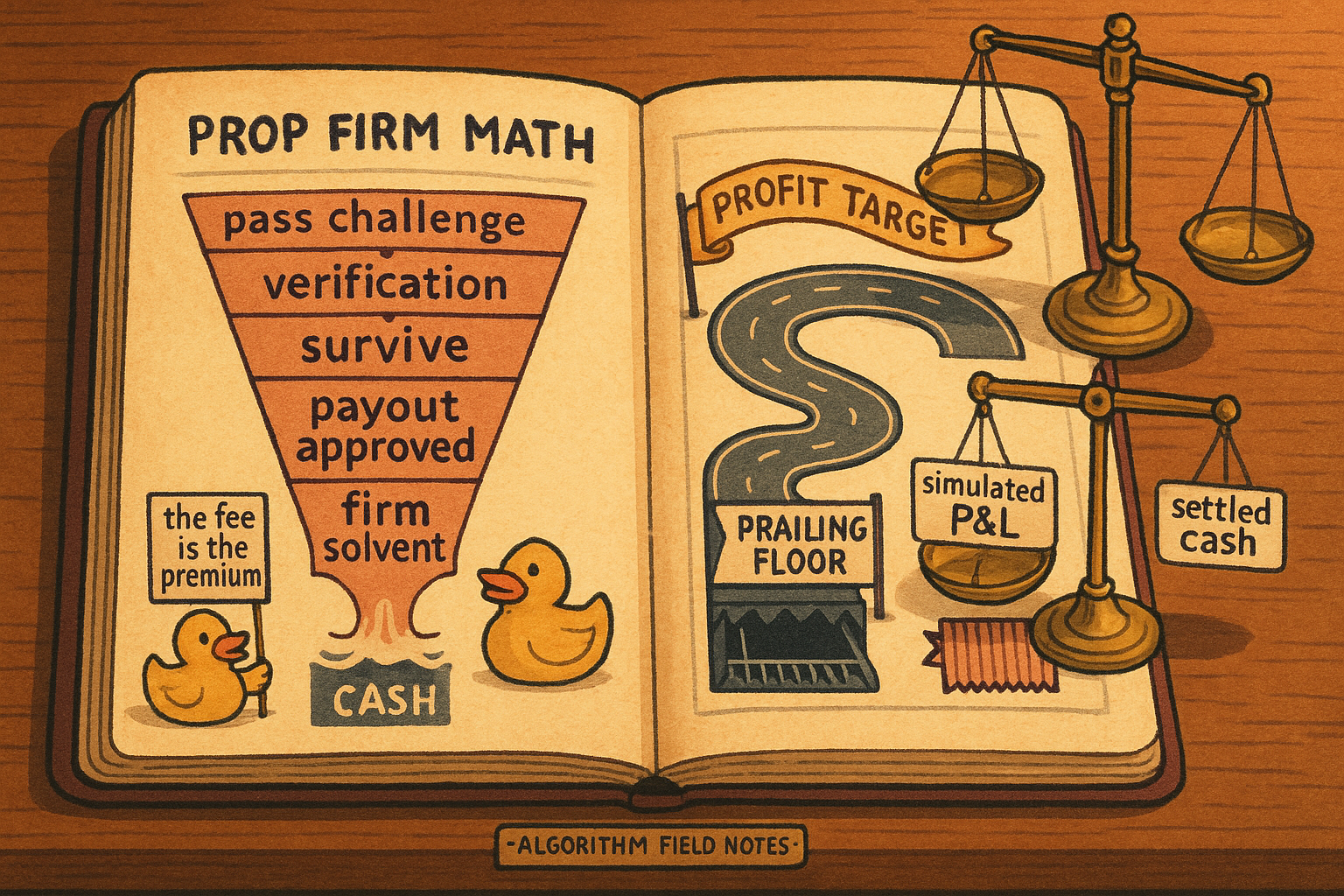
You buy a discretionary payout contract written on a simulated book. The fee buys an attempt to reach a profit target without piercing absorbing floors. Clear the gates and the firm may share a fraction of the simulated profit as cash, at its discretion. Traders who size and optimize for the challenge alone turn positive-looking strategies into negative-EV fee machines.
The objective that runs through the book:
maximize discounted realized cash payouts after fees, trading costs, rule risk, and counterparty risk.
Pass probability, verification survival, funded lifetime, and growth sit inside that objective as intermediate metrics. Maximize any one of them alone and you can destroy total value. Strategy, sizing stack, literal rule schema, payout process, and counterparty form one system. A signal with post-cost edge still loses money if the path dies on a daily cliff or the firm never pays.
Who this is for
I assume you can read a barrier equation and a block bootstrap. You size from code or a spreadsheet. "Risk 1%" and "pass the challenge" fail as decision procedures under daily-loss cliffs, trailing floors, lot quantization, and a firm that moves second. Pip primers belong elsewhere. The book estimates cash from a validated edge, or shows before the next fee that the conversion fails.
The chain
Cash requires six links:
- Edge. Post-cost, out-of-sample drift mu bounded away from zero. Lower bound straddles zero: stop. Risk geometry does not rescue a zero-EV strategy.
- Path. Rules score path shape. At equal expectancy, lumpy paths breach; smoother paths survive.
- Sizing. Size from the cushion above the active floor, well below full Kelly, as the minimum over every live cliff, rounded down to executable lots.
- Simulation. No closed form covers the full rule set. Monte Carlo on the trade log under the literal rules returns survival-adjusted Net EV.
- Counterparty-adjusted EV. Pass probability is simulated bookkeeping. Settlement fractions and payment hazard push the break-even above naive fee recovery.
- Cash. Settled payout from a firm that still exists and still pays. Farm, churn, or hybrid follows from that hazard.
Retail prop screens stop at headline returns. They leave links five and six unmodeled.
What the book covers
Part I — The Contract. Purchase object, single objective, farm/churn/hybrid fork from payment hazard, rules as executable constraints, running example: dated 10k FTMO 2-Step CFD account with barriers tight enough that mistakes show.
Part II — The Path to the Barrier. First-passage math, path dependence of daily and trailing floors, five-layer sizing stack, four-state controller from challenge through post-payout farming.
Part III — The Return Process. Edge gate (walk-forward, nested CV, block-bootstrap lower bound), path geometry the rules reward, portfolios on joint breach probability, execution as a term in realized edge.
Part IV — Simulation and Economics. Rule-aware simulator, payout-EV chain, attempt portfolios, firm selection under adversarial counterparty risk.
Part V — Stress Test and Operation. Synthetic end-to-end stress test (Strategy A): designed inputs, measured outputs, companion code. Live health engine for funded accounts after edge decay. Closing synthesis.
Appendices. Frictionless academic core, notation, rule-schema detail, bibliography by source class.
Reading order
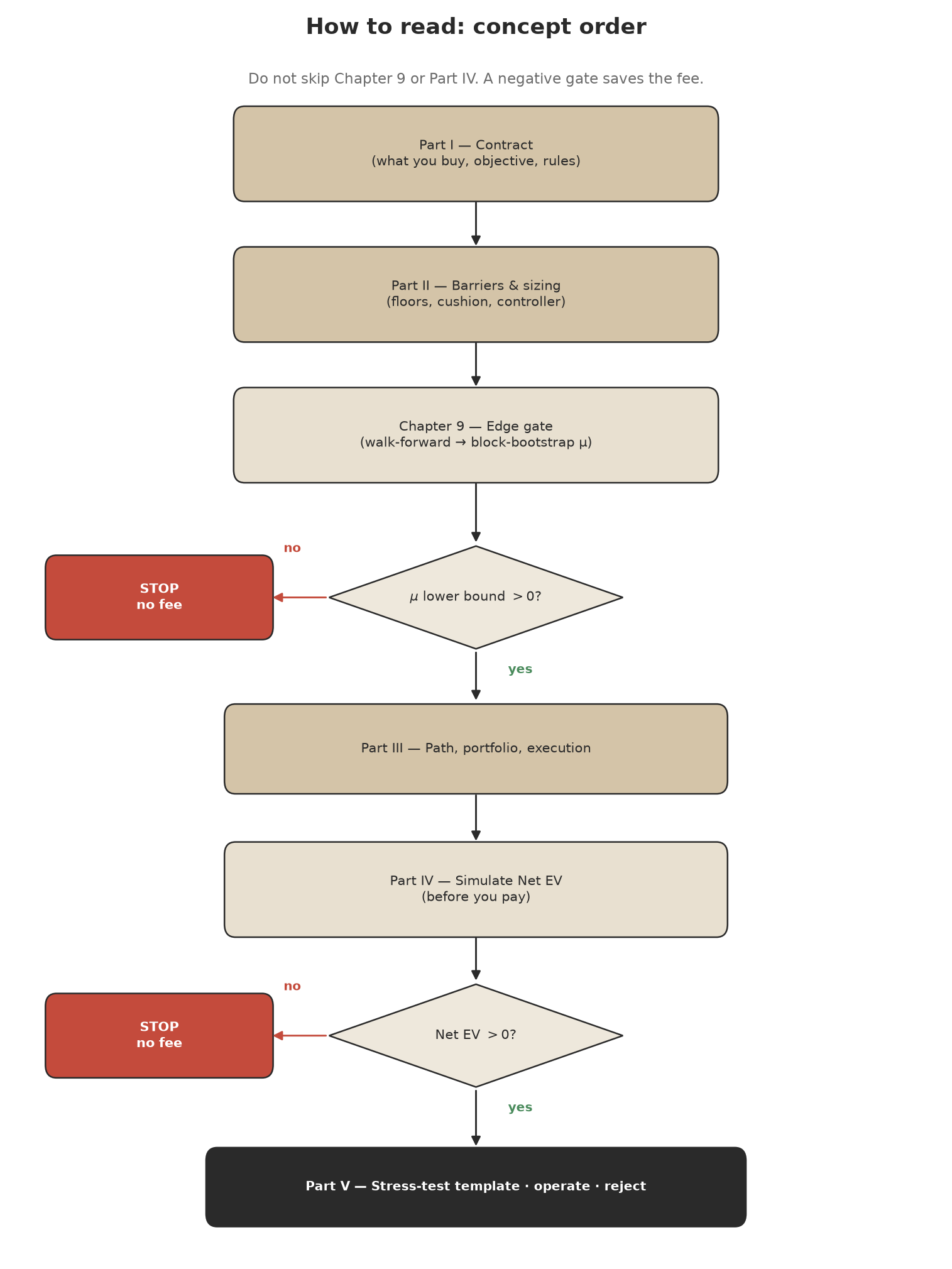
Parts I–II first. Chapter 9 is mandatory; everything downstream assumes mu is real. Part IV decides before you pay a fee. Part V is the rejection template. Strategy A is synthetic; swap in a real trade log.
The decision the book forces: can this strategy, at this size, on this symbol, survive these rules long enough to reach a payout and get paid by this counterparty often enough across enough attempts to beat the full cost chain? A negative answer saves the fee.
Download the full book (PDF)
This post is the introduction only. The full pre-publication edition — contract framing, barrier math, sizing stack, edge gate, simulation, counterparty-adjusted Net EV, stress test, and appendices — is in the PDF.
Pre-publication edition, July 2026 (v0.9). Free to read; treat it as a working draft, not a finished textbook.
KEY POINTS
- A prop account is a discretionary payout contract on a simulated book, not brokerage capital.
- Optimize discounted realized cash after fees, costs, rule risk, and counterparty risk — not pass rate alone.
- Six links from edge to cash; retail screens usually stop before counterparty-adjusted EV.
- If the post-cost lower bound on mu straddles zero, or Net EV after hazard is negative, skip the fee.
- Full derivations, figures, worked FTMO 10k example, and appendices are in the PDF above.
A note on AI. The ideas, research, analysis, and conclusions in this article are my own. I use AI tools to help with editing and wordsmithing, because English is not my first language, and I am not shy about that. AI-generated ideas and AI-assisted writing are not the same thing: the first is empty slop from a generic prompt, the second is a tool for communicating years of real research more clearly. Judge the work by its substance, not by whether software helped polish the prose.