4.77 Cross-Venue Arb: Deribit Inverse Options × Polymarket Binaries
Pair a Deribit inverse call with Polymarket binaries and you build a payoff that never loses: 24 trades, zero losses, 20.7% each. The catch: it is a directional bet with a floor, and it barely ever fires.
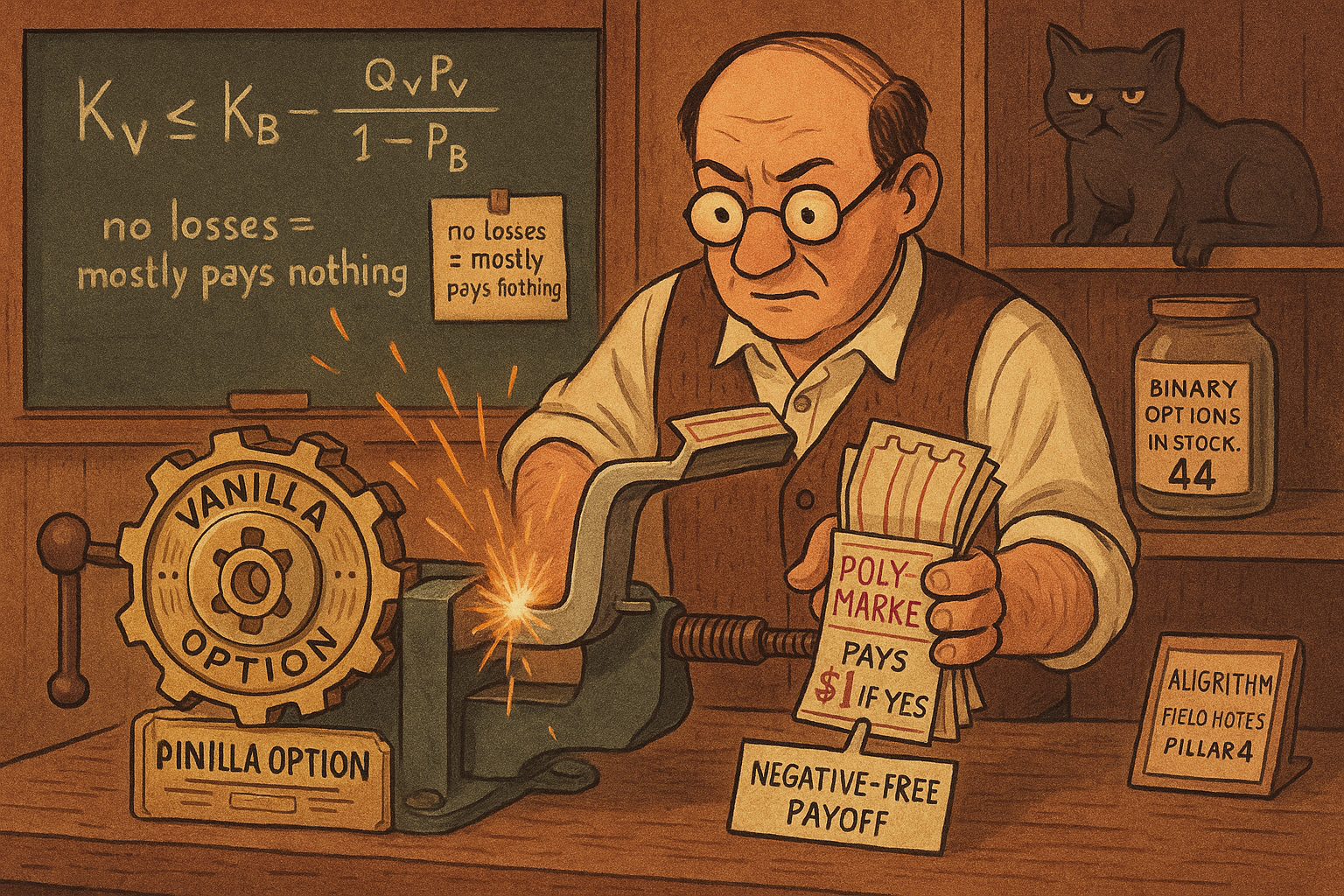
Open two browser tabs. In one, a Deribit Bitcoin call expiring Friday at 08:00 UTC, priced and settled in BTC. In the other, a Polymarket contract asking "Will Bitcoin be above $90,000 on Friday?", priced in cents between zero and one dollar. One is a regulated-adjacent institutional derivative quoted by market makers running Black-76. The other is a bet that pays a flat dollar, priced by whoever showed up to click yes or no. Nobody prices these two against each other, because they look nothing alike. That gap is the trade.
Augustin Valery's paper works out the exact condition under which you can buy a vanilla option on one venue and a pile of binary contracts on the other, and walk to expiry knowing you cannot lose money. He tests it on Bitcoin and Ether over 580 days and reports 24 trades, zero losses, and about 20.7% average return per trade. Strong headline. The fine print is that the thing is barely ever available, and calling it "arbitrage" hides that it is a directional bet with a floor bolted on. Both halves of that sentence are true, and both matter.
Two instruments that look nothing alike
Start with the Deribit leg, because its payoff is weird before it is useful. A Deribit call is an inverse option: you pay for it in Bitcoin, and it settles in Bitcoin. The intrinsic value in coin terms is the notional times max of one minus strike over spot, or zero.
$$ V_C^{\mathbb{B}}(K, T) = N^{\mathbb{B}} \cdot \max\!\left( 1 - \frac{K}{S_T},\, 0 \right) $$
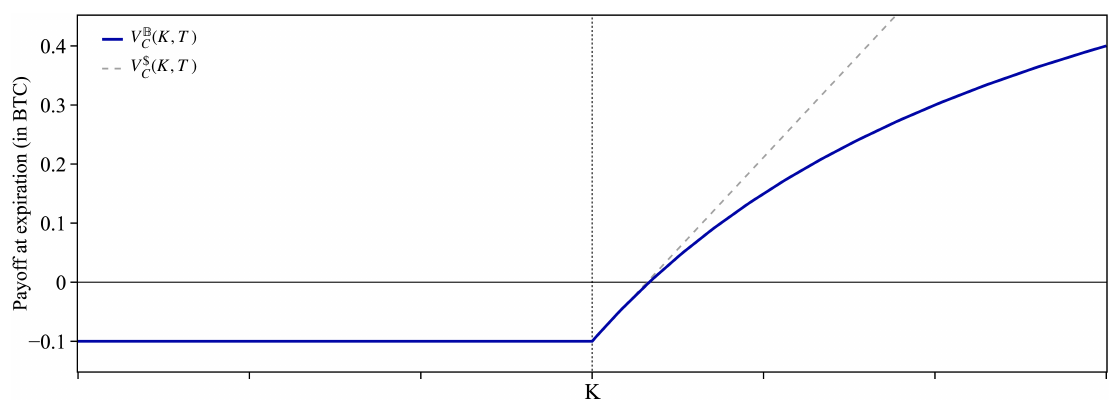
Read it in plain terms. N is how many coins of notional. K is the strike, S_T is the spot at expiry. When the option finishes in the money, its coin-denominated payoff is one minus the ratio of strike to spot. The higher BTC goes, the smaller K over S_T gets, so the payoff in coins keeps climbing but at a slowing rate. That decay is the "inverse" quirk: a call that pays in the same asset it bets on has a concave payoff when you measure it in coins.
Work one number. Take one BTC of notional, strike $88,588, and suppose BTC prints $92,000 at expiry. The coin payoff is one minus 88,588 over 92,000, which is one minus 0.9629, so 0.0371 BTC. Convert that to dollars at the $92,000 expiry price and you get $3,412, which is exactly spot minus strike. The one-over-S_T factor that bent the coin payoff cancels the moment you sell the coins for dollars. That is the whole reason the paper insists on converting the vanilla leg to dollars first: only in dollar terms does the inverse option flatten back into the ordinary piecewise-linear call payoff that lines up against a binary.
The Polymarket leg is the opposite kind of animal. A binary pays a fixed one dollar if its outcome resolves true and nothing if it resolves false. Its value at expiry lives in the set of zero or one:
$$ V_C(K, T) = \begin{cases} 1 & \text{if } S_T > K \\ 0 & \text{otherwise} \end{cases} $$
You pay a price P between zero and one for it, so your net outcome is either minus P if you are wrong or one minus P if you are right. A binary "yes" is a digital call, a binary "no" is a digital put, and the price is the crowd's implied probability. Buy the "no" at $0.15 and you are paying 15 cents to collect 85 cents if the price finishes below the strike. Flat payoff on each side of the strike, a cliff at the strike. Nothing concave about it.
The trade: bolt a floor onto a call
Here is the move. A vanilla call bleeds its premium whenever the underlying finishes below the strike. Its payoff is minus P for any S_T below K, then negative-but-rising between K and K plus P, then positive above that. So the call loses money across a whole region of outcomes. The binary that points the other way pays off in exactly that region. Buy enough binary puts and their winnings cover the call's premium whenever the call dies. Do it right and the combined position never settles negative.
The paper is careful about the word "enough," because a naive hedge breaks in the other direction. When BTC rallies past the binary's strike, the binary puts you bought all expire worthless, and now you are down their combined premium. You need the call's upside to cover that too. Two conditions, then: enough binaries to cover the call, and enough distance between the strikes that the call's gain covers the binaries when they lose. Miss either and the floor has a hole.
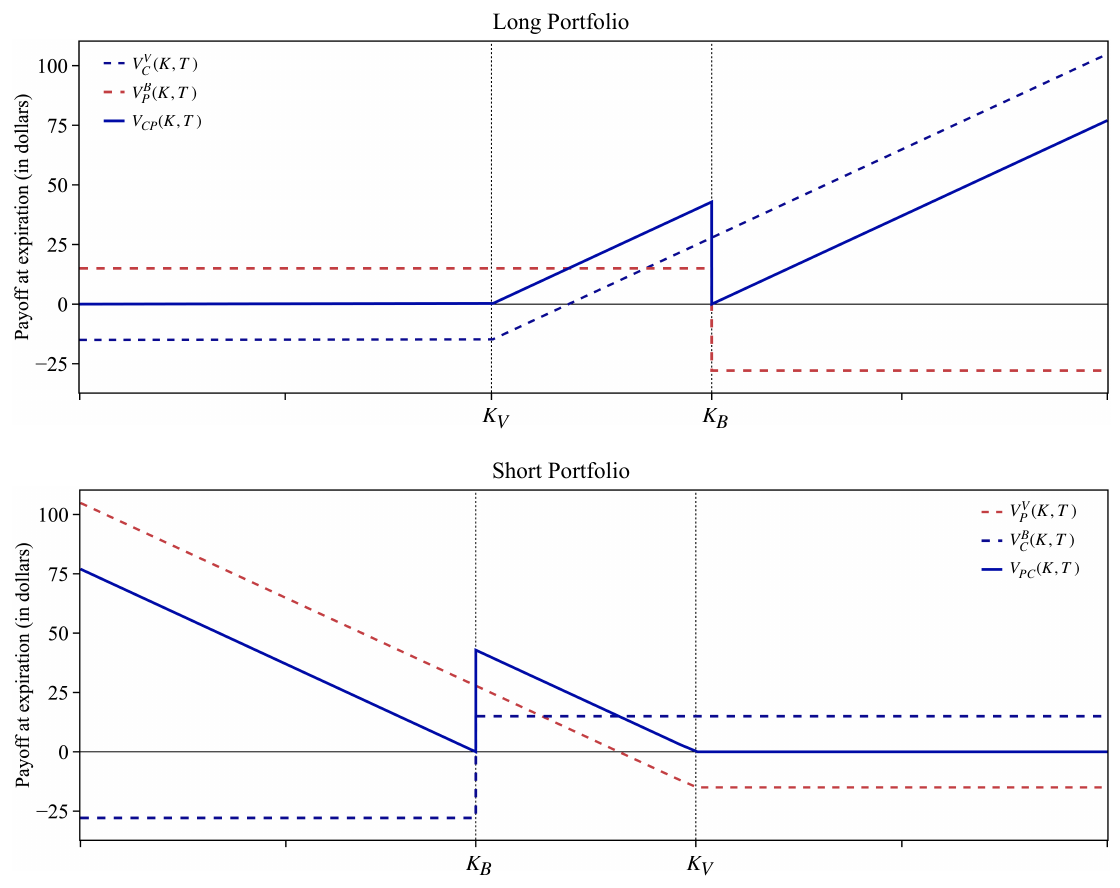
The combined line is the point. Below the vanilla strike K_V the two legs cancel to a flat zero, not a loss. Inside the interval between K_V and K_B both legs pay, giving a bump. Above K_B the call runs on its own. The shape is an ordinary long-option payoff with its downside sawed off at zero. That is also the tell: this is a call in disguise, not a market-neutral arbitrage. You still need Bitcoin to move your way to make anything.