6.40 From Econophysics to Practical Trading Signals
Econophysics describes markets beautifully but predicts nothing tradable alone. It shows where to look and keeps the tails in mind; reaching profit takes the same testing and costs as any strategy.
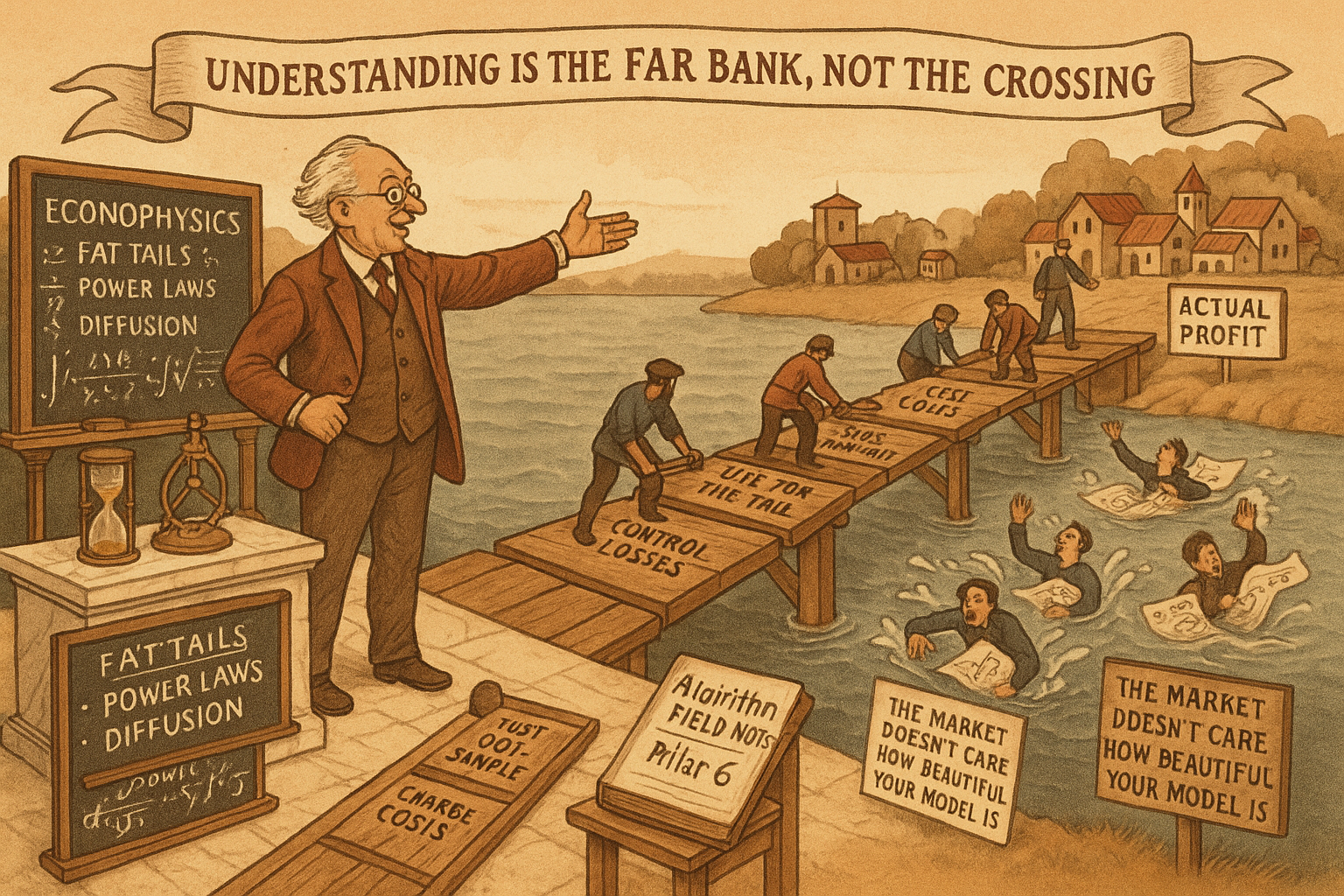
Econophysics gives you a beautiful understanding of markets and almost no money directly. The fat tails, the anomalous diffusion, the power laws, the entropy, the complex-systems framing of this pillar's final run, all of it explains why markets behave as they do with a depth that charting and folklore never approach, and none of it is a trading signal on its own. The gap between understanding a market and profiting from one is wide, and it is where most of the elegant physics dies, because a model that describes price beautifully is not the same as a rule that extracts money from it after costs. This closes Pillar 6 by being honest about what the physics buys you and what it does not.
Understanding is not an edge
The seduction of econophysics is that the models are genuinely true in a way most trading lore is not. A Lévy distribution really does fit the body of returns better than a Gaussian; markets really do diffuse anomalously; crashes really do follow power laws. The trouble is that being a correct description and being a profitable signal are different properties, and the physics delivers the first while staying silent on the second. Knowing that returns are fat-tailed tells you to size for catastrophe; it does not tell you when the catastrophe comes. Knowing that a series superdiffuses tells you it trended; it does not tell you it will keep trending. The descriptive truth is real and the predictive payoff has to be extracted separately, against all the obstacles the rest of this pillar catalogs.
This is why the econophysics literature is full of models that explain everything and predict nothing tradable. The log-periodic crash precursor, the Tsallis-entropy return distribution, the multifractal volatility model, each captures a real feature of markets and each, when you try to trade it, runs into the same wall: the structure it describes is either too weak to beat costs, too unstable to persist, or already priced by everyone who read the same papers. The elegance of the description is not evidence of tradability, and the temptation to assume it is, to believe that a model this beautiful must pay, is exactly the trap "The Three Stages of a Trading Idea: Absurd, Familiar, Inevitable" warned about, mistaking your own excitement for an edge.
The bridge is the same discipline as everything else
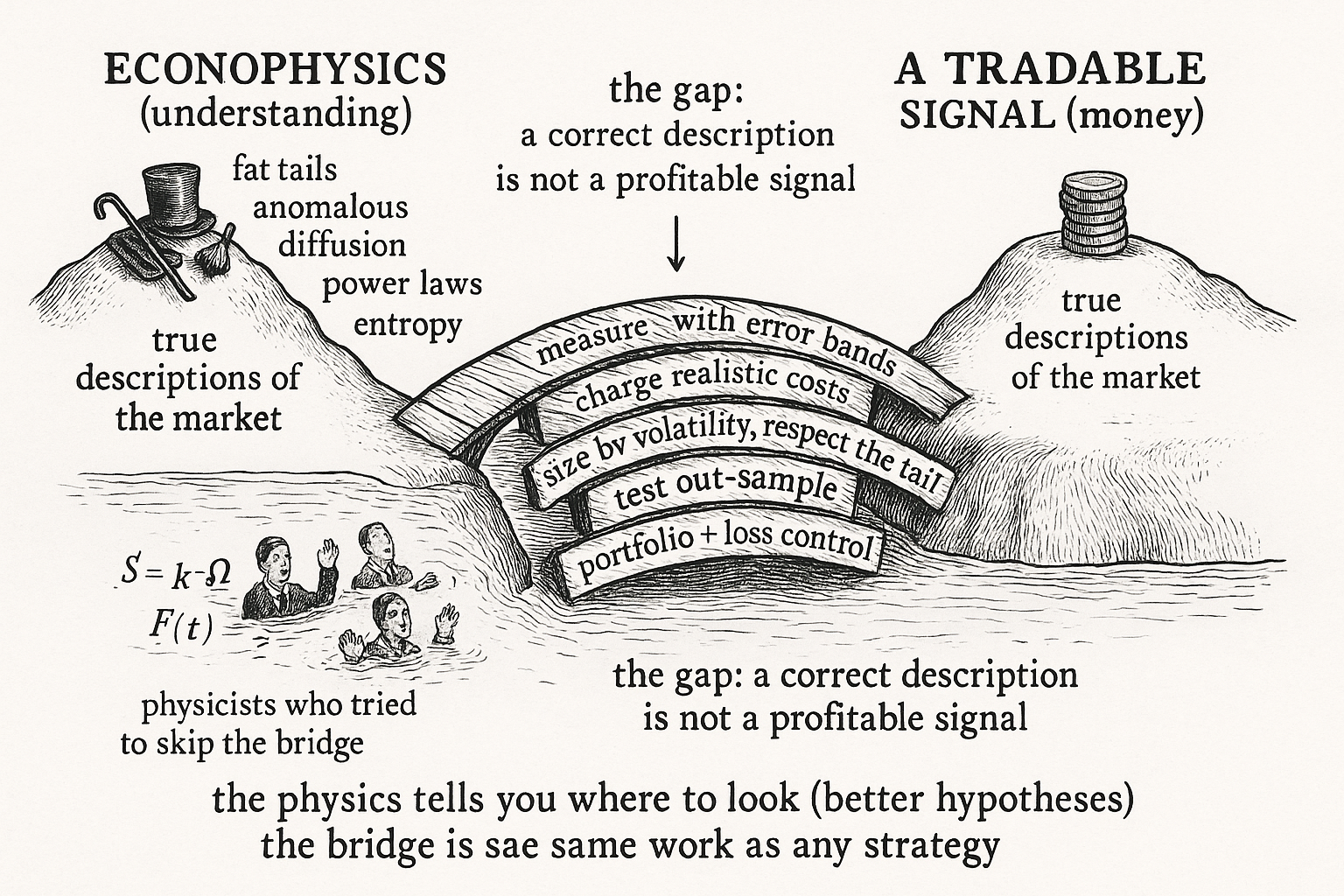
Crossing from understanding to a signal requires the unglamorous machinery this entire series has built. The physics tells you where to look, the departures from the random walk, the regimes where diffusion is anomalous, the conditions where structure appears, and finding where to look is a genuine contribution, because it beats searching blindly. But turning a promising place into a tradable signal demands the same steps as any other strategy: measure the structure honestly with proper error bands, as in "Variance Ratio Tests for Traders"; charge realistic costs and confirm the edge survives them, as in "Cost-Aware Ranking: The Missing Step in Cross-Sectional Strategies"; size by volatility and respect the fat tail; check it out-of-sample with the skepticism about overfitting that haunts every article here; and build the portfolio and the loss control that turn a raw signal into something you can actually run.
The physics, in other words, is an input to the front of the pipeline, not a replacement for the pipeline. It supplies hypotheses with better motivation than a data-mined pattern, an idea grounded in a mechanism rather than an accident of the backtest, which matters because a mechanistically motivated signal is less likely to be pure overfit. But a well-motivated hypothesis still has to survive the same testing as a poorly-motivated one, and many do not. The value of econophysics is that it raises the quality of your hypotheses and your understanding of risk; the work of converting a hypothesis into a strategy is unchanged, and skipping it because the physics is elegant is how smart people lose money with beautiful models.
What the physics is actually for
The honest conclusion is that econophysics earns its place not as a signal factory but as a way of seeing the market correctly, which protects you and occasionally points you somewhere useful. It protects you by making the fat tails, the regime shifts, and the complex-systems fragility vivid and permanent in your thinking, so you size and build for the market that exists rather than the Gaussian one that is convenient, which is the difference between surviving and not. It points you by suggesting where exploitable structure might live and why, giving your search a mechanism to chase instead of a blind sweep. And it disciplines your expectations by explaining why edges decay and why crashes are inevitable, so you neither over-trust a model nor get blindsided by the tail.
That is a substantial return on understanding, and it is not the same as a return on capital, which only the full discipline of the pillar produces. The trader who takes econophysics as a worldview, sizes for its tails, hunts where it points, and then runs every candidate through the same ruthless testing and cost accounting as everything else, gets the best of it. The trader who takes it as a shortcut, who believes the beauty of the model substitutes for the verification, joins the long line of physicists who arrived in finance certain that markets would yield to elegant mathematics and learned, expensively, that the market does not care how beautiful your model is, only whether your edge survives contact with costs, capacity, and the tail. The whole of this pillar has been the bridge from understanding to survival, and the physics is the far bank, worth reaching and not, by itself, worth standing on.
Visualizing the bridge
KEY POINTS
- Econophysics gives a deep, true understanding of markets and almost no money directly. The fat tails, anomalous diffusion, power laws, and complex-systems framing explain market behavior without being trading signals.
- A correct description and a profitable signal are different properties. The physics delivers the description and stays silent on the prediction: knowing returns are fat-tailed says size for catastrophe, not when it comes.
- The literature is full of models that explain everything and predict nothing tradable, because the structure they describe is too weak to beat costs, too unstable to persist, or already priced by everyone who read the papers.
- The elegance of a model is not evidence of tradability. Believing a beautiful model must pay is mistaking your excitement for an edge, the absurd-idea trap.
- The physics is an input to the front of the pipeline, supplying better-motivated hypotheses, not a replacement for it. A well-motivated hypothesis still needs the same honest testing, cost accounting, sizing, and out-of-sample validation as any other.
- Econophysics earns its place as a way of seeing the market correctly: it makes the tails and fragility permanent in your thinking, points your search at mechanisms, and disciplines your expectations, which is a return on understanding, not a return on capital.
A note on AI. The ideas, research, analysis, and conclusions in this article are my own. I use AI tools to help with editing and wordsmithing, because English is not my first language, and I am not shy about that. AI-generated ideas and AI-assisted writing are not the same thing: the first is empty slop from a generic prompt, the second is a tool for communicating years of real research more clearly. Judge the work by its substance, not by whether software helped polish the prose.