2.59 Convolution: Detecting Reversals by Folding Price
A market turn is a reflection in time, so fold price about a candidate bar and correlate the halves. A bright, scale-persistent symmetry stripe marks the reversal, at the cost of honest, unavoidable confirmation lag.
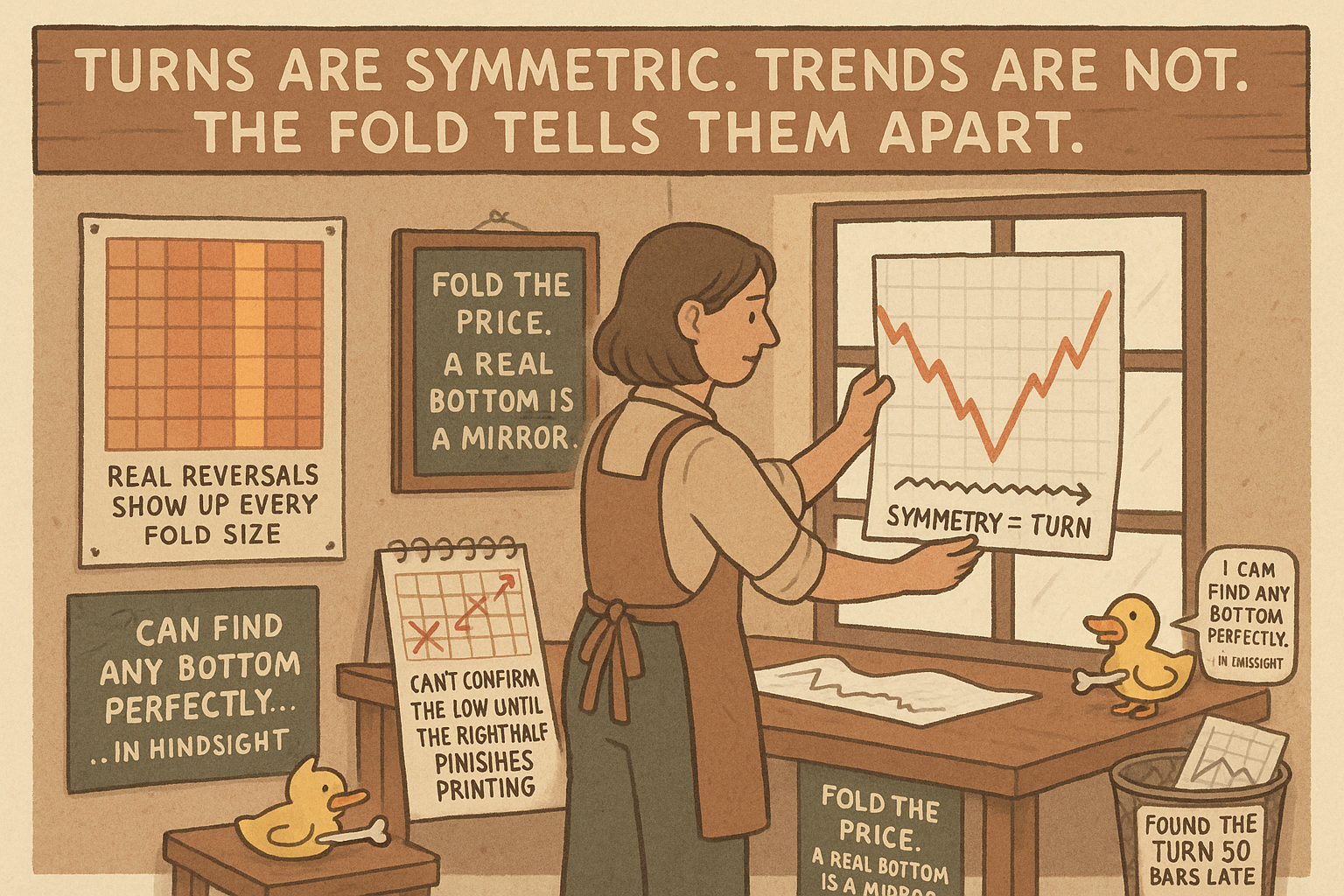
The whole point of trend trading is to be in the market the right way around after a major turn, and the old article "Why Moving Averages Can Lie at Turning Points" showed why the usual tools find that turn late: a moving average at a reversal reports a blend of the regime that just ended. So skip the average and ask a sharper question directly. A market bottom has a shape: prices fall into it and rise out of it, roughly mirror images around the low. If a stretch of price is symmetric about some bar, that bar is a turn. Folding the price around a candidate point and measuring how well the two halves match is a reversal detector that owes nothing to a moving average, and it lights up at the turn instead of after it.
What a turn actually looks like
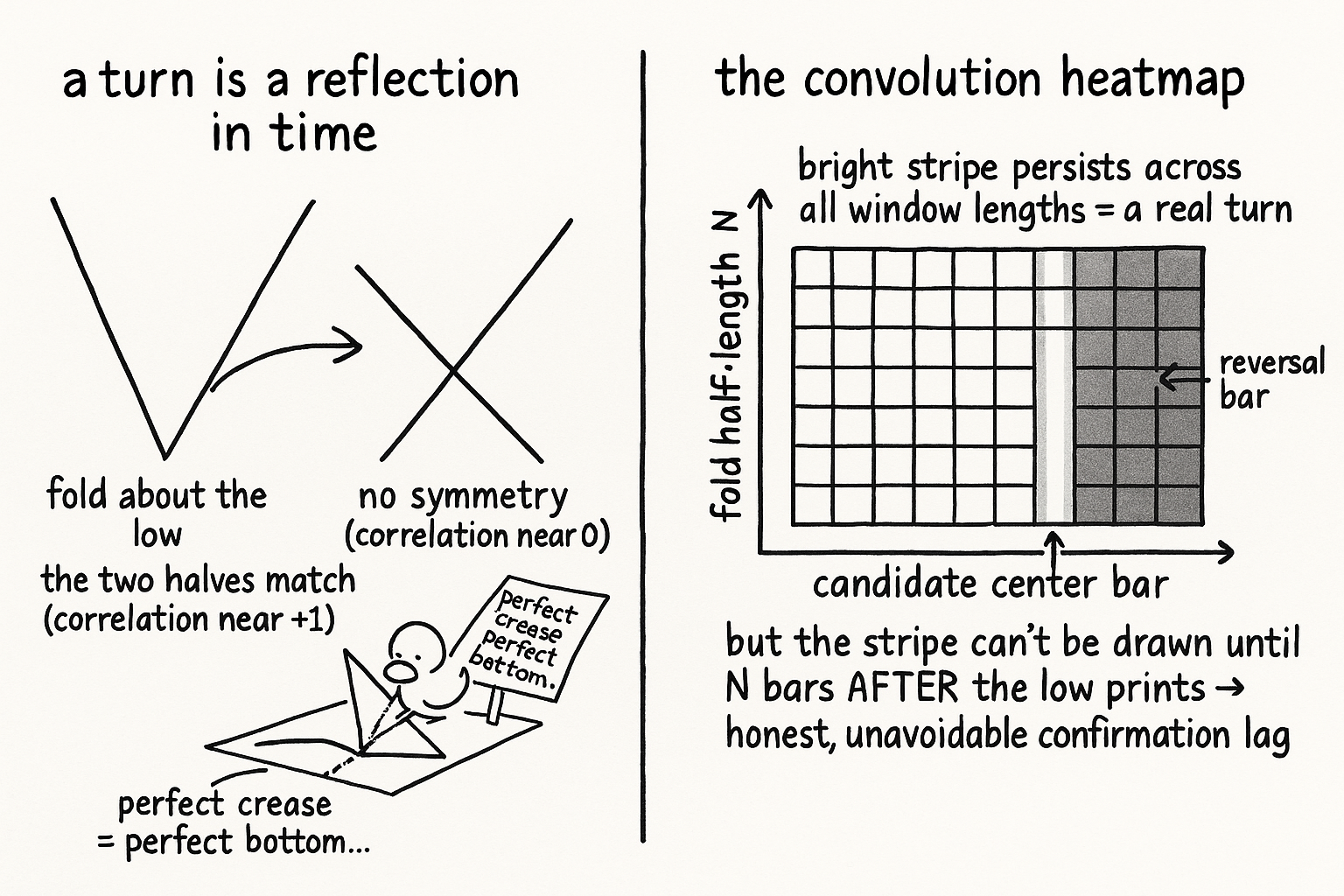
Consider an idealized bottom. Prices decrease in a clean line down to the low, then increase in a clean line away from it. Pick the low as a hinge and fold the chart along it, so the bars before the low land on top of the bars after it. The down-leg and the up-leg lie on top of each other almost perfectly, because a reversal is a reflection in time. That mirror symmetry is the signature of a turn, and a top is the same picture upside down. No oscillator, no lookback tuning, just a geometric fact: turns are symmetric, trends are not. A trending stretch folded about any of its bars produces two halves going the same direction, which do not match when one is reversed.
Convolution is the operation that measures this folding. It is the close cousin of correlation, with one twist, you reverse one of the two series before you slide and multiply, and that reversal is exactly the fold. Cross-correlation slides two series past each other and asks how similar they are at each offset; convolution does the same after flipping one in time. Flip price about a candidate bar and correlate it with itself and you are asking, quantitatively, how symmetric is the price around this point.
Folding price and scoring the match
For a candidate center bar, take a window of length N on each side and measure the correlation between the forward half and the time-reversed back half. The cleanest score is the Pearson correlation coefficient between the two folded segments.
$$ C(n) = \frac{\sum_{k=1}^{N}\big(x_{n-k}-\bar{x}\big)\big(x_{n+k}-\bar{x}\big)}{\sqrt{\sum_{k=1}^{N}\big(x_{n-k}-\bar{x}\big)^2}\;\sqrt{\sum_{k=1}^{N}\big(x_{n+k}-\bar{x}\big)^2}} $$
Here n is the candidate center bar and k steps outward to each side. The numerator pairs the bar k steps before the center with the bar k steps after it, for every k out to N, and sums the products of their deviations from the window mean; the denominator normalizes so the score lands between minus one and plus one. A score near plus one at bar n means the price k bars before n mirrors the price k bars after n for the whole window, a clean reflection, a turn. A score near zero means no symmetry, a trend or noise. You can compute this for a range of window lengths N at once and stack the results into a heatmap: candidate bars on one axis, fold half-length on the other, brightness equal to the correlation. A real turn shows up as a bright vertical stripe at the reversal bar that persists across many window lengths, because a genuine reflection is symmetric whether you fold two bars or twenty.
The heatmap is the honest way to read it, because a strong symmetry score at only one window length is probably an accident, while a stripe that holds across scales is structure. Treat the brightest, most scale-persistent column as the detected reversal.
The catch every fold hides
The fold has a built-in delay, and pretending otherwise is the trap. To know that bar n is a symmetric center you need the bars after it, all N of them, because symmetry is a statement about both sides. The correlation at the true low cannot be computed until N bars after the low has printed, so a fold half-length of 20 means a 20-bar wait before the bottom can confirm. This is not a flaw in the method, it is the price of asking a question about both sides of a point, and any tool claiming to confirm a reversal in real time with no lag is lying or peeking. Convolution is honest about the lag, which is more than the moving-average crossover from the old article "Why Moving Averages Can Lie at Turning Points" manages, but honest lag is still lag. Short windows confirm faster and false-trigger on noise that happens to look symmetric; long windows are reliable and slow. Pick the half-length for the swing you trade, no shorter.
The deeper limit is that symmetry assumes the turn is reflection-like, and real bottoms are messy, sharp V on one side, slow rounding on the other, gaps, noise. The correlation degrades exactly when the turn is asymmetric, which is often. The old article "Dominant Cycle Estimation Without Astrology" gives the natural setting for the fold length, scale it to the measured cycle so you are folding over a swing that actually exists, and gate the detector on cycle quality the same way every cycle-mode tool in this pillar must be gated. Read the convolution heatmap as evidence of symmetry, weigh it against its unavoidable confirmation lag, and never sell it as a leading reversal call, because the bars it needs to declare the turn arrive after the turn.
KEY POINTS
- A market turn is a reflection in time: price falls into a bottom and rises out of it roughly symmetrically, so folding price about a candidate bar and measuring how well the halves match detects the turn.
- Convolution is correlation with one series reversed in time, and that reversal is exactly the fold, so it quantifies symmetry about a point.
- Score a candidate center bar with the Pearson correlation between its forward half and time-reversed back half; near plus one means a clean reflection (a turn), near zero means a trend or noise.
- Compute across many fold half-lengths and read it as a heatmap. A real reversal is a bright vertical stripe that persists across window lengths; a one-window hit is probably an accident.
- The method has unavoidable confirmation lag: knowing bar n is a symmetric center needs the N bars after it, so a 20-bar fold confirms 20 bars after the low. It is honest lag, not zero lag.
- Symmetry degrades on asymmetric real turns. Scale the fold length to the measured dominant cycle from the old article "Dominant Cycle Estimation Without Astrology", gate on cycle quality, and never sell convolution as a leading reversal call.
A note on AI. The ideas, research, analysis, and conclusions in this article are my own. I use AI tools to help with editing and wordsmithing, because English is not my first language, and I am not shy about that. AI-generated ideas and AI-assisted writing are not the same thing: the first is empty slop from a generic prompt, the second is a tool for communicating years of real research more clearly. Judge the work by its substance, not by whether software helped polish the prose.